When you compare CFDs vs stocks, the price chart can look similar, but the legal and financial exposure differs. A direct share purchase gives you an ownership stake in a company. A contract for difference, or CFD, is a derivative contract tied to price movement in an underlying asset.
Can South Africans profit from CFDs without owning shares?
Yes, CFDs allow South Africans to profit from rising or falling share prices without owning the actual shares. However, leverage can increase losses quickly, and CFD traders do not receive shareholder voting rights.

🏆10 Best Forex Brokers in South Africa
| Rank | Broker | Broker Review | Regulators | Minimum Deposit | Visit Broker |
|---|---|---|---|---|---|
| 🥇 |  | Read Review | ASIC, FSA, CBI, BVI, FSCA, FRSA, CySEC, ISA, JFSA | $100 | Visit Now |
| 🥈 |  | Read Review | FSCA, FCA, DFSA, FSA, CMA | $0 | Visit Now |
| 🥉 |  | Read Review | FSCA, FSC, CYSEC, DFSA, CMA, FSC, FSA | $5 | Visit Now |
| 4 |  | Read Review | ASIC, CySEC, FSA, SCB | $0 | Visit Now |
| 5 |  | Read Review | BVI FSC | $0 | Visit Now |
| 6 |  | Read Review | FSA, FSC, FSCA, ASIC, CMA | $20 | Visit Now |
| 7 |  | Read Review | Exness is a globally regulated broker, holding multiple licenses from respected financial regulators around the world. | $10 | Visit Now |
| 8 |  | Read Review | ASIC, CySEC, FSCA, FSA, FSC, CMA | $100 | Visit Now |
| 9 |  | Read Review | FSC | $10 | Visit Now |
| 10 |  | Read Review | FSA, CySEC, FSCA, FSC | $10 | Visit Now |


Are stocks better than CFDs for long-term investors in South Africa?
Stocks are generally better suited to long-term investing because they offer company ownership and potential dividends. CFDs are more commonly used for short-term trading, as leverage and overnight fees can increase costs and risks.
CFDs and stocks side by side
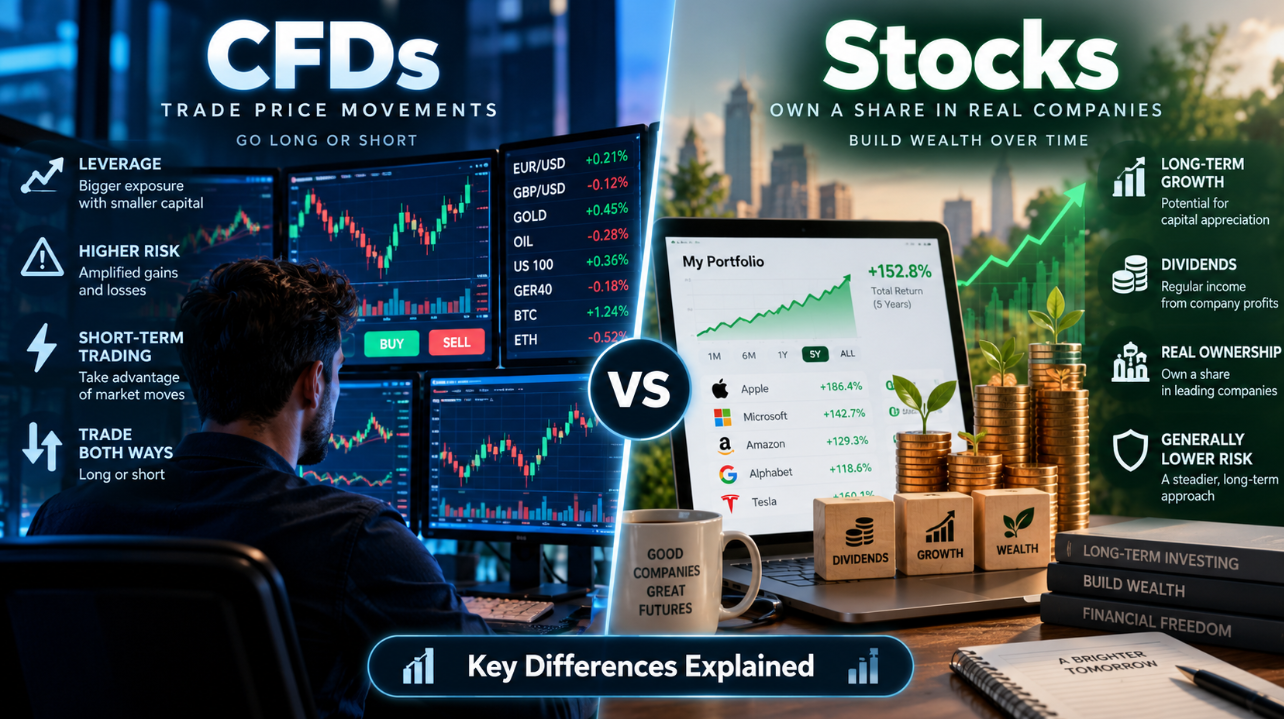
Traders can trade a CFD linked to a company or buy its shares directly, but these are two different types of investment. Ownership rights, trading costs, and risk differ, as shown in the table below.
| Feature | Share CFD | Direct shares |
|---|---|---|
| Ownership | Contract exposure to a share price | Ownership stake in the company |
| Voting rights | No shareholder vote from the CFD | Ordinary shares generally include voting rights |
| Dividends | Cash adjustment can apply under provider terms | Dividend can be paid if declared |
| Leverage | Common, with a smaller deposit than exposure | Usually paid at the purchase price |
| Short selling | Direct short exposure is usually available | Share borrowing can be required |
| Finance cost | Cash CFDs can attract overnight finance charges | No CFD-style overnight finance charge |
| Time horizon | Often chosen for shorter-term market exposure | Often chosen for longer-term investment aims |
| Main risk | Leverage can magnify losses against deposited cash | Share price can fall, and company failure can erase invested capital |
Ownership and leverage drive much of the difference. Ownership creates shareholder rights and potential dividend income. Leverage changes how much cash supports a market exposure and how sharply gains or losses affect the cash committed.
Quick Answer for South African Traders
With CFDs, you trade a contract linked to a share price. With direct stocks, you purchase an ownership stake in the business. They may follow the same price on a chart, but the rights, costs and exposure are different.
| Question | Quick answer |
|---|---|
| What is a stock? | A direct ownership interest in a company, with rights depending on the share class. |
| What is a share CFD? | A derivative tracking share-price changes without transferring ownership. |
| Which commonly uses leverage? | CFDs; direct cash shares are normally bought for their full purchase price. |
| Can I short the market? | Share CFDs often allow short exposure; direct share short selling generally needs additional arrangements. |
| Which has overnight financing? | Cash CFDs commonly have it; fully paid direct shares do not have CFD-style overnight finance. |
| What matters most? | Ownership goals, costs, investment horizon, risks and the regulated legal entity. |
CFDs vs Stocks in South Africa: What This Guide Covers
- CFDs and stocks side by side
- Ownership, dividends, and shareholder rights
- Leverage, deposit requirements and loss exposure
- Short selling and falling markets
- Costs: Finance charges, spreads, and share fees
- Risks and regulation in South Africa
- Which option is suitable for your goals?
- What happens when you buy JSE shares directly?
- How share CFDs work on a trading platform
- Real example: R10,000 in shares vs a share CFD
- How much can you lose on a share CFD?
- Dividend payments and CFD adjustments
- Understanding JSE fees and taxes
- Trading hours and overnight positions
- How company news affects both products
- How to check a broker or investment platform
- CFDs vs ETFs and direct shares
- Which is more suitable for beginners?
- Common mistakes South Africans make
- Risk management checklist
- Who this guide is for
- Who this guide is not for
- Realistic expectations
- Quick summary table
- Conclusion and frequently asked questions
CFDs and Stocks in South Africa: Important Facts
- Buying an ordinary share normally makes you a shareholder, while entering a share CFD does not.
- Share CFDs can provide leveraged exposure and access to short positions, subject to the provider’s terms.
- The cash required to open a CFD is not the same thing as the total amount at risk.
- Company announcements and dividends may affect both instruments, but the legal treatment differs.
- Fees, regulatory permissions and account terms should be checked before funding an account.
Ownership, dividends, and shareholder rights
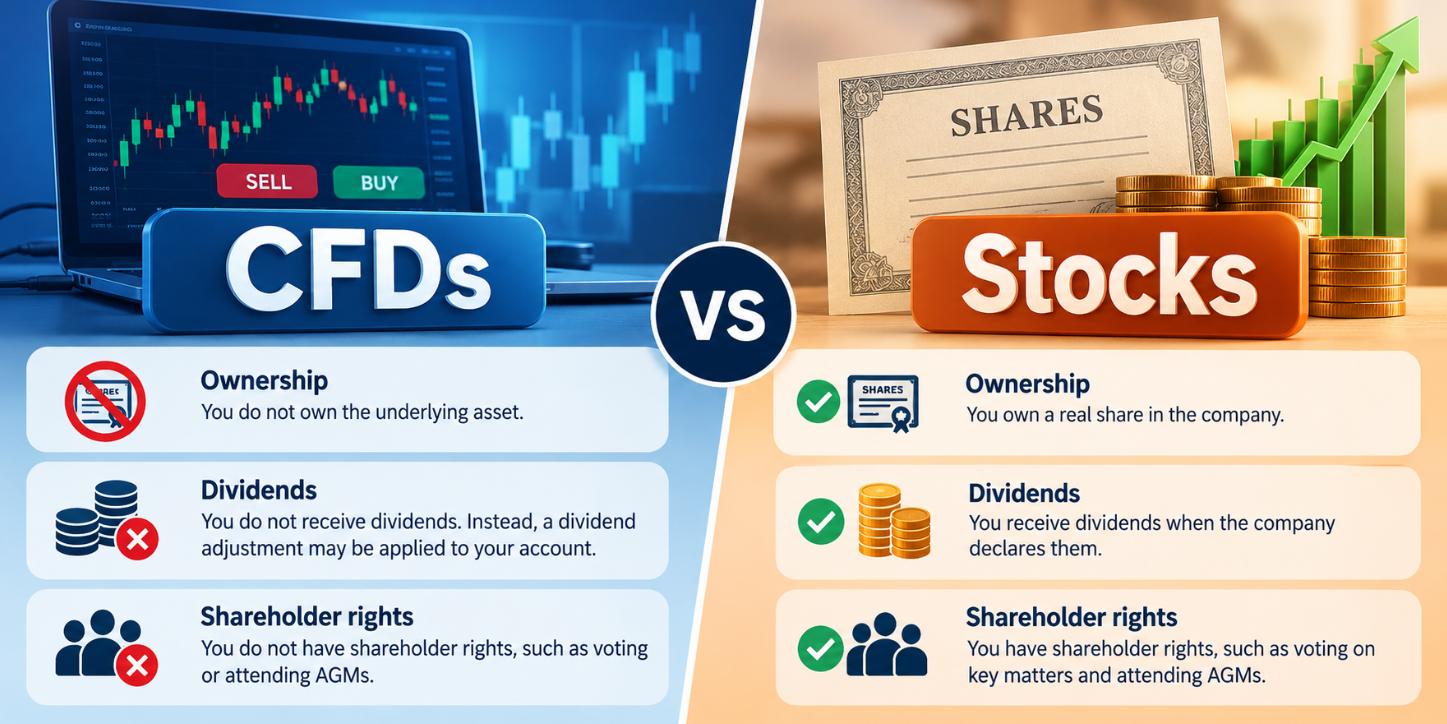
An ordinary share gives its holder an ownership stake in the company.
JSE ordinary shares generally include voting rights at annual general meetings, potential dividends if the company declares them, and a residual claim after creditors and preference shareholders if a company is wound up. Share prices can rise or fall, and dividends are never guaranteed.
A CFD does not transfer the underlying share to the trader. The contract tracks price movement under the provider's terms, which means a CFD holder does not receive shareholder voting rights from the contract.
Corporate actions can still affect the CFD through contractual adjustments, but those adjustments are not shareholder rights.
Dividends create another distinction. A direct shareholder can receive a declared dividend. South African dividends received by individuals are generally subject to a 20% dividends tax, normally withheld before payment, unless an exemption or reduced rate applies.
A long share CFD can receive a cash adjustment when the underlying share trades ex-dividend, while a short CFD can face a debit. The exact adjustment depends on provider terms, the market, and applicable tax treatment.
What happens when you buy JSE shares directly?
When you buy shares through a stockbroking or investment platform, the transaction normally settles into an ownership interest in the shares. How that interest is registered or held in custody depends on the broker and the market infrastructure. Your return then depends on the share price, any dividends declared and the costs of holding or selling the investment.
For example, someone buying shares worth R10,000 with cash has paid for that market exposure rather than posting a smaller derivative margin. The investment can still fall dramatically. Owning shares does not guarantee a positive return, and an individual company can fail.
Dividend payments and CFD adjustments
A shareholder may receive a dividend when a company declares one and the shareholder meets the relevant entitlement conditions. The payment is not guaranteed, and any tax treatment depends on the investor and applicable rules.
A share CFD holder is not a shareholder in the underlying company. Instead, the provider can apply a contractual cash adjustment to long or short positions around a dividend event. Always read the contract specification, particularly where withholding or adjustment amounts are involved.
Leverage, deposit requirements and loss exposure
Leverage lets a trader take market exposure above the cash deposit placed against the CFD. The deposit is collateral, not the maximum possible economic exposure.
Profit and loss calculations reflect the size of the CFD exposure, which means a modest move in the underlying share can create a much larger percentage change against the cash deposited.
Consider a hypothetical R10,000 share exposure. A direct cash purchase requires R10,000 before fees and tax.
If a CFD provider required a 20% initial deposit for the same exposure, the trader would place R2,000 as collateral. A 5% move in the underlying share equals R500 before fees, finance charges, tax, or other adjustments. R500 equals 5% of R10,000, but 25% of the R2,000 deposit.
Leverage does not enlarge the underlying market move; it changes the relationship between exposure and cash committed. A move against the trader can reduce account equity sharply, and providers can close CFD positions when account funds fall below required levels.
Deposit rules differ across providers, assets, client categories, and market conditions, so a hypothetical percentage must never be treated as a universal rate.
How share CFDs work on a trading platform
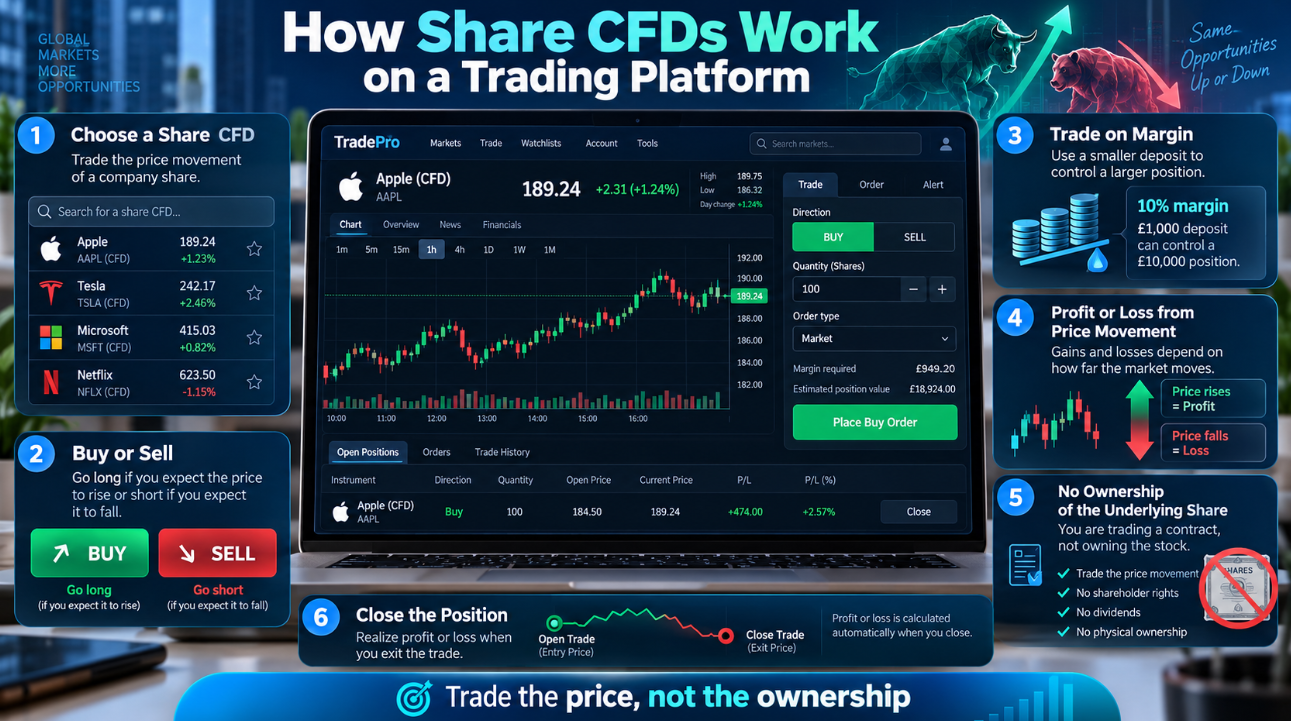
A share CFD is an agreement with a provider to exchange the difference between the opening and closing value of an underlying share exposure. You can generally choose a long position if you expect the price to rise or a short position if you expect it to fall, where the contract permits it.
Before entering, check the trade size, margin requirement, overnight financing, spread, commission and adjustment rules. These details can change the result even when the underlying share performs exactly as expected.
Real example: R10,000 in shares vs a share CFD
Imagine two people who each want exposure to a listed company worth R10,000. One buys the shares directly. The other uses a CFD with a hypothetical 20% margin requirement. Both start with R10,000 of underlying market exposure, but the cash committed at entry is different. A 5% price movement equals R500 before costs in either case.
| Illustrative factor | Direct cash shares | Share CFD at 20% margin |
|---|---|---|
| Market exposure | R10,000 | R10,000 |
| Initial cash purchase / margin | R10,000 | R2,000 |
| Gain from 5% rise | R500 | R500 |
| Loss from 5% fall | R500 | R500 |
| R500 loss as share of initial cash | 5% | 25% |
| Own the company shares? | Yes | No |
This simplified comparison excludes brokerage, spreads, commission, finance charges, corporate actions, taxes and any forced close-out. A provider may apply a different margin rate.
How much can you lose on a share CFD?
Losses depend on the value of the exposure and the price move, not just the initial margin. A R10,000 position losing 10% produces a R1,000 market loss before costs. If the provider required R2,000 of margin, that move represents half the initial margin.
Real accounts are subject to margin calls, stop-out thresholds, slippage, gaps and any applicable negative-balance rules. A protective stop is useful for planning, but it is not a guarantee of execution at the requested price.
Short selling and falling markets
A CFD can provide direct exposure to a fall in a share price. The trader opens a short CFD, then gains if the closing price is below the opening price before relevant costs. An increase in the share price produces a loss instead.
Three differences are important for short exposure:
- A CFD can offer a direct short route through the derivative contract.
- A direct share short-sale can require a securities borrowing arrangement.
- Borrow fees, finance charges, and availability can change by share and provider.
JSE equity rules provide for securities borrowing arrangements where shares are required for settlement, and direct short-sale mechanics depend on broker arrangements and available stock. Short exposure also introduces the prospect of losses if the share price increases.
A short CFD can incur a borrow charge as well, which means that short exposure is not cost-free.
Trading hours and overnight positions
Direct JSE share orders normally follow the exchange’s applicable dealing sessions. A provider may offer different CFD dealing hours and platform access, but the ability to log in does not mean every share CFD is tradable at that moment. Some markets close while a position remains open.
CFDs held after a provider’s applicable rollover point may accrue financing charges. Direct cash shares do not have equivalent CFD financing merely because they are held overnight. Weekend news can also cause prices to gap on the next available dealing session.
Costs: Finance charges, spreads, and share fees
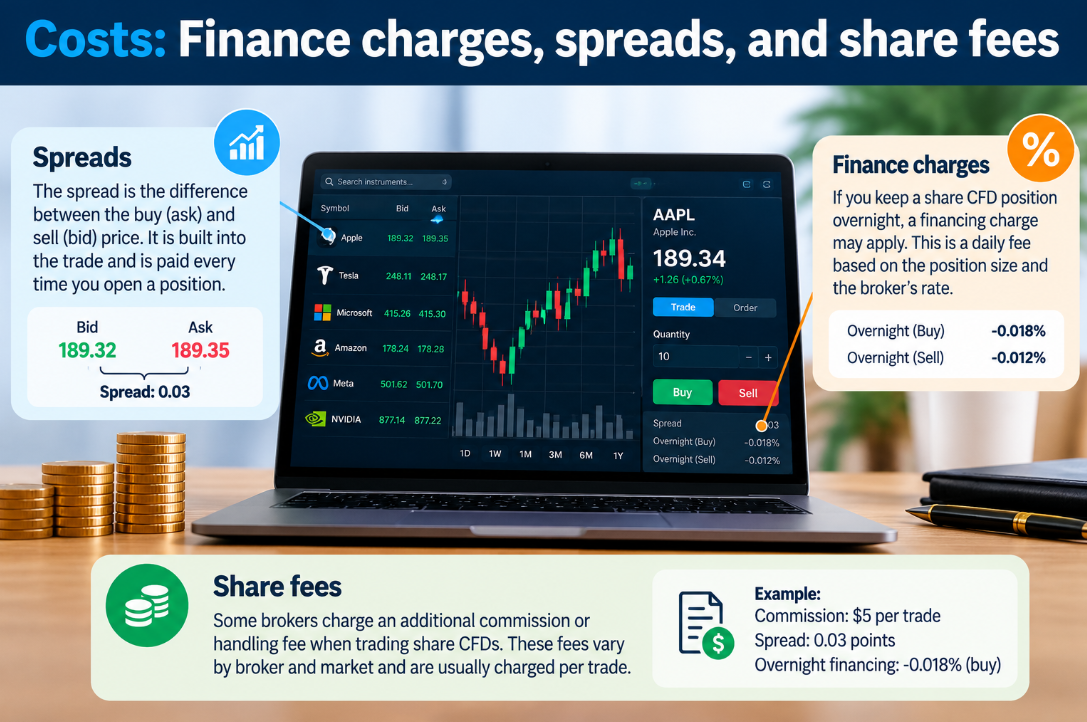
Cost depends on the instrument, provider, market, account structure, trade size, and time horizon. Therefore, commission is one factor among several. A direct share purchase and a share CFD can create different charges even when both track the same company.
Securities Transfer Tax is currently 0.25% on the taxable amount for a transfer of a security within its scope. Shares fall within the SARS definition of a security. A CFD holder does not acquire the underlying share through the contract, meaning the legal transaction differs from a direct share transfer.
Personal tax outcomes can differ materially, and a registered tax practitioner can assess the facts of a case.
Time horizon also affects cost. Overnight finance on a cash CFD can recur for each applicable night, while direct shares can incur brokerage, custody, platform, currency conversion, or statutory charges based on the service.
Before a trade, check the provider's current fee schedule because a generic cost assumption can be misleading.
Understanding JSE fees and taxes
For direct shares, review the platform’s brokerage, custody or administration charges, market spread and any applicable securities transfer tax. For share CFDs, look at the spread, trading commission, financing, borrow fees and currency conversion costs. Tax treatment can depend on the exact transaction and your circumstances.
A simple headline commission percentage is not enough to compare total costs over months or years. Get the current fee schedule and calculate a realistic holding period before choosing either route.
Risks and regulation in South Africa
Direct shares expose an investor to company, sector, liquidity, and market risk. A share price can fall drastically or reach zero if the company fails.
CFDs add derivative contract risk and leverage, while provider terms can affect close-out rules, finance charges, corporate action adjustments, and short-sale costs.
Four risk areas warrant careful review:
- Leverage can turn a modest price move into a large account loss.
- Volatility or low liquidity can cause wider spreads and difficult exits.
- Provider failure or operational problems can affect CFD account outcomes.
- Frequent leveraged trades can encourage excessive risk and poor discipline.
South African CFD clients should verify the legal entity behind an offer before funds change hands. An OTC derivative provider requires FSCA authorisation under the Financial Markets Act framework.
An FSP registration by itself does not prove permission to act as an OTC derivative provider. The FSCA search facilities can confirm FSP registration, while the provider's regulatory record and legal documents can help confirm the relevant permissions.
Financial education cannot replace advice based on a person's income, debts, tax position, time horizon, objectives, and tolerance for loss. A licensed financial adviser or registered tax practitioner can help where personal circumstances affect the decision.
How company news affects both products
Earnings reports, changes in leadership, corporate actions, legal disputes and economic news can move an underlying share price. That move can affect a direct shareholder and a trader holding a CFD linked to the same company.
The difference is how the position is held. A long-term investor may choose to remain a shareholder through volatility, while a leveraged CFD position may face margin pressure or forced closure before the trader’s longer-term view has time to play out.
How to check a broker or investment platform
Before depositing money, identify the exact legal entity providing the product. A stockbroking service and an OTC derivative product may involve different permissions, entities and client agreements, even when advertised under the same brand name.
Use the FSCA’s official resources to check relevant authorisations, read the account agreement and confirm the product being sold. For CFDs, also review close-out rules, negative-balance terms and how client funds are handled.
| Check | Why it matters |
|---|---|
| Contracting legal entity | Identifies the company responsible for the account |
| Relevant regulatory authorisation | Checks permissions for the service actually offered |
| Custody or client-money arrangements | Clarifies where assets and funds are held |
| Fee schedule | Shows recurring and transaction charges |
| Corporate-action terms | Explains distributions, adjustments and events |
| Withdrawals and complaints | Explains how issues are handled |
Which option is suitable for your goals?
Neither route is automatically superior. The relevant choice depends on whether you want ownership, how long you expect to hold the exposure, whether leverage fits your risk capacity, and whether short exposure is part of your plan.
| Decision factor | CFDs can be suitable when… | Stocks can be suitable when… |
|---|---|---|
| Primary objective | You want leveraged price exposure | You want direct company ownership |
| Time horizon | You expect a shorter market trade | You plan a longer investment period |
| Leverage tolerance | You understand amplified gains and losses | You prefer unleveraged cash ownership |
| Falling markets | You want direct short exposure | You do not require a short position |
| Dividends and rights | Contract adjustments meet your objective | Shareholder rights and dividends are important |
| Monitoring capacity | You can watch risk and account equity closely | You prefer less dependence on leveraged close-out rules |
A person can hold direct shares for investment aims and trade CFDs for a separate speculative purpose, but each exposure should have its own risk limit and cost assessment. The smaller CFD deposit should never be mistaken for a smaller economic exposure.
CFDs vs ETFs and direct shares
An exchange-traded fund, or ETF, is another form of investment that can give exposure to a basket of securities rather than one company. Buying ETF units directly is different from trading a CFD referencing an ETF or an index. Ownership, rights, diversification and charges depend on the product structure.
For someone trying to build diversified long-term exposure, comparing direct shares with cash ETFs may be more relevant than comparing either with a leveraged CFD. That does not make a diversified investment risk-free; it simply changes what is owned and how the risks are spread.
Which is more suitable for beginners?

Many beginners find fully paid cash shares easier to understand because there is no CFD margin level or ongoing leveraged close-out process to manage. But a cash share can still decline sharply, so the investment amount and business risks still matter.
A CFD introduces extra steps: calculating exposure, understanding margin, allowing for financing and watching the broker’s close-out rules. New traders should learn those mechanics on a demo account before risking money they cannot afford to lose.
Common mistakes South Africans make when comparing CFDs and stocks
One of the biggest mistakes is comparing the CFD’s required margin with the full price of a cash share and concluding that the CFD is automatically cheaper or safer. The positions can have identical exposure even though the cash required at entry is different.
- Assuming a share CFD includes shareholder voting rights.
- Treating the initial margin as the maximum possible loss.
- Ignoring overnight finance on positions held for weeks or months.
- Confusing dividend cash adjustments with direct dividend income.
- Comparing brokers without checking the contracting entity and product permissions.
- Assuming a stop-loss will always fill at its requested level.
Risk management checklist before trading
Before placing an order, decide how much money you are prepared to lose, whether the trade needs leverage and what would invalidate your view. The most useful risk calculation is based on total exposure and a realistic price move, not the margin requirement alone.
- Calculate the rand value of the full position.
- Check spreads, brokerage, commissions, financing and taxes as applicable.
- Assess the effect of a sharp move or opening gap.
- Confirm the stop, margin call and liquidation rules for CFDs.
- Review concentration in one company or sector.
- Verify the platform and exact legal entity.
Who This Guide Is For
This guide is for South Africans comparing an investment in directly owned shares with short-term or leveraged exposure through share CFDs. It can help first-time JSE investors, retail traders and anyone looking at a platform that offers both products understand what changes when ownership is replaced by a derivative contract.
Who This Guide Is Not For
This guide is not a promise of easy profits or a recommendation to use leverage. It is also not personalised legal, tax or investment advice. Anyone making a decision based on their income, liabilities, tax position or ability to absorb losses may need advice from a properly qualified professional.
Realistic Expectations About CFDs and Stocks
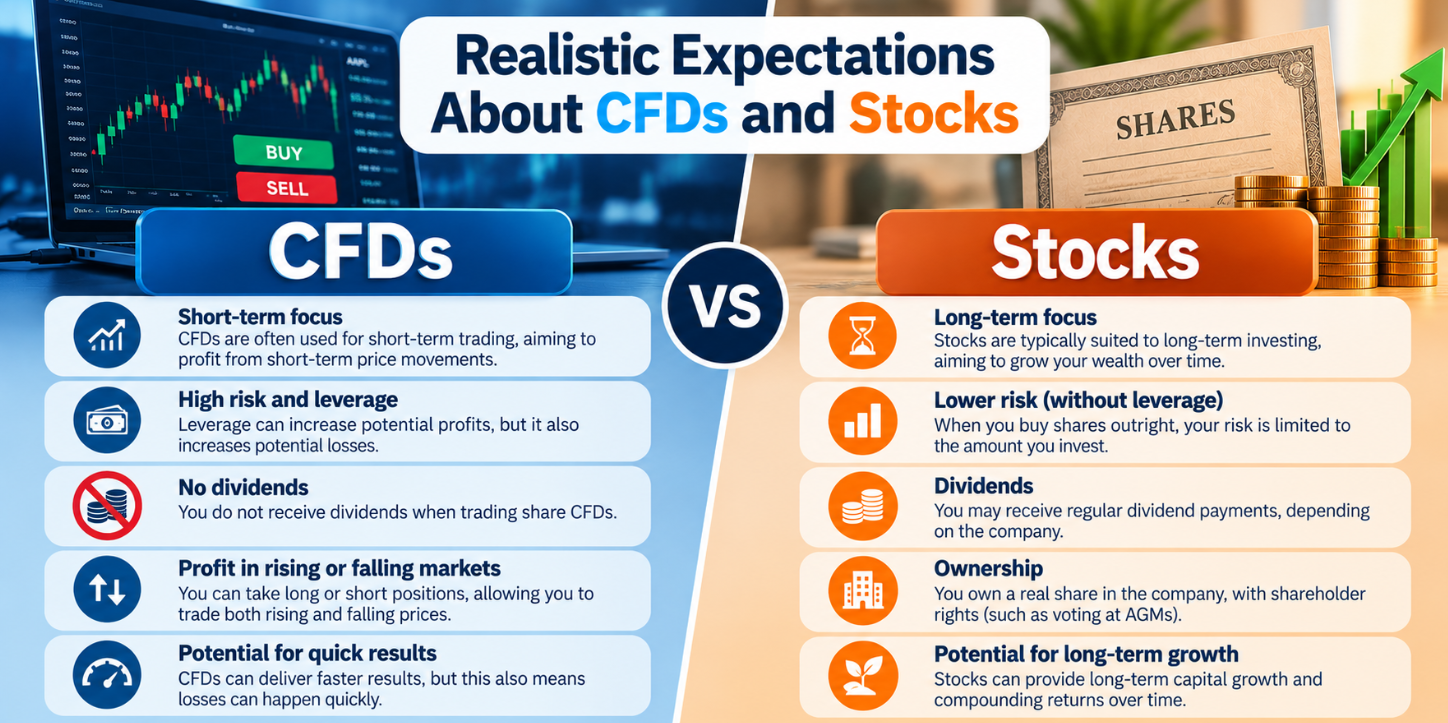
Neither direct shares nor CFDs make profits inevitable. Company prices can fall for years, and leveraged trades can lose money quickly even after a small price movement. Costs can also turn a modest gross gain into a disappointing net result.
The practical benefit of understanding the difference is being able to choose the instrument that actually matches your objective. If you want ownership, buy an ownership product. If you want a derivative trade, first understand the contract and the full downside risk.
Quick Summary Table: CFDs vs Stocks in South Africa
| Main difference | Share CFDs | Direct shares |
|---|---|---|
| What you hold | Derivative contract | Ownership interest |
| Voting rights | No | Usually for ordinary shares |
| Dividend treatment | Contractual adjustment may apply | Dividend if declared and payable |
| Upfront capital | Margin may be smaller than exposure | Full cash purchase price |
| Short positions | Often available | Requires separate arrangements |
| Overnight CFD financing | May apply | Not applicable to fully paid shares |
| Key concern | Leverage and provider terms | Company and market risk |
Conclusion
Stocks and CFDs can track the same company, but the exposure is fundamentally different. Direct shares provide ownership rights and potential dividends, while CFDs provide derivative price exposure with leverage, short-sale flexibility, and finance charges that can affect the result over time.
Base the choice on objective, time horizon, risk capacity, cost structure, and the level of oversight you can provide. Before you open a CFD account or share account, verify the provider's current regulatory status, legal entity, product terms, and fee schedule.
You might also like:
- EasyEquities review
- 10 Best FSCA Regulated Forex Brokers 2026
- Best Day Trading Apps in South Africa (2026)
Frequently asked questions
Are CFDs riskier than stocks?
CFDs can create greater loss pressure against deposited cash because leverage increases exposure relative to the deposit. Direct shares also expose investors to substantial risk, and a company failure can erase the invested sum. The risk difference depends on leverage, trade size, diversification, time horizon, and the investor's ability to absorb losses.
Do CFD traders receive dividends?
A CFD trader does not receive a shareholder dividend because the trader does not own the underlying share through the CFD. A long share CFD can receive a cash adjustment linked to a dividend, while a short CFD can face a debit. Provider terms and local tax treatment determine the exact adjustment.
How does leverage change CFD losses?
Leverage lets a smaller deposit support a larger market exposure. Profit or loss reflects that larger exposure instead of the deposit in isolation. If R2,000 supports R10,000 of exposure, a R500 adverse price move equals 25% of the deposit before fees, finance charges, tax, or other account adjustments.
Are CFDs suitable for long-term investment?
CFDs are generally more closely associated with leveraged market exposure than direct ownership. Cash CFDs can incur overnight finance charges, which can become significant over an extended period. Direct shares avoid CFD-style overnight finance charges and provide ownership rights, but brokerage, tax, custody, and currency conversion can still apply.
How can South Africans check whether a CFD provider is authorised?
Check the exact legal entity against the FSCA's regulated entity and FSP search facilities, then confirm the firm's relevant permission for OTC derivative activity. An FSP number by itself does not establish ODP authorisation. The legal entity on the account agreement should match the entity whose regulatory status you verify.
Can you buy CFDs and shares through the same platform?
Some platforms offer both products, but each may be provided under different agreements or by different entities. Check the order ticket to confirm whether you are buying shares or entering a CFD.
Do I own JSE shares if I trade a share CFD?
No. A share CFD creates contractual exposure to the share price. It does not transfer the underlying shares or the company’s shareholder voting rights to you.
What is the minimum amount needed to trade share CFDs in South Africa?
There is no single universal amount. Required margin, minimum trade size, account funding rules and trading costs differ by provider and instrument.
Can I lose more than the CFD margin I deposited?
The initial margin is not a loss cap. Market losses can exceed it, subject to applicable close-out and negative-balance terms. Check those terms before opening an account.
What happens to a CFD when a company pays a dividend?
The CFD provider may apply a cash adjustment according to the contract’s terms. The trader does not receive the dividend in the capacity of a shareholder through that CFD.
You Might Also Like




Recommended brokers