
South African equities trade at some of the lowest valuations across the emerging-market universe in 2026. The six JSE stocks below are the names most consistently flagged by local analysts as undervalued — three cyclical industrials (Sasol, Sibanye Stillwater, Motus), two defensives (Absa, Pepkor), and TFG in the middle. Undervalued is not automatically a buy signal — every discount has a reason.
What is the best undervalued stock in South Africa?
The best undervalued stock in South Africa depends on the sector exposure and risk tolerance that suits the investor. Sasol leads the deep-value list for 2026 on a forward P/E discount and improving cash flows after multi-year restructuring, while Absa offers the strongest combination of dividend yield and earnings stability among the six.

🏆10 Best Forex Brokers in South Africa
| Rank | Broker | Broker Review | Regulators | Minimum Deposit | Visit Broker |
|---|---|---|---|---|---|
| 🥇 |  | Read Review | ASIC, FSA, CBI, BVI, FSCA, FRSA, CySEC, ISA, JFSA | $100 | Visit Now |
| 🥈 |  | Read Review | FSCA, FCA, DFSA, FSA, CMA | $0 | Visit Now |
| 🥉 |  | Read Review | FSCA, FSC, CYSEC, DFSA, CMA, FSC, FSA | $5 | Visit Now |
| 4 |  | Read Review | ASIC, CySEC, FSA, SCB | $0 | Visit Now |
| 5 |  | Read Review | BVI FSC | $0 | Visit Now |
| 6 |  | Read Review | FSA, FSC, FSCA, ASIC, CMA | $20 | Visit Now |
| 7 |  | Read Review | Exness is a globally regulated broker, holding multiple licenses from respected financial regulators around the world. | $10 | Visit Now |
| 8 |  | Read Review | ASIC, CySEC, FSCA, FSA, FSC, CMA | $100 | Visit Now |
| 9 |  | Read Review | FSC | $10 | Visit Now |
| 10 |  | Read Review | FSA, CySEC, FSCA, FSC | $10 | Visit Now |


Are undervalued stocks safe to buy?
Undervalued stocks are safer when the discount reflects temporary sentiment rather than a structural business problem, and when the balance sheet can absorb a continued downturn. The safety test comes down to three things: can the company still generate free cash flow at current revenue levels, is the debt load manageable at current interest rates, and is the industry in long-term growth or long-term decline. None of these six stocks are risk-free – Sasol carries commodity and carbon-transition exposure, Sibanye carries PGM price risk, and the retailers carry consumer-spending risk. Verify the fundamentals yourself before buying, and never treat an analyst's "undervalued" label as a buy signal on its own.
6 undervalued South African stocks compared
Each stock on this list trades on the JSE with a different sector exposure, which matters more for portfolio construction than the raw valuation discount. The table below compares headline figures – always verify live numbers before trading.
| Stock | JSE Ticker | Sector | Market Cap | P/E Ratio | Dividend Yield |
|---|---|---|---|---|---|
| Sasol Ltd | SOL | Chemicals / Integrated Energy | ~R65–80 bn | ~5–7x | ~4–6% |
| Absa Group Ltd | ABG | Banking / Financial Services | ~R160 bn | ~7–8x | ~6–8% |
| Sibanye Stillwater Ltd | SSW | Precious Metals & Battery Metals Mining | ~R70 bn | Variable (cyclical) | Variable |
| The Foschini Group Ltd | TFG | Multi-brand Retail | ~R35 bn | ~10–12x | ~5–6% |
| Motus Holdings Ltd | MTH | Automotive Retail & Distribution | ~R18 bn | ~5–6x | ~6–7% |
| Pepkor Holdings Ltd | PPH | Discount & Value Retail | ~R80 bn | ~12–14x | ~2–3% |
Sasol, Motus, and Absa screen cheapest on P/E against sector peers. Sibanye looks cheap on book value and PGM resource base but carries the most volatile earnings. TFG and Pepkor sit at higher P/E multiples but trade at steep discounts to their pre-COVID valuation highs. The right pick depends on whether you want yield (Absa, Motus), cyclical upside (Sasol, Sibanye), or consumer-recovery exposure (TFG, Pepkor).
What is an undervalued stock?
An undervalued stock is a listed company trading below its estimated intrinsic value – the discounted present value of its future free cash flows, or a multiple of earnings, book value, or dividends below the company's own long-run average or the sector average. Intrinsic value is an estimate, not a fact, so "undervalued" always carries an analyst assumption behind it.
In the South African context, undervaluation often reflects a combination of domestic macro pressure (interest rates, rand weakness, consumer spending), sector-specific cyclical weakness (commodity prices, retail cycles), and persistent foreign-investor underweight on the JSE. The result is that fundamentally sound companies can trade at 30%–50% discounts to their international peers for years at a time, which is both the opportunity and the risk of value investing on the JSE.
6 Most Undervalued Stocks in South Africa (2026):
- Sasol Ltd (SOL) – Best Overall for Deep-Value Industrial Recovery Play.
- Absa Group Ltd (ABG) – Best for Dividend Yield and Banking Stability.
- Sibanye Stillwater Ltd (SSW) – Best for Cyclical PGM and Battery-Metals Rebound.
- The Foschini Group Ltd (TFG) – Best for Multi-Brand Retail Recovery.
- Motus Holdings Ltd (MTH) – Best for Automotive Retail Discount Value.
- Pepkor Holdings Ltd (PPH) – Best for Discount Retail Market-Share Growth.
How we assessed the stocks
The order reflects a combination of valuation discount, balance-sheet strength, dividend sustainability, and sector outlook. Each stock had to be JSE-listed, trading at a measurable discount to either its own long-run average P/E or to the sector peer group, and have at least three years of audited financial results available.
Four factors drove the order:
- Forward P/E discount against the stock's own five-year average weighted first – deeper discounts ranked higher where fundamentals supported it.
- Free cash flow coverage and debt sustainability affected the next position – a cheap stock with unsustainable debt ranked below a slightly less cheap stock with a clean balance sheet.
- Dividend history and yield sustainability shaped mid-table positions.
- Sector outlook and macroeconomic exposure completed the ranking.
Deep-value plays (Sasol, Motus) ranked higher where the valuation gap was wider but the fundamentals were defensible. Quality-at-a-discount plays (Absa, Pepkor) ranked on consistency rather than absolute discount depth.
Stock reviews and undervaluation details
1. Sasol Ltd (SOL)
- Sasol ranks first on this list because the stock trades at one of the deepest valuation discounts in the JSE large-cap universe, with a forward P/E in the mid-single digits despite stabilising free cash flow and a materially lower debt load than the 2020–2022 crisis period.
- The company's integrated chemicals and synthetic fuels operations in Secunda remain the largest single-asset exposure, with additional upside from the Mozambique gas pipeline and strategic repositioning around lower-carbon energy over the next decade.
- Sasol's share price is weighed down by three persistent concerns: oil and gas price exposure, Secunda's carbon intensity under tightening South African emissions rules, and the long-term capex required for energy transition. All three are real, but the market may have overpriced them given the current cash generation.
Profile
| Feature | Sasol Ltd (SOL) |
|---|---|
| JSE ticker | SOL |
| Sector | Chemicals / Integrated Energy |
| Market cap | ~R65–80 billion |
| Forward P/E | ~5–7x |
| Dividend yield | ~4–6% |
| 52-week range | Verify live on JSE |
| Analyst view | Deep-value cyclical, mixed broker ratings |
| Listed since | 1979 (JSE) |

Pros and Cons
| ✅ Pros | ❌ Cons |
|---|---|
| Deep forward P/E discount against sector peers | Significant oil and gas price exposure |
| Improved cash flow and lower debt vs 2020–2022 crisis | Secunda carbon intensity under tightening SA rules |
| Integrated chemicals business diversifies away from pure energy | Long-term energy-transition capex uncertainty |
| Mozambique gas pipeline adds strategic upside | Dividend has been volatile over the cycle |
| JSE heavyweight with liquid trading | ESG screens exclude Sasol from several large funds |
Why is Sasol considered undervalued in 2026?
Sasol is considered undervalued because its forward P/E sits in the mid-single digits while free cash flow has stabilised and debt has come down materially from the 2020–2022 crisis peak. The market continues to price in oil price risk and carbon-transition costs more aggressively than the current fundamentals suggest, which creates the valuation gap.
What are the biggest risks of buying Sasol?
The biggest risks for Sasol are oil and gas price volatility, Secunda's carbon intensity under tightening South African emissions rules, and the long-term capital cost of energy transition. ESG-restricted funds also exclude Sasol, which keeps a structural lid on institutional demand. Any investor should model a stress case where commodity prices fall sharply.
2. Absa Group Ltd (ABG)
- Absa Group ranks second as the most consistently dividend-paying bank on this list, with a forward P/E in the 7–8x range and a dividend yield that has sat comfortably above 6% through most of the last five years.
- Absa's African banking footprint across 12 countries diversifies revenue away from pure South African consumer credit, while its home-market retail and commercial banking operations remain the earnings core. Return on equity has consistently sat above 15% through the cycle.
- The valuation discount reflects South African macroeconomic concerns, credit-cycle risk, and the broader EM bank discount against developed-market peers. The stock has traded in a relatively tight valuation band for several years, which argues for income-focused rather than capital-growth-focused positioning.
Profile
| Feature | Absa Group Ltd (ABG) |
|---|---|
| JSE ticker | ABG |
| Sector | Banking / Financial Services |
| Market cap | ~R160 billion |
| Forward P/E | ~7–8x |
| Dividend yield | ~6–8% |
| 52-week range | Verify live on JSE |
| Analyst view | Steady income, discount to DM bank peers |
| Listed since | 1995 (JSE, previously Barclays Africa) |

Pros and Cons
| ✅ Pros | ❌ Cons |
|---|---|
| Dividend yield consistently above 6% through cycle | Discount to DM bank peers may be structural, not cyclical |
| Return on equity consistently above 15% | South African credit-cycle exposure |
| African banking footprint across 12 countries | Interest-rate downturns compress net interest margin |
| Strong Tier 1 capital ratio above regulatory minimums | Rand weakness drags international earnings when translated |
| Liquid JSE Top 40 constituent | Share price has traded in a tight band for years |
Why do analysts classify Absa as undervalued?
Analysts classify Absa as undervalued because the stock trades at a forward P/E of 7–8x and a dividend yield above 6%, while delivering return on equity above 15% through the economic cycle. The valuation discount reflects South African macro risk and the broader EM bank discount rather than any specific operational weakness at Absa itself.
What should investors consider before buying Absa shares?
Prospective Absa investors should evaluate South Africa's macroeconomic trajectory, the interest-rate cycle, and credit-impairment trends in the consumer and commercial books. The stock is more suitable for income-focused investors than capital-growth investors because the valuation has traded in a narrow band for several years – the yield is the primary return source.
3. Sibanye Stillwater Ltd (SSW)
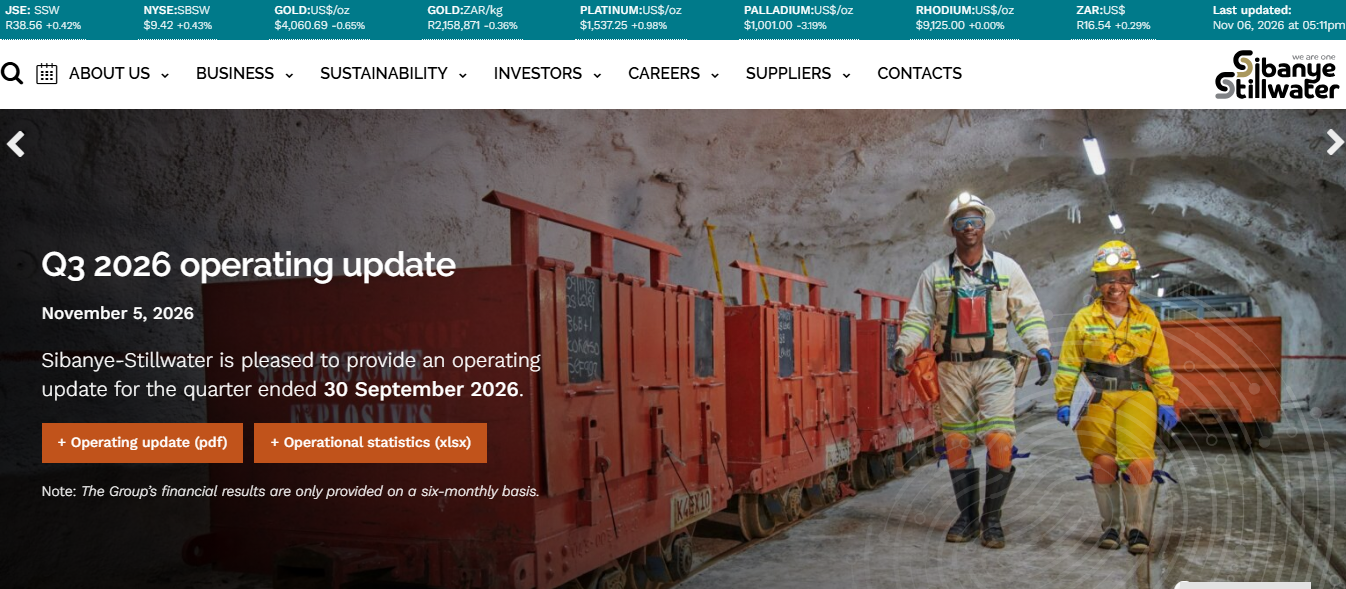
- Sibanye Stillwater ranks third as the deep-value PGM and battery-metals play on this list. The share price has fallen materially from its 2021 peak alongside a collapse in platinum group metals pricing, but the company's reserve base and operational footprint remain among the largest in the sector.
- The group operates PGM mines in South Africa and the United States, gold operations in South Africa, and a growing battery-metals business (nickel, lithium) through its European and Australian acquisitions. The diversification reduces single-commodity risk but has also stretched management focus during the downturn.
- Sibanye is the highest-risk stock on this list and should not be mistaken for a defensive value play. Earnings are cyclical, dividend payments have been suspended during downturns, and operational safety risks remain an ongoing concern in the SA PGM operations.
Profile
| Feature | Sibanye Stillwater Ltd (SSW) |
|---|---|
| JSE ticker | SSW |
| Sector | Precious Metals & Battery Metals Mining |
| Market cap | ~R70 billion |
| Forward P/E | Variable (cyclical earnings) |
| Dividend yield | Variable (suspended in downturns) |
| 52-week range | Verify live on JSE |
| Analyst view | High-risk cyclical, PGM rebound play |
| Listed since | 2013 (demerged from Gold Fields) |
Pros and Cons
| ✅ Pros | ❌ Cons |
|---|---|
| Diversified exposure to PGM, gold, nickel and lithium | Earnings highly cyclical – dividend not reliable |
| Deep valuation discount vs 2021 peak | PGM pricing structural concerns from EV transition |
| Among the largest PGM reserve bases globally | Operational safety incidents in SA deep-level mines |
| US Stillwater operations hedge against SA country risk | Battery-metals strategy execution still unproven at scale |
| Potential upside if PGM demand recovers | Dividend suspended during 2024–2025 downturn |
Why is Sibanye Stillwater classified as undervalued?
Sibanye Stillwater is classified as undervalued because the share price has fallen materially from its 2021 peak while the underlying PGM and gold reserve base remains intact. The stock trades well below both book value and the long-run average multiple of the sector, which creates upside potential if platinum group metals pricing recovers from current cyclical lows.
Is Sibanye a safe long-term investment?
Sibanye is not a safe defensive investment – it is a cyclical commodity play with suspended dividends during downturns and ongoing operational safety risks in deep-level South African mines. Suitable only for investors who can tolerate high earnings volatility and who have a view on the PGM price cycle and the EV-driven demand shift.
4. The Foschini Group Ltd (TFG)
- The Foschini Group ranks fourth as a multi-brand retailer with international diversification, operating TFG Africa (local brands including Markham, Foschini, Totalsports), TFG London, and TFG Australia. The share price has lagged earnings recovery since the COVID trough, creating the valuation gap.
- TFG's multi-brand portfolio spans clothing, jewellery, cosmetics, sports, and home – which reduces single-category risk but also keeps the business exposed to the broader South African consumer cycle. Credit retail and cash retail both contribute meaningfully to earnings.
- The main risk is South African consumer spending power, particularly in the mid-market segments where TFG's largest brands operate. Interest rates, household debt, and employment trends all feed directly into the earnings outlook.
Profile
| Feature | The Foschini Group Ltd (TFG) |
|---|---|
| JSE ticker | TFG |
| Sector | Multi-brand Retail |
| Market cap | ~R35 billion |
| Forward P/E | ~10–12x |
| Dividend yield | ~5–6% |
| 52-week range | Verify live on JSE |
| Analyst view | Multi-brand retail recovery, consumer-dependent |
| Listed since | 1941 (JSE) |

Pros and Cons
| ✅ Pros | ❌ Cons |
|---|---|
| Multi-brand portfolio reduces single-category risk | Heavy South African consumer exposure |
| International diversification via London and Australia | Credit retail book exposed to defaults in downturns |
| Dividend yield consistently in the 5–6% range | Share price has lagged peer recovery since COVID |
| Strong digital commerce investment | Mid-market apparel pressured by discount retailers |
| Over 80 years of JSE trading history | Supply-chain disruption affects margin visibility |
Why do analysts consider TFG undervalued?
Analysts consider TFG undervalued because its multi-brand portfolio, international diversification, and 5–6% dividend yield are not fully reflected in a share price that has lagged peer recovery since COVID. The valuation gap is driven by consumer-spending concerns rather than any structural weakness in the underlying business model.
What risks should investors note before buying TFG?
TFG faces retail-sector risks including weaker household spending, higher consumer credit defaults, supply-chain disruption, and margin pressure from discount competitors. South African economic slowdowns directly affect sales, and the credit retail book carries bad-debt risk in a rising unemployment environment.
5. Motus Holdings Ltd (MTH)
- Motus Holdings ranks fifth as the cheapest stock on this list by P/E multiple, trading in the 5–6x forward earnings range alongside a dividend yield above 6%. The company operates the largest multi-brand vehicle distribution network in South Africa, with additional operations in the UK and Australia.
- Motus was demerged from Imperial Logistics in 2018 and has since built out its international presence while maintaining market-leading position in South African vehicle retail. The business combines new-vehicle sales, used vehicles, parts, aftermarket services, and vehicle rental.
- The main valuation driver is interest-rate sensitivity – vehicle finance makes up a significant share of the business, and higher rates directly reduce new-vehicle affordability. Any sustained rate-cutting cycle would be a material positive catalyst for the share price.
Profile
| Feature | Motus Holdings Ltd (MTH) |
|---|---|
| JSE ticker | MTH |
| Sector | Automotive Retail & Distribution |
| Market cap | ~R18 billion |
| Forward P/E | ~5–6x |
| Dividend yield | ~6–7% |
| 52-week range | Verify live on JSE |
| Analyst view | Deep-value cyclical, interest-rate sensitive |
| Listed since | 2018 (demerged from Imperial) |

Pros and Cons
| ✅ Pros | ❌ Cons |
|---|---|
| Cheapest forward P/E among the six at ~5–6x | Interest-rate sensitive – vehicle finance affordability |
| Dividend yield above 6% supports income thesis | New-vehicle demand tied to consumer confidence |
| Diversified SA, UK, and Australia operations | UK consumer market pressured by cost-of-living crisis |
| Market-leading position in SA vehicle retail | Supply-chain constraints affect vehicle availability |
| Aftermarket and parts business provides margin stability | Smaller market cap means lower institutional coverage |
Why is Motus regarded as undervalued in 2026?
Motus is regarded as undervalued because it trades at a forward P/E of 5–6x – the cheapest on this list – while generating consistent dividend payments above 6% yield. The valuation reflects interest-rate concerns rather than any weakness in the underlying business, which maintains market-leading positions in South African vehicle distribution.
What could impact Motus's future performance?
Motus is sensitive to interest-rate cycles, vehicle affordability, consumer credit conditions, and supply constraints. Any slowdown in new-vehicle demand or disruption in global auto supply chains could reduce earnings. Exposure to the UK consumer market through international operations adds another layer of macro risk investors should monitor.
6. Pepkor Holdings Ltd (PPH)
- Pepkor Holdings ranks sixth as the largest discount retailer in Southern Africa, operating PEP, Ackermans, PEP Home, Tekkie Town, HiFi Corp, and Incredible Connection across more than 5,900 stores. The group targets the mass-market and low-income consumer segment where defensive demand is strongest.
- The stock trades at a higher P/E multiple (~12–14x) than the others on this list but at a substantial discount to its pre-Steinhoff-crisis valuation highs. Discount retail has proven resilient through South African consumer downturns, which supports the earnings base.
- The main risks are grey-market import competition on low-cost apparel, consumer credit stress in the lower income segments, and lingering reputational effects from the Pepkor group's historical connection to Steinhoff. The business itself is operationally sound, but sentiment moves slowly.
Profile
| Feature | Pepkor Holdings Ltd (PPH) |
|---|---|
| JSE ticker | PPH |
| Sector | Discount & Value Retail |
| Market cap | ~R80 billion |
| Forward P/E | ~12–14x |
| Dividend yield | ~2–3% |
| 52-week range | Verify live on JSE |
| Analyst view | Defensive discount retail, Steinhoff sentiment overhang |
| Listed since | 2017 (JSE post Steinhoff spin-off) |

Pros and Cons
| ✅ Pros | ❌ Cons |
|---|---|
| Over 5,900 stores across Southern Africa | Steinhoff reputational overhang still affects sentiment |
| Defensive demand in low-income consumer segment | Grey-market apparel imports pressure low-cost pricing |
| Strong market-share leadership in discount retail | Consumer credit stress in lower-income segments |
| Diversified brand portfolio across apparel and electronics | Higher P/E than deep-value peers on this list |
| Trades at steep discount to pre-Steinhoff valuation highs | Dividend yield modest at 2–3% |
Why is Pepkor considered undervalued in 2026?
Pepkor is considered undervalued because the share price trades at a steep discount to its pre-Steinhoff-crisis highs despite operationally sound performance across its 5,900-plus stores. The Steinhoff reputational overhang affects investor sentiment more than the underlying business fundamentals, which creates the valuation gap.
Is Pepkor a defensive stock?
Pepkor is more defensive than most JSE-listed retailers because its discount and value brands serve lower-income consumer segments that tend to maintain spending through macro downturns. However, defensive in retail does not mean recession-proof – severe consumer credit stress and unemployment would still affect footfall and average basket size.
What to check before buying undervalued stocks
Undervalued is an analyst label, not a buy signal. The honest work is in confirming that the discount reflects temporary conditions rather than a structural problem with the business. The checks below work across every stock on this list.
- Verify the valuation discount against the company's own five-year average P/E, not just the sector peer group.
- Check free cash flow generation at current revenue levels – a cheap stock with falling free cash flow is often cheap for a reason.
- Confirm debt levels are manageable at current interest rates, including both short-term and long-term obligations.
- Read the latest interim and annual results, paying particular attention to segmental performance and management commentary on the forward outlook.
- Match the stock's sector cycle to your holding period – cyclical stocks suit multi-year holdings, defensive stocks suit income-focused portfolios.
For example, Motus at a 5–6x forward P/E looks cheap in isolation, but the earnings are tied to interest-rate cycles and new-vehicle demand. In a continued high-rate environment, those earnings could compress further before any recovery, which would make the stock look cheaper still – and potentially remain cheap for several years.
How to buy undervalued stocks safely
- Verify the valuation claim yourself using the latest financial statements rather than relying on a broker or screener label alone.
- Build the position gradually using rand-cost averaging over multiple buys, rather than committing full capital at a single price.
- Size positions conservatively – a single undervalued stock should not exceed 5–10% of a total equity portfolio.
- Set a clear investment thesis with an exit trigger (valuation recovery, thesis breakdown, or time-based review) before buying.
- Reinvest dividends where the thesis remains intact and monitor quarterly results to confirm the recovery is tracking.
Value investing requires patience. The market can keep a stock undervalued for years before sentiment turns, which is why dividend-paying value stocks are generally more suitable than non-paying ones – the yield compensates for the waiting period while the thesis plays out.
JSE listing, value investing, and risk in South Africa
The Johannesburg Stock Exchange (JSE) is the regulated South African stock exchange under the Financial Sector Conduct Authority (FSCA) and the Financial Markets Act. All six stocks on this list are JSE-listed, with the FSCA regulating the disclosures, financial reporting, and market conduct required of listed companies.
South African value investing carries specific risks beyond the usual equity-market risk. Rand weakness affects internationally exposed companies' translated earnings, local interest rates affect both consumer-facing businesses and financial stocks, and foreign-investor sentiment can push the whole JSE lower regardless of individual company fundamentals. These macro factors matter more for value plays than for growth stocks because the thesis depends on sentiment eventually turning.
Capital gains and dividends on JSE-listed stocks are taxable in South Africa under SARS rules – capital gains at the inclusion rate in the year of disposal, dividends subject to dividends withholding tax at 20%. A registered SA tax practitioner can clarify the specific treatment and the effect of tax-free savings accounts (TFSAs) on investment returns.
Final verdict
Sasol leads this list on deep-value cyclical upside, Absa leads on income stability, and Sibanye Stillwater leads on sector rebound potential if PGM prices recover. TFG, Motus, and Pepkor round out the list with retail and automotive exposure at steep discounts to pre-COVID valuations.
For South African investors, the practical approach is diversification across at least three of these names rather than concentration in one – the macro factors driving JSE undervaluation affect all six stocks simultaneously, but the sector-specific risks differ materially. Always verify the fundamentals yourself before buying, hold with a multi-year horizon, and remember that undervalued is a starting point for research, not a buy signal in itself.
You might also like:
- Best Forex Trading Strategies
- Best Shares to Buy Today on the JSE
- Best Cryptocurrencies for Scalping
- Best Cryptocurrency Trading Platforms
- Best High Leverage Forex Brokers
Frequently asked questions
What does "undervalued stocks in South Africa" mean?
Undervalued stocks in South Africa are JSE-listed companies trading below their estimated fair value based on earnings, assets, or future cash flows. In the South African context, these shares may be overlooked due to macro pressure, sector sentiment, or foreign-investor underweighting on the JSE, which creates potential upside when conditions normalise.
How are undervalued JSE stocks identified?
Undervalued JSE stocks are identified through valuation metrics including forward price-to-earnings, discounted cash flow, PEG ratio, price-to-book, and dividend yield comparisons. Analysts also benchmark the stock's current multiple against its own five-year average and against sector peers on both local and international exchanges.
Why are many South African stocks undervalued in 2026?
Many South African stocks are undervalued in 2026 due to persistent macro pressure, rand volatility, interest-rate uncertainty, and foreign-investor underweighting of the broader emerging-market universe. Despite strong fundamentals at the individual company level, these macro factors keep valuations compressed across large parts of the JSE.
Are undervalued stocks always a safe investment?
No. Some stocks are undervalued for legitimate reasons including declining earnings, structural industry change, excessive debt, or governance issues. The honest work before buying is confirming that the discount reflects temporary conditions rather than a structural problem. Dividend coverage, free cash flow, and debt sustainability are the three metrics that matter most.
Which sectors have the most undervalued South African stocks?
Mining, banking, retail, chemicals, and automotive sectors frequently contain undervalued JSE stocks. External factors including commodity prices, consumer spending, interest rates, and energy demand all drive sector-level discounts. The six stocks on this list cover five of those sectors, which reflects the breadth of the current value opportunity on the JSE.
Can undervalued South African stocks provide long-term growth?
Yes. Many undervalued JSE companies possess strong earnings potential, improving fundamentals, and favourable long-term industry trends. When sentiment improves or macro conditions normalise, these stocks can re-rate substantially, rewarding patient investors with both capital growth and accumulated dividends over the holding period.
What risks should investors consider when buying undervalued stocks?
Key risks include continued macro weakness, currency fluctuations, commodity cycles, regulatory change, and company-specific issues. The most important risk to avoid is the "value trap" – a stock that is cheap because the underlying business is deteriorating, where the share price keeps falling and never recovers.
Do undervalued stocks pay dividends?
Many undervalued South African stocks pay attractive dividends – banks, miners, and industrials often yield above 5%. Lower share prices can increase effective yield, but sustainability depends on earnings strength, free cash flow, and the company's dividend policy through economic cycles. Verify dividend history before relying on yield.
Should undervalued stocks be held long-term?
Undervalued stocks typically reward patient investors because value often takes years to be recognised by the market. Long-term holding allows companies to execute growth strategies, improve financials, and benefit from sector recoveries. A minimum three-to-five-year holding period is realistic for most value plays on this list.
How can beginners safely invest in undervalued South African stocks?
Beginners should research each company thoroughly, diversify across sectors, and avoid concentrating in a single theme. Starting with financially strong businesses that pay dividends, reviewing multi-year performance, and using tax-free savings accounts (TFSAs) where applicable helps reduce risk while capturing the long-term value opportunity.
You Might Also Like




Recommended brokers