A standard EFT offers a simple route from a South African bank account to a crypto platform, but the experience differs significantly between providers. Transfer time, platform fees, bank compatibility, deposit limits, and payment references can change which option fits your bank and deposit size.
VALR ranks first because its ZAR EFT route has no platform deposit fee or VALR deposit cap, while Standard Bank transfers can reflect nearly immediately. Luno follows with free bank transfer deposits and no EFT cap at verification level 3, but Capitec and Absa clients cannot send a regular EFT to Luno.
Ten platforms met our entry test. Each offers a retail crypto product to South Africans, has a verifiable regulatory basis, and provides a direct ZAR EFT or bank transfer route.
FSCA authorisation concerns the financial service provider; it does not guarantee an investment or crypto asset. Our comparison provides general information and does not constitute personal financial advice.
Which platform ranks first for EFT deposits?
VALR takes first place for a standard ZAR EFT. Its fee is R0, VALR does not have an EFT deposit cap on the account; each client receives a unique VR reference, and Standard Bank clients can select VALR as a pre-approved beneficiary. Other bank transfers can take up to 48 hours.
| Rank | Platform | EFT time | Platform fee | Bank fit | Deposit limit | Allocation |
|---|---|---|---|---|---|---|
| 1 | VALR | Standard Bank near immediate; up to 48 hours elsewhere | R0 | Standard Bank pre-approved; SA bank EFT | No VALR EFT cap | Unique VR reference |
| 2 | Luno | Standard Bank near immediate; up to 2 business days elsewhere | R0 | Standard Bank, Nedbank, TymeBank, and FNB; no regular EFT from Capitec or Absa | No cap at Level 3 | Unique BX or LN reference |
| 3 | AFRIDAX | No guaranteed time | R0 | EFT to Standard Bank beneficiary | Verification thresholds | Unique reference |
| 4 | OVEX | Up to 2 business days | R0 | Verified local South African bank account | Verification level | Unique SN reference |
| 5 | Altify | Usually hours to 1 business day; up to 3 | Verify preview | Verified local South African bank account | R50 minimum; account maximum | Unique reference |
| 6 | Xago | Near-instant fiat on/off-ramp | 0.25% trading fee; 0.50% currency-conversion fee | EFT/bank funding | R1 million annual XDA; up to R10 million annually for taxpayers | Deposit reference |
| 7 | Cape Crypto | Up to 2 business days | Verify current screen | Verified local South African bank account | Confirm in account | Deposit Reference |
| 8 | AltCoinTrader | 24–72 hours | 0.5%, max R95 | Regular EFT; separate bank-pay routes | Confirm in account | Unique ZAR reference |
| 9 | Bybit | Up to 3 business days | Shown in deposit flow | ZAR EFT virtual account | Account-specific | Virtual account |
| 10 | ChainEX | Up to 2 business days in older guide | Confirm in account | Local bank EFT | Account-specific | Unique reference |
A lower rank does not mean the EFT route lacks legitimacy. The order reflects cost, transfer time, bank compatibility, limit disclosure, allocation friction, and how current the deposit documentation is.
How we assessed each EFT route
Our order assigns 25% to transfer time, 25% to platform deposit cost, 20% to bank compatibility, 15% to deposit limit disclosure, and 15% to allocation and reconciliation. Regulatory status acts as an entry condition, not a bonus score.
Regular EFT means a normal ZAR bank transfer in this guide. Instant EFT, Ozow, Capitec Pay, Absa Pay, card deposits, and P2P payments have separate fees and settlement rules, and those methods do not affect the standard EFT order.
The FSCA has a current register of authorised Crypto Asset Service Providers, but you should also check the broker’s legal disclosures and current account documentation.
| Assessment Factor | Weight | What We Checked |
|---|---|---|
| EFT Transfer Time | 25% | How quickly a standard bank transfer can reflect |
| Deposit Cost | 25% | Platform fees charged for standard EFT deposits |
| Bank Compatibility | 20% | Which South African banks can use the EFT route |
| Deposit Limits | 15% | Minimums, maximums and how clearly limits are disclosed |
| Allocation Process | 15% | References, reconciliation and risk of manual allocation |
| Regulatory Status | Entry Requirement | Provider must meet the regulatory entry criteria |
The 10 verified EFT platforms compared
| Platform | Best For | Main EFT Advantage | Main Limitation |
|---|---|---|---|
| VALR | Best overall EFT option | R0 platform fee and no VALR EFT cap | Non-Standard Bank transfers may take longer |
| Luno | Best for supported major banks | Free bank transfers and strong bank integration | No regular EFT from Capitec or Absa |
| AFRIDAX | Simple Standard Bank EFT | R0 EFT deposits | No guaranteed transfer time |
| OVEX | Larger verified accounts | Free EFT deposits | Limits depend on verification level |
| Altify | Smaller starting deposits | R50 minimum | Deposit fee information should be checked in the live flow |
| Xago | Fiat on/off-ramp users | Fast settlement options | Other transaction costs may apply |
| Cape Crypto | Straightforward local EFT | Local bank transfer support | Up to two business days |
| AltCoinTrader | Traditional EFT users | Established ZAR EFT route | 0.5% deposit fee capped at R95 |
| Bybit | Users wanting ZAR access to a global platform | ZAR virtual account | Can take up to three business days |
| ChainEX | Local exchange users | Direct ZAR EFT support | Detailed EFT documentation is older |
1. VALR

VALR holds FSP number 53308. A verified client can deposit ZAR from a bank account in their own name via EFT, with a unique VR reference. The platform charges R0, has no EFT minimum, and places no VALR cap on EFT deposits; a bank can impose its own transfer limit.
Standard Bank clients can select VALR as a pre-approved beneficiary, and transfers can reflect near immediately, subject to bank delays. Other bank transfers can take up to 48 hours. Repeated equal deposits within 24 hours can trigger review.
2. Luno
Luno holds FSP number 53314. Regular bank transfer deposits cost R0, and Luno does not have an EFT deposit cap on Level 3 South African accounts. Standard Bank deposits can reflect quickly; other accepted banks can take up to two business days.
Standard Bank, Nedbank, and TymeBank clients can select Luno as a pre-approved beneficiary, while FNB clients can add it manually. Capitec and Absa clients cannot send a regular EFT to Luno. Each transfer requires a unique BX or LN reference.
3. AFRIDAX
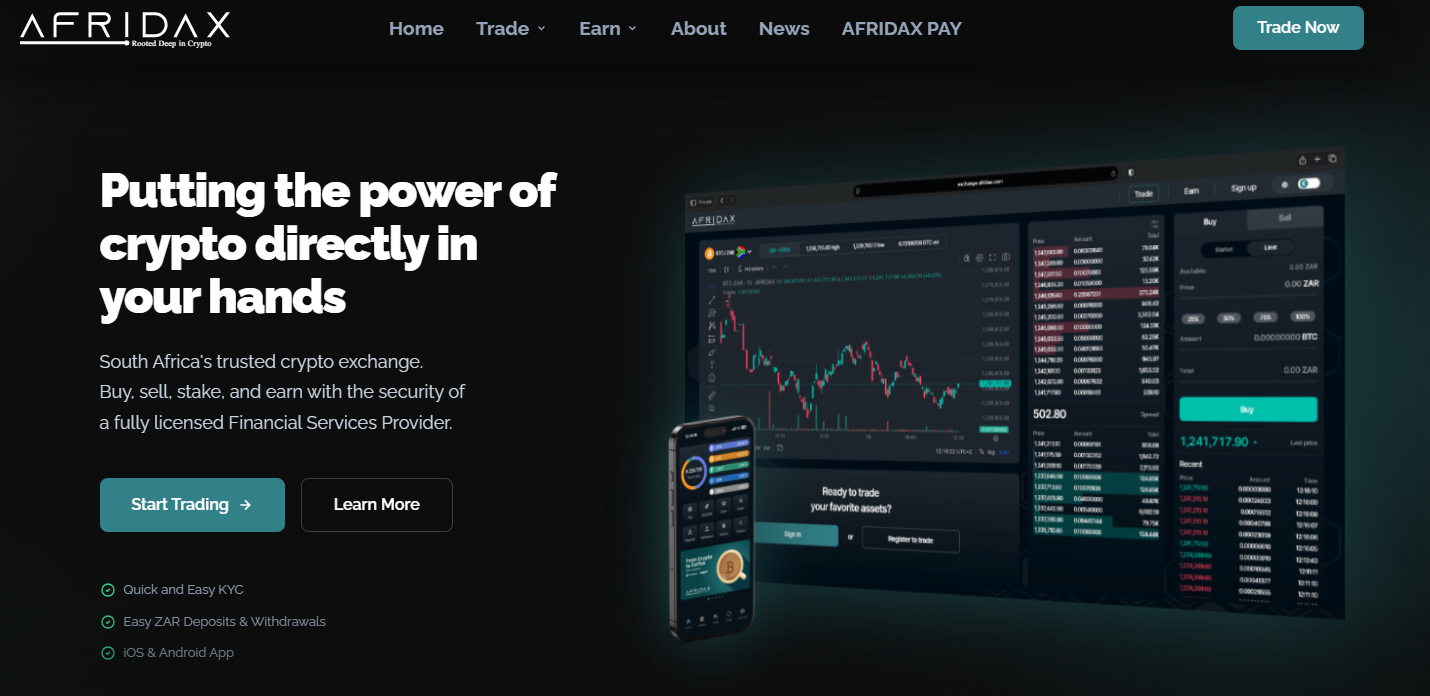
AFRIDAX is an authorised South African FSP and CASP under number 54234. ZAR deposits via EFT cost R0 and go to an AFRIDAX Standard Bank account. Each profile has a unique reference, which links the transfer to the correct ZAR wallet.
AFRIDAX does not promise a fixed EFT arrival time because bank and third-party transfer times can differ. Deposit thresholds depend on verification level, which makes a universal maximum inaccurate.
An EFT must originate from the account holder’s bank account; an absent or wrong reference requires manual allocation.
4. OVEX
OVEX holds FSP number 53922 and accepts personal South African accounts. Regular ZAR EFT deposits cost R0, can take up to two business days, and require a unique SN reference in the client account.
The transfer must originate from a local bank account in your own name. Two equal deposits within 24 hours can delay allocation. Deposit capacity depends on verification level, which means a client with a large EFT should confirm the applicable account limit before transferring.
5. Altify
Altify has two authorised South African entities, with FSP numbers 52727 and 53289. ZAR bank deposits have a minimum of R50.
Transfers often reflect within a few hours to one business day, with a maximum stated timeframe of three business days. Each EFT requires a unique payment reference shown in the account.
Altify’s current fee page is inconsistent; its tier table shows a 0.50% bank deposit fee, while the FAQ indicates that ZAR deposits are free. Always check the charge in the deposit preview before approval. Daily and monthly maximums appear in the account flow.
6. Xago
Xago holds FSP number 53416 and accepts ZAR deposits by EFT from a bank account held in the verified client’s own name.
You can view the deposit details on the Xago Wallet. Xago does not guarantee a standard bank transfer time, while its fiat on/off-ramp service can settle nearly instantly once the bank transfer is complete.
Xago charges 0.25% for crypto trades and 0.50% for currency conversions, while gateway transaction rates are quoted when you sign up.
South African residents have an annual Xago Discretionary Allowance of R1 million for crypto purchases, which can increase to R10 million for taxpayers after tax compliance verification.
The allowance is not a per-EFT deposit cap. Bank withdrawals can go to the client’s registered bank account through banking rails.
7. Cape Crypto
Cape Crypto holds FSP number 53746. Regular ZAR bank transfers can take up to two business days and require the Deposit Reference from the client account. Transfers must originate from your South African bank account, and third-party deposits are not accepted.
Check the current deposit screen before transferring funds. The deposit guide confirms regular bank transfer support and the two-day timeframe.
8. AltCoinTrader
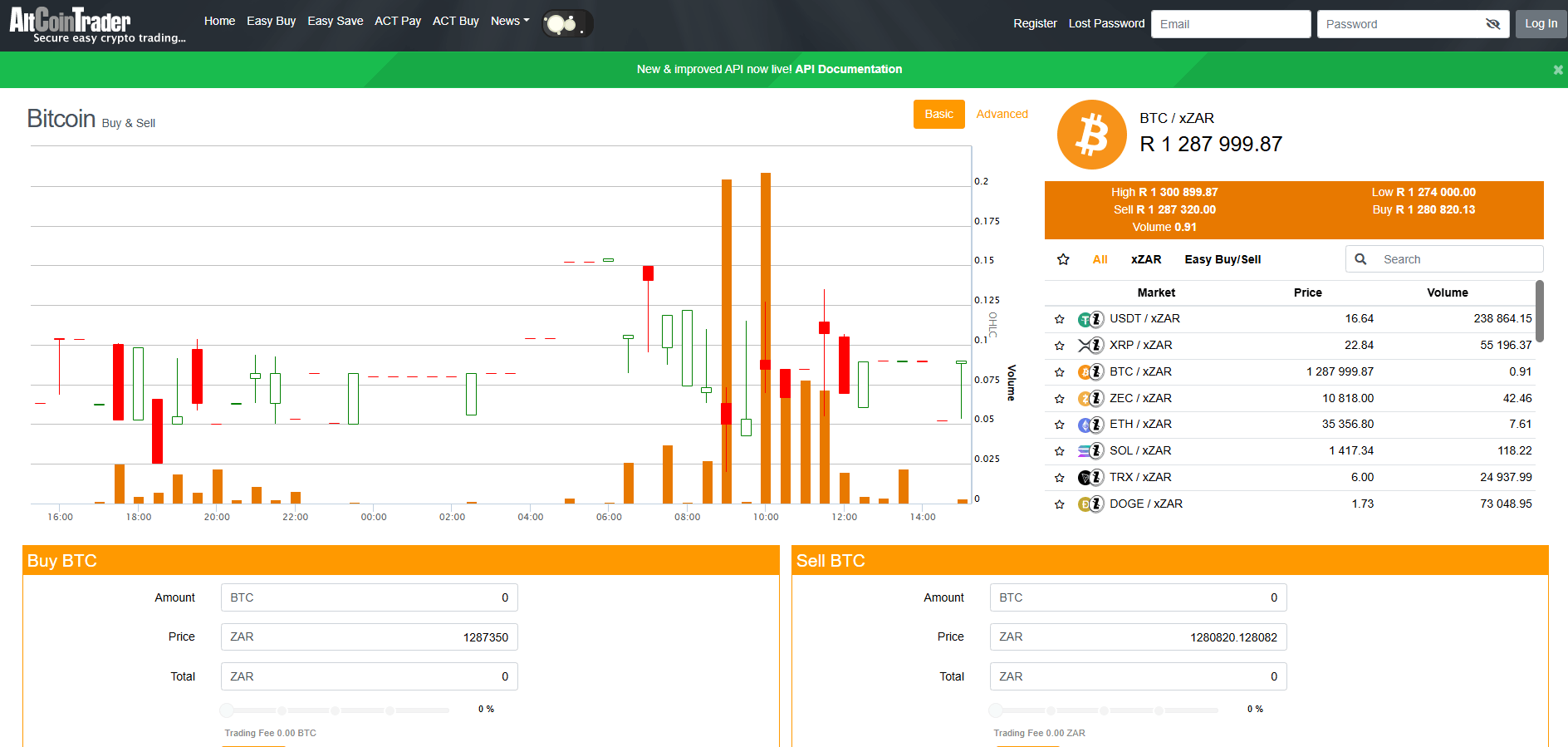
AltCoinTrader holds FSP number 53614 and accepts traditional ZAR EFT deposits. Its current fee schedule charges 0.5% on a ZAR deposit, capped at R95, while bank charges can vary by bank. Traditional EFT can take 24 to 72 hours.
Capitec Pay and Absa Pay provide separate deposit routes, but neither is a standard EFT. Absa Pay has a 2.5% deposit fee, and Capitec Pay has a separate charge. A standard EFT relies on the client’s unique ZAR deposit reference for allocation.
9. Bybit
Bybit supports ZAR bank transfers via EFT for South African clients. The route creates a virtual account and requires South African identity details. A first deposit can require separate proof of address and a selfie, even after identity verification. Bank transfer deposits can take up to three business days.
Bybit Fintech South Africa is a juristic representative of Altify SA Capital, FSP 52727. Fees and transaction limits appear in the payment flow, and you must check both before transferring funds. Instant EFT via Ozow is a separate payment method.
10. ChainEX
ChainEX is a South African exchange with FSP number 53799, and its live site provides EFT from a bank account as a ZAR deposit route. The account provides bank details and a unique reference.
ChainEX ranks tenth because its detailed EFT guide is four years old. The guide indicates a maximum of two business days for a ZAR EFT to reflect, while current bank-specific details and the current standard EFT charge require confirmation inside the account. The lower rank reflects documentation age, not an absent EFT route.
Which platform fits your bank?
Standard Bank clients have the broadest documented convenience among the top options. VALR is a pre-approved Standard Bank beneficiary, and Standard Bank-to-Standard Bank transfers can reflect near immediately.
Luno also offers near-immediate potential for Standard Bank, with pre-approved beneficiary details. FNB clients can fund Luno after manual beneficiary setup, while Nedbank and TymeBank clients can select Luno from pre-approved beneficiaries.
Capitec and Absa clients cannot send a regular EFT to Luno. AFRIDAX receives ZAR EFT deposits into a Standard Bank account. Confirm bank acceptance before a large transfer.
| South African Bank | Best Documented EFT Option | Important Note |
|---|---|---|
| Standard Bank | VALR | Pre-approved beneficiary and transfers may reflect near immediately |
| Standard Bank | Luno | Pre-approved beneficiary with near-immediate potential |
| Nedbank | Luno | Available as a pre-approved beneficiary |
| TymeBank | Luno | Available as a pre-approved beneficiary |
| FNB | Luno | Can be added manually as a beneficiary |
| Capitec | Other EFT-supported platforms | Regular EFT to Luno is not supported |
| Absa | Other EFT-supported platforms | Regular EFT to Luno is not supported |
How to reduce EFT allocation delays
A payment reference often decides whether an EFT credits the correct wallet without manual review. Here are five checks that can reduce avoidable issues:
- Verify the provider’s current regulatory status and EFT option before transferring.
- Send money from a bank account in the verified client’s own name.
- Copy the beneficiary details and unique deposit reference exactly from the account.
- Confirm the platform fee, bank charge, deposit limit, and expected transfer time.
- Save formal proof of payment until the ZAR balance reflects in the correct account.
Repeated equal deposits can trigger allocation checks on VALR and OVEX. A wrong or absent reference can force manual review. Instant EFT, Ozow, Capitec Pay, and Absa Pay have separate fees and transfer mechanics.
| EFT Check | Why It Matters |
|---|---|
| Use your own bank account | Third-party deposits may be rejected or manually reviewed |
| Copy the correct reference | A wrong reference can stop automatic allocation |
| Confirm beneficiary details | Prevents funds being sent to the wrong banking destination |
| Check deposit limits | Large transfers may exceed account or verification limits |
| Confirm current fees | Deposit charges can vary between platforms and payment methods |
| Keep proof of payment | Helps support trace and allocate a delayed EFT |
| Avoid repeated identical transfers | Some platforms may flag them for additional review |
Conclusion
VALR ranks first for a standard EFT because its R0 fee, lack of a platform EFT cap, Standard Bank beneficiary setup, and reference process combine well for South African deposits. Luno follows closely for accepted banks, while AFRIDAX provides a R0 route with a direct reference process.
Your bank can change the order. Capitec and Absa clients, for example, cannot send a regular EFT to Luno.
Before transferring, verify the live deposit fee, bank details, account limit, and reference in the provider's account. Crypto has a substantial risk of capital losses, and an FSCA-authorised provider does not remove that risk.
Frequently asked questions
Is EFT the same as Instant EFT?
A regular EFT is a conventional bank transfer to the beneficiary details supplied for a crypto account. Instant EFT is a separate pay-by-bank service with its own fee and transfer path.
Does FSCA authorisation remove crypto risk?
FSCA authorisation does not remove crypto market risk or guarantee capital. It confirms authorisation for regulated financial services within the provider’s licence scope. Crypto prices are extremely volatile, and an investor can lose the total amount committed. Provider authorisation and investment risk are separate issues.
Can I deposit from someone else’s bank account?
A third-party bank account is generally unsuitable for the platforms in this comparison. Most regulated crypto brokers require that bank details or payment identity match the verified account holder. A mismatch can cause rejection, a refund, or manual review. To avoid delays, only deposit from an account held in your own name.
What proof should I retain after an EFT?
Save formal proof of payment with the amount, date, beneficiary details, and payment reference. A provider can request it if a transfer does not allocate correctly. Screenshots are not always accepted; VALR, for example, requires PDF proof for relevant support cases. Retain the document until the ZAR balance reflects.
What are the best crypto brokers for EFT in South Africa?
The best crypto brokers for EFT in South Africa are platforms that support local bank transfers, offer competitive fees, provide strong security, and make ZAR deposits and withdrawals straightforward.
Can I deposit ZAR via EFT with a crypto broker?
Yes. Many crypto brokers and exchanges serving South African users allow ZAR deposits through EFT, although processing times and minimum deposit requirements can differ between platforms.
How long do EFT deposits take on crypto platforms?
EFT deposits can arrive within a few hours or take up to one or two business days, depending on the broker, your bank, and the time the transfer is made.
Are there fees for EFT deposits and withdrawals?
Some crypto brokers offer free EFT deposits, while others may charge a small fee. Withdrawal fees can also vary, so it is worth checking the broker’s latest banking fee schedule before transferring funds.
Is EFT safe for funding a crypto trading account?
EFT can be a secure way to fund a crypto account when you use a reputable platform and transfer money only to verified banking details supplied by the broker or exchange.
Can I withdraw crypto profits back to my South African bank account?
Yes. If the platform supports ZAR withdrawals, you can usually sell your crypto, convert the funds to rand, and request an EFT withdrawal to a verified South African bank account.
You Might Also Like




Recommended brokers