
South Africans can buy, hold, and sell crypto assets for their own account. Crypto is not legal tender, and a lawful personal trade is different from a regulated crypto financial service.
Tax duties, anti-money laundering controls, provider authorisation, and cross-border restrictions can still affect a transaction.
Crypto currently falls within several South African regulatory frameworks. The Financial Sector Conduct Authority (FSCA) covers financial services linked to crypto assets under the Financial Advisory and Intermediary Services Act (FAIS Act), while the FIC, South Africa’s financial intelligence authority, covers anti-money laundering duties for crypto asset service providers (CASPs). SARS applies normal tax principles to crypto profits and losses.
A separate set of rules affects transfers across South Africa’s borders. Draft capital flow regulations and a draft Crypto Assets Manual are under consultation in 2026, which means a trader should distinguish current law from proposals that have not taken effect.
Information in this guide is general financial and regulatory information, not personal legal, tax, or investment advice.
Can South Africans trade crypto legally in 2026?
Yes. South African law does not prohibit ordinary crypto ownership or trade for your own account. A personal investor does not require a CASP licence merely because that person buys or sells crypto for personal purposes.
The regulatory trigger arises where a business provides financial services in relation to crypto assets, such as advice or intermediary services.

🏆10 Best Forex Brokers in South Africa
| Rank | Broker | Broker Review | Regulators | Minimum Deposit | Visit Broker |
|---|---|---|---|---|---|
| 🥇 |  | Read Review | ASIC, FSA, CBI, BVI, FSCA, FRSA, CySEC, ISA, JFSA | $100 | Visit Now |
| 🥈 |  | Read Review | FSCA, FCA, DFSA, FSA, CMA | $0 | Visit Now |
| 🥉 |  | Read Review | FSCA, FSC, CYSEC, DFSA, CMA, FSC, FSA | $5 | Visit Now |
| 4 |  | Read Review | ASIC, CySEC, FSA, SCB | $0 | Visit Now |
| 5 |  | Read Review | BVI FSC | $0 | Visit Now |
| 6 |  | Read Review | FSA, FSC, FSCA, ASIC, CMA | $20 | Visit Now |
| 7 |  | Read Review | Exness is a globally regulated broker, holding multiple licenses from respected financial regulators around the world. | $10 | Visit Now |
| 8 |  | Read Review | ASIC, CySEC, FSCA, FSA, FSC, CMA | $100 | Visit Now |
| 9 |  | Read Review | FSC | $10 | Visit Now |
| 10 |  | Read Review | FSA, CySEC, FSCA, FSC | $10 | Visit Now |


How is crypto regulated in South Africa?
South Africa does not place crypto under one regulator.
The FSCA covers market conduct and regulated financial services; the FIC covers anti-money laundering and counter-terrorist finance controls; SARS covers tax; and the South African Reserve Bank (SARB), with National Treasury, has responsibility for monetary, payment, and capital flow policy relevant to crypto.
FSCA and FAIS: Crypto as a financial product
Crypto assets became a financial product under the FAIS Act after the FSCA declaration took effect in October 2022.
A person who, as a regular feature of business, renders a financial service in relation to crypto assets must hold the required FAIS authorisation or act as a representative of an authorised financial services provider, subject to the applicable exemptions and scope rules.
The key distinction is between personal account activity and a financial service offered as a business. An investor who buys Bitcoin for personal ownership is not in the same category as a firm that provides advice, intermediary services, or crypto-related investment management.
Provider status should be checked against the FSCA’s authorised financial services provider records before money is sent.
FIC rules: AML, KYC, and the Travel Rule
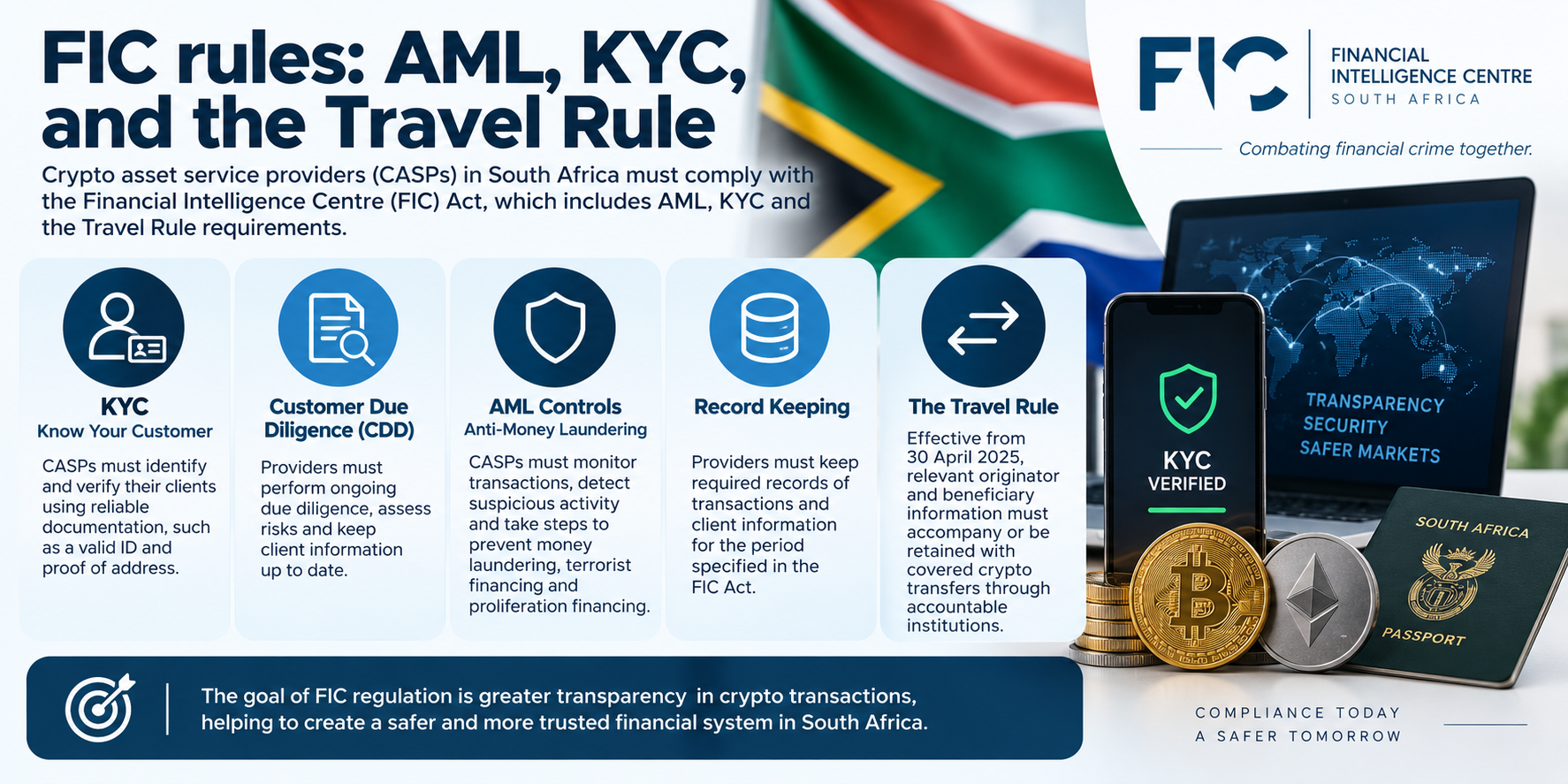
CASPs have had accountable institution duties under the FIC Act since 19 December 2022. Those duties include customer due diligence, transaction oversight, record retention, and measures against money laundering, terrorist financing, and proliferation financing.
Identity checks at a regulated platform can reflect a statutory compliance duty, while optional administration is a separate issue.
Directive 9, effective from 30 April 2025, applies the Travel Rule to covered crypto asset transfers through accountable institutions. Relevant originator and beneficiary information must accompany or be retained with covered transfers.
The purpose is traceability where crypto moves through CASPs, with information available to competent authorities under the legal framework.
What crypto activities are legal, regulated, or restricted?
The legal result depends on the activity. Personal ownership, a regulated financial service, a tax event, and a cross-border transfer do not fall into one category, even when each event involves the same crypto asset.
| Activity | 2026 legal status | What it means for you | Main authority |
|---|---|---|---|
| Buy, hold, or sell for own account | Permitted | Personal trade does not itself require a CASP licence | FSCA |
| Accept crypto by private agreement | Permitted by agreement | Crypto still has no legal-tender status | SARB |
| Give crypto financial advice as a business | Regulated | FAIS authorisation can apply | FSCA |
| Provide crypto intermediary services | Regulated | Provider authorisation and conduct duties can apply | FSCA |
| Transfer crypto through a CASP | Regulated service | FIC duties and the Travel Rule can apply | FIC |
| Transfer crypto across national borders | Separate compliance area | Check current capital-flow rules before transfer | SARB and National Treasury |
Two distinctions help prevent costly errors. A lawful personal trade is not proof that every firm connected to the transaction is properly authorised, and FSCA authorisation is not a guarantee against market loss, fraud, cybercrime, insolvency, or custody failure.
Cross-border activity also warrants separate review because South Africa’s capital flow framework is under reform in 2026.
How is crypto taxed in South Africa?
Crypto is taxable in South Africa. Normal income tax principles apply, and taxpayers must declare taxable crypto gains or losses in the tax year in which income is received or accrues.
A gain can fall on a revenue account or capital account, based on the facts, the taxpayer’s intention, and the nature of the activity.
The difference can affect the tax result. Frequent, business-like crypto activity can point towards ordinary income treatment, while a disposal of an asset held as a long-term investment can fall within the capital gains tax framework.
Classification is fact-specific, so a label such as “investor” or “trader” does not settle the tax treatment by itself.
| Scenario | Possible tax treatment | Records to retain | 2026 point to verify |
|---|---|---|---|
| Frequent business-like trade | Revenue account | Dates, amounts, fees, statements | Marginal tax rate |
| Long-term investment disposal | Capital account can apply | Base cost and disposal records | CGT treatment |
| Mining rewards | Income can arise | Receipts, costs, rand amounts | Income classification |
| Crypto for goods or services | Barter rules can apply | Invoice, rand amount, transaction record | Tax character |
The Crypto-Asset Reporting Framework (CARF) took effect in South Africa on 1 March 2026. Relevant crypto asset service providers must collect and report specified customer and transaction data to SARS, with the first reporting period from 1 March 2026 to 28 February 2027.
CARF concerns tax transparency; it does not create a separate crypto tax. Individual taxpayers still declare crypto transactions under the ordinary tax system.
Record quality can become decisive if SARS queries a return. Transaction dates, asset quantities, rand amounts at the relevant time, acquisition costs, disposal proceeds, fees, wallet evidence, exchange statements, and related invoices can help establish how a gain or loss arose.
Taxpayers with uncertain revenue-versus-capital treatment should obtain advice from a qualified South African tax professional.
What are the 2026 rules for cross-border crypto transfers?
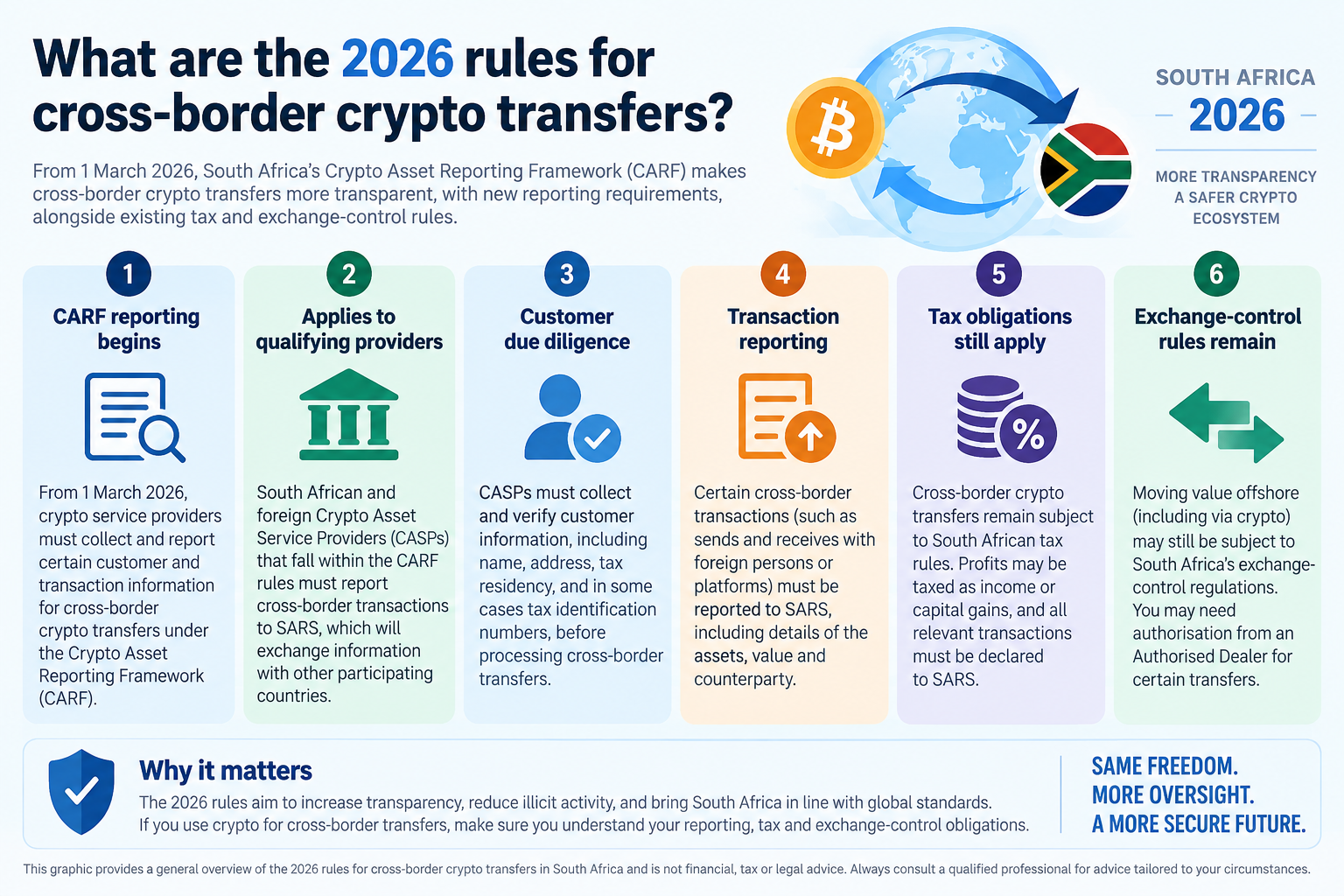
A local crypto purchase and a cross-border crypto transfer are different compliance events. Under current exchange-control policy, an individual cannot buy crypto on a South African platform with rand and send the crypto offshore, where the transaction externalises capital without permission.
Exchange Control Regulation 10(1)(c) prohibits the export of capital, or a right to capital, without permission.
An individual can acquire crypto abroad through permitted foreign-currency transfers. Current guidance provides for a Single Discretionary Allowance of up to R1 million per calendar year and a Foreign Capital Allowance of up to R10 million per calendar year, with the applicable tax-compliance process for the latter route.
The foreign currency first moves through an authorised dealer before the offshore crypto purchase.
South Africa also has draft Capital Flow Management Regulations and a draft Crypto Assets Manual for cross-border activity.
The proposed manual identifies cross-border triggers between a domestic authorised CASP and an offshore CASP, plus specified transfers from a domestic authorised CASP to a non-custodial wallet. The proposal also provides for FinSurv reporting on covered flows.
Draft provisions are not final law. If you plan a cross-border crypto transfer, you should verify the current SARB and Financial Surveillance Department requirements before money or crypto moves outside South Africa, because the final 2026 framework can differ from the consultation text.
How to trade crypto legally and reduce risk
A lawful trade can still expose an investor to fraud, loss, tax errors, or a provider with the wrong authorisation. A disciplined check before a deposit can separate platform promotional claims from regulatory facts and can reduce avoidable compliance problems.
- Verify the provider with the FSCA. Search the authorised financial services provider records for the legal entity behind the platform. A brand name or website design does not prove FAIS authorisation for crypto-related financial services.
- Match the licence to the legal entity. Compare the FSP details, company identity, contact information, and website with the firm that will receive your money. Impersonation scams can copy the identity of a genuine authorised firm.
- Expect identity and transfer checks. A legitimate CASP can require customer identification, transaction information, and originator or beneficiary details under FIC obligations and Directive 9. An identity request should still be verified through the provider’s genuine channel.
- Retain transaction and tax records. Save trade confirmations, wallet records, rand amounts, fees, purchase evidence, disposal evidence, and relevant statements. Complete records can support the tax classification and amount disclosed to SARS.
- Treat offshore transfers separately. Check the current SARB and FinSurv framework before a cross-border crypto transfer. A transaction that is lawful within South Africa does not automatically satisfy the separate rules that can apply to capital sent outside the country.
Regulatory status cannot remove crypto’s market and operational risks. Prices can be volatile, fraud can mimic legitimate firms, custody failure can block funds, and recovery can be difficult after theft or insolvency. An FSCA-authorised provider is not the same as a guaranteed investment.
| Pros | Cons |
|---|---|
| Legal to trade – South Africans can legally buy, sell, hold, and trade crypto assets. | Not legal tender – Crypto assets are not recognised as official South African currency. |
| FSCA oversight – Crypto Asset Service Providers offering regulated financial services must obtain the appropriate FSCA licence. | Tax obligations – Profits from crypto trading or investing may be subject to normal income tax or Capital Gains Tax. |
| Better consumer protection – Using an authorised CASP provides more regulatory oversight than dealing with an unregulated provider. | High market risk – Crypto prices can move sharply, creating the possibility of substantial losses. |
| Growing regulatory clarity – South Africa has developed a clearer framework for crypto service providers and financial services involving crypto assets. | More reporting and compliance – Crypto transactions are becoming increasingly visible to SARS, particularly following the introduction of CARF in 2026. |
| Wide investment access – Traders can access Bitcoin, Ethereum, stablecoins, and numerous other digital assets through crypto platforms. | Scams remain a concern – Regulation does not eliminate fraudulent platforms, phishing, wallet theft, or other crypto-related scams. |
| 24/7 trading – Unlike traditional stock exchanges, crypto markets generally operate around the clock. | Exchange-control rules can apply – Moving funds offshore for crypto-related purposes may involve South African exchange-control requirements. |
Conclusion
South Africans can own and trade crypto, but crypto is not legal tender, and regulated services fall under the FAIS and FIC frameworks. Tax obligations can arise from gains or income, while cross-border transfers require separate care because the capital flow regime is under reform in 2026.
Before money leaves your bank account, verify the provider’s current FSCA authorisation, understand the tax record you will create, and check the latest cross-border requirements if funds or crypto will move outside South Africa.
Frequently asked questions
Can I trade crypto without an FSCA licence?
An individual who buys, holds, or sells crypto for a personal account does not require a CASP licence merely for that activity. FAIS authorisation becomes relevant where a person or firm provides regulated financial services in relation to crypto assets as a business, subject to the scope of the law and applicable exemptions.
Does an FSCA licence guarantee my crypto investment is protected?
An FSCA licence confirms authorisation for the regulated financial services covered by the licence; it does not guarantee a crypto asset’s price, investment return, platform solvency, custody outcome, or recovery after fraud. Crypto also does not become legal tender because an authorised provider offers a related service.
Does CARF change how crypto is taxed in 2026?
CARF changes tax transparency and service-provider reporting, not the basic tax principles applied to crypto. The framework took effect on 1 March 2026, while individual taxpayers continue to declare taxable crypto transactions through the normal income tax system. Revenue-versus-capital classification still depends on the facts of each case.
What records should I retain for SARS if I trade crypto?
Retain transaction dates, asset quantities, rand amounts, acquisition costs, disposal proceeds, fees, exchange statements, wallet records, and related invoices or receipts. Records should be detailed enough to show how each taxable amount was calculated and why the taxpayer treated a gain or loss as revenue or capital.
Is crypto trading legal in South Africa?
Yes. South Africans can legally buy, sell, and hold crypto for their own account. Crypto is not legal tender, though, and businesses offering regulated crypto financial services may need FSCA authorisation.
Do I need an FSCA licence to trade crypto personally?
No. You do not need an FSCA licence simply to trade crypto for yourself. Licensing becomes relevant when a person or company provides regulated financial advice, intermediary services, or other crypto-related financial services as a business.
Do I have to pay tax on crypto profits in South Africa?
Yes. Crypto profits can be taxable. Depending on your activity, gains may be treated as ordinary income or under capital gains tax rules. The exact treatment depends on factors such as your intention, trading frequency, and how the crypto was held.
Can SARS track my crypto transactions?
SARS can obtain information from regulated crypto service providers and other reporting channels. From 1 March 2026, South Africa’s Crypto-Asset Reporting Framework also increased tax transparency requirements for relevant crypto asset service providers.
Can I send crypto from South Africa to an offshore wallet or exchange?
You need to be careful. Cross-border crypto transfers can trigger separate capital-flow and exchange-control requirements. A transaction that is legal inside South Africa does not automatically mean the same transfer is permitted when capital moves offshore.
Is it safe to use an FSCA-authorised crypto provider?
FSCA authorisation is an important regulatory check, but it does not guarantee that you will make money or that you are protected from every risk. Crypto prices can fall sharply, platforms can experience operational problems, and fraud or custody failures can still occur.
You Might Also Like




Recommended brokers