Choosing the right forex broker is one of the most important decisions a beginner can make. The broker you select will shape your entire trading experience—from how much it costs to trade, to whether your funds are safe, to how quickly your orders execute. With hundreds of brokers competing for your business, each claiming to offer the best spreads and platforms, it's easy to feel overwhelmed. This guide cuts through the noise and walks you through the 15 most crucial forex broker facts every beginner must evaluate before opening an account.
Many new traders focus only on spreads or bonuses and miss the bigger picture: regulation, platform stability, withdrawal reliability, and customer support. Making the wrong choice can cost you thousands in unnecessary fees, expose your funds to risk, or leave you stuck with a broker that won't process your withdrawal. This guide shows you exactly what to look for so you can trade with confidence.
- How to verify forex broker regulation and check for red flags
- Why trading platform choice matters and what to test on demo
- How spreads and hidden fees eat into your profits
- What account types are available and which suits beginners
- How leverage works and why it's dangerous if misused
- Why execution speed and slippage directly impact your bottom line
- How to evaluate customer support before you need it in a crisis
- Why deposit and withdrawal speed reflects broker credibility
- What bonuses really cost and when they're worth it
- How to spot reliable brokers using reputation sources
Why Choosing the Right Forex Broker Matters
Selecting the right forex broker can be the difference between long-term success and unnecessary risks. With hundreds of brokers available, traders—especially beginners—must evaluate key factors that influence trading safety, profitability, and experience. A broker is not just a middleman; it's your gateway to the markets. A poor choice can cost you thousands in avoidable fees, expose your capital to unnecessary risk, or leave you frustrated with slow execution and unresponsive support.
The stakes are real. A broker that lacks proper regulation might disappear with your funds. One with poor execution speed could fill your orders at prices worse than you expected, costing you money on every trade. Hidden fees compound over time, turning a profitable strategy into a losing one. Platform crashes during volatile market moves can lock you out when you need to act. These aren't theoretical risks—they happen to traders every day who didn't do their homework.
This guide focuses on what beginners actually need to know. You don't need extreme leverage. You don't need the widest product selection. You need safety, transparency, reasonable costs, and support when things go wrong. The brokers that excel in these areas might not be the loudest in your social media feed, but they're the ones that will still be there and still be reliable years from now.

🏆10 Best Forex Brokers in South Africa
| Rank | Broker | Broker Review | Regulators | Minimum Deposit | Visit Broker |
|---|---|---|---|---|---|
| 🥇 |  | Read Review | ASIC, FSA, CBI, BVI, FSCA, FRSA, CySEC, ISA, JFSA | $100 | Visit Now |
| 🥈 |  | Read Review | FSCA, FCA, DFSA, FSA, CMA | $0 | Visit Now |
| 🥉 |  | Read Review | FSCA, FSC, CYSEC, DFSA, CMA, FSC, FSA | $5 | Visit Now |
| 4 |  | Read Review | ASIC, CySEC, FSA, SCB | $0 | Visit Now |
| 5 |  | Read Review | BVI FSC | $0 | Visit Now |
| 6 |  | Read Review | FSA, FSC, FSCA, ASIC, CMA | $20 | Visit Now |
| 7 |  | Read Review | Exness is a globally regulated broker, holding multiple licenses from respected financial regulators around the world. | $10 | Visit Now |
| 8 |  | Read Review | ASIC, CySEC, FSCA, FSA, FSC, CMA | $100 | Visit Now |
| 9 |  | Read Review | FSC | $10 | Visit Now |
| 10 |  | Read Review | FSA, CySEC, FSCA, FSC | $10 | Visit Now |


Do I Really Need to Compare Brokers, or Will Any Regulated Broker Work?
Regulation is a baseline, not a guarantee of quality. Two regulated brokers can differ dramatically: one offers tight spreads and fast execution, the other has wide spreads and slow withdrawals. Comparing 3-4 regulated brokers on demo (testing platform, spreads, support, withdrawal process) takes 2-3 weeks and saves you thousands in unnecessary fees and frustration over the years. It's time well spent.
15 Crucial Forex Broker Facts to Consider
- Broker Regulation & Licensing
- Trading Platforms & Tools
- Spreads & Trading Costs
- Commissions & Hidden Fees
- Account Types for Different Trading Styles
- Minimum Deposit Requirements
- Leverage Options & Risk
- Deposit & Withdrawal Methods
- Safety of Funds (Segregated Accounts)
- Execution Speed & Slippage
- Customer Support Quality
- Education & Learning Resources
- Available Trading Instruments
- Bonuses, Promotions & Loyalty Rewards
- Reputation & User Reviews
1. Broker Regulation & Licensing
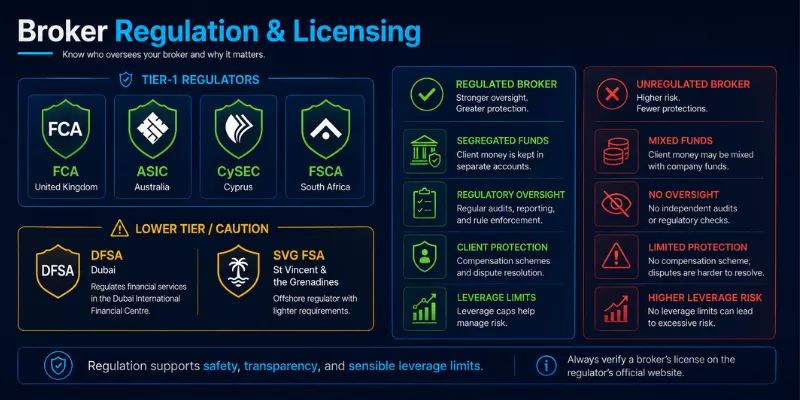
Is your broker regulated? This is the single most important question. Regulation is not a marketing feature—it's legal protection for your funds. A regulated broker must follow strict capital requirements, client fund segregation rules, transparent pricing practices, and complaint procedures. An unregulated broker can do almost anything, including disappearing with your money.
Many brokers operate across multiple jurisdictions with different entities. A broker might be FCA-regulated in the UK, ASIC-regulated in Australia, and completely unregulated in South Africa. You need to know which entity your account is with and what protector covers it. Don't rely on the broker's website to tell you—search the regulator's official register directly.
What Regulation Protects You From
Regulation requires brokers to segregate client funds from their own business money. If the broker runs out of capital, your trading account is separate and protected. Without segregation, your funds sit in the broker's general bank account alongside their operational costs. If they go bankrupt, you stand in line with other creditors and might recover only a small fraction of your deposit.
Regulation also caps leverage. The FCA limits retail traders to 30:1 on major pairs. ASIC limits retail traders to 50:1 on majors. These caps exist because regulators know that extreme leverage blows up accounts. An unregulated broker might offer 500:1 leverage, which sounds exciting until you realize one bad trade wipes you out completely.
Regulated brokers must also maintain minimum capital reserves and undergo regular audits. They can't simply close shop and disappear. If they violate rules, regulators investigate, publish warnings, and enforce penalties.
Trusted Regulatory Authorities
| Regulator | Jurisdiction | Leverage Cap (Retail) | Client Fund Protection |
|---|---|---|---|
| FCA | United Kingdom | 30:1 majors | FSCS up to £50,000 |
| ASIC | Australia | 50:1 majors | Segregated accounts |
| CySEC | Cyprus | 30:1 majors | ICF up to €20,000 |
| FSCA | South Africa | 20:1 majors | Segregated accounts |
| DFSA | Dubai (UAE) | 50:1 majors | Client protection scheme |
| SVG FSA | St Vincent & Grenadines | Unlimited | Limited/None |
Always search the broker's exact legal entity name in the regulator's official register. Don't trust logos on the website. A broker might claim to be "FCA-regulated" when actually only their UK subsidiary is regulated; their South African entity might be unregulated. Read your account agreement to see which company you're actually trading with, then verify that company on the regulator's site.
2. Trading Platforms & Tools
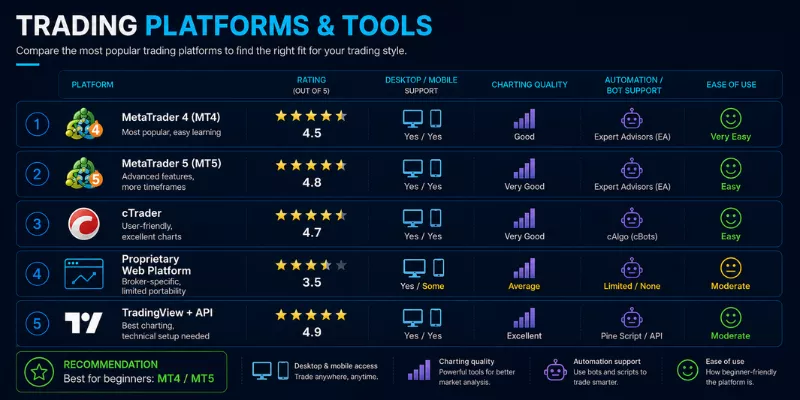
The trading platform is where you spend hours each week, so choosing one that feels right matters more than most traders realize. A platform that crashes during volatile news, takes 10 seconds to open a trade, or has unclear order tickets can cost you money and sanity. The best platform for you is one you understand well enough to use accurately under pressure—not necessarily the one with the most indicators.
Most brokers offer industry-standard platforms like MetaTrader 4 (MT4), MetaTrader 5 (MT5), or cTrader. If a broker only offers their own proprietary platform with no alternatives, that's a warning sign. Proprietary platforms aren't necessarily bad, but you can't take your charts and strategies if you switch brokers. Standard platforms give you flexibility.
What to Test on a Demo Account
Before funding a live account, spend at least two weeks on the broker's demo platform. Not to test a strategy—to test the platform itself. Place multiple orders and watch how quickly they fill. Check if the bid/ask prices match what you see on other sources. Try closing a position in the middle of a big price move and see if it executes at the expected price or slips. Close the platform and reopen it; does it remember your open positions and settings?
Test the mobile app on your phone. Mobile trading is convenient, but if the app crashes or is slow, you might miss important moments. Check whether you can set alerts, modify orders, and close positions quickly from your phone. Read the fine print on order types—does the broker offer guaranteed stops, or only basic stop-losses that can slip?
On demo, you also test customer support. Submit a simple question via chat or email. How long does it take to get an answer? Is the response helpful or generic? This tells you what to expect when you have a real problem on a live account.
Supported Platforms
| Platform | Desktop | Mobile | Charting | Automation (EA/Bots) | Ease of Use |
|---|---|---|---|---|---|
| MetaTrader 4 | Yes | Yes | Good | Yes (Expert Advisors) | Moderate |
| MetaTrader 5 | Yes | Yes | Excellent | Yes (Expert Advisors) | Moderate |
| cTrader | Yes | Yes | Excellent | Yes (cBots) | Easy |
| Proprietary Web | Yes (Browser) | Yes | Varies | No | Easy |
| TradingView + Broker API | Yes (Browser) | Yes | Excellent | Yes (via API) | Moderate |
The platform should include built-in charting with common indicators (moving averages, MACD, RSI, Bollinger Bands), support for different timeframes, and the ability to save your chart layouts. Mobile apps should allow one-touch closing of positions and let you see your account balance, open positions, and available margin at a glance.
3. Spreads & Trading Costs
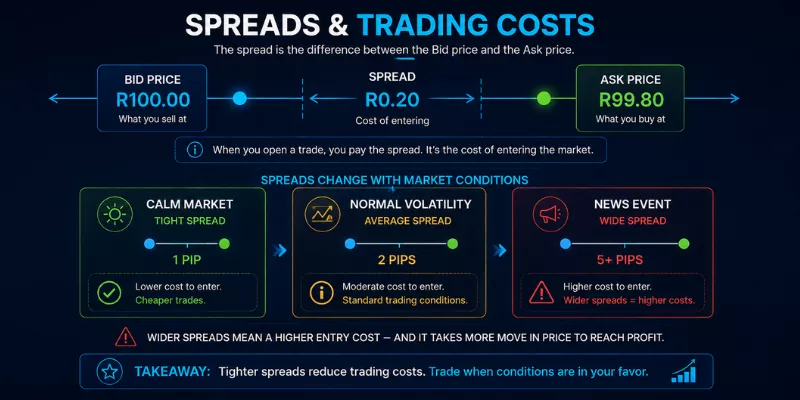
The spread is the difference between the bid price (what you sell at) and the ask price (what you buy at). It's how the broker makes money. Every time you open a trade, you start with a small loss equal to the spread. If you buy EUR/USD at 1.1050 and can only sell at 1.1048, you've lost 2 pips before the market even moves. On a 1 lot, that's about $20 in friction cost.
Spreads vary by instrument and market conditions. Major pairs like EUR/USD and GBP/USD have tight spreads (often 1-2 pips during London/New York overlap). Exotic pairs like USD/ZAR have wider spreads (5-10 pips). During high-impact news or when the market opens, all spreads widen. A "0.1 pip spread" quoted on a broker's website might be the best-case scenario—not what you actually pay most of the time.
Fixed vs. Variable Spreads
Fixed spreads don't change, even during volatile news. They're stable but usually wider than variable spreads. Variable spreads tighten during calm periods but widen significantly during fast-moving news. For beginners, fixed spreads often feel safer psychologically, but variable spreads on average cost less. The choice depends on whether you trade during news or only during quiet times.
Some brokers advertise "0 spread" accounts but charge commissions instead. A 0.5 pip commission per side (1 pip round trip) on EUR/USD is essentially the same cost as a 1 pip spread, so don't assume zero-spread accounts are cheaper—calculate the total cost.
Spread Comparison Table
| Instrument | Tight Market Spread | Normal Market Spread | High Volatility Spread | News Event Spread |
|---|---|---|---|---|
| EUR/USD | 0.5 - 1 pip | 1 - 2 pips | 2 - 4 pips | 5 - 15 pips |
| GBP/USD | 1 - 1.5 pips | 1.5 - 2.5 pips | 3 - 5 pips | 10 - 20 pips |
| USD/JPY | 0.5 - 1 pip | 1 - 2 pips | 2 - 4 pips | 8 - 18 pips |
| USD/ZAR | 5 - 8 pips | 8 - 15 pips | 15 - 30 pips | 30 - 100 pips |
| Gold (XAU/USD) | 0.2 - 0.5 pips | 0.5 - 1 pip | 1 - 2 pips | 3 - 8 pips |
| S&P 500 (SPX500) | 1 - 2 points | 2 - 5 points | 5 - 10 points | 10 - 30 points |
Impact on Your Profitability
| Monthly Trades | Avg Spread | Position Size | Total Spread Cost | Swap Costs (3-day hold) | Commissions | Monthly Total Cost | % of $5k Account |
|---|---|---|---|---|---|---|---|
| 20 trades | 1.5 pips | 0.1 lots | $30 | $15 | $0 | $45 | 0.9% |
| 50 trades | 1.5 pips | 0.1 lots | $75 | $35 | $0 | $110 | 2.2% |
| 50 trades | 2 pips | 0.2 lots | $200 | $40 | $0 | $240 | 4.8% |
| 100 trades | 1.5 pips | 0.1 lots | $150 | $70 | $0 | $220 | 4.4% |
| 100 trades | 2 pips | 0.2 lots | $400 | $80 | $200 | $680 | 13.6% |
If you trade EUR/USD 100 times per month with an average 2 pip spread, you pay 200 pips in total spread costs. At 1 lot per trade, that's $2,000 per month in friction—just to cover spreads. Over a year, that's $24,000. If you're also paying commissions, overnight swap fees, and withdrawal charges, the total cost becomes substantial. Beginners often underestimate how much they lose to fees before they lose to poor trading decisions.
4. Commissions & Hidden Fees
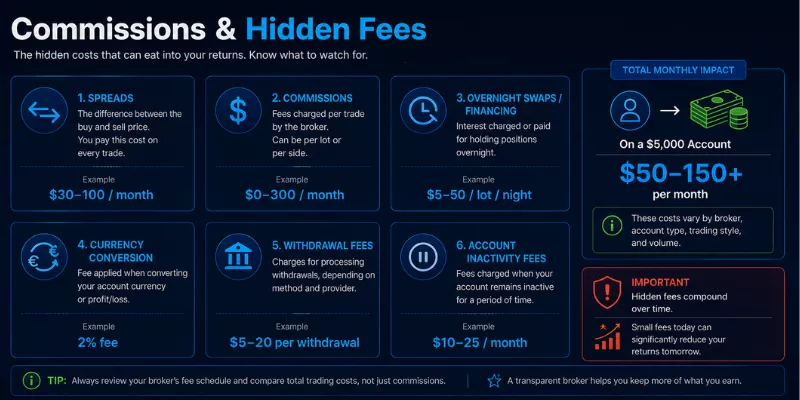
Beyond spreads, brokers charge fees that often aren't obvious. Overnight swaps (financing charges) are added to your account if you hold a position past the broker's daily cut-off (usually 5 PM EST). Swap rates vary but can be $5-50 per lot per night depending on the currency pair and interest rate differential. Hold a 10-lot position for a month, and you might pay $1,000-5,000 in swap alone.
Withdrawal fees might seem small ($5-20) but add up if you withdraw weekly. Inactivity fees appear if your account sits dormant for 90+ days (usually $10-25 per month). Some brokers charge for demo accounts, negative balance protection, or using certain payment methods. The smallest fees are easy to ignore, but they compound.
Where Hidden Fees Hide
Read the broker's fee schedule section-by-section. Check whether they charge for deposit (unusual but possible), for withdrawal by different methods, for opening certain account types, for converting currencies, for account maintenance, or for using their mobile app. Ask customer support directly: "Are there any other costs I should know about?" A transparent broker will give you a complete list.
Some brokers charge for guaranteed stops—an order that promises to close at a specific price even if the market gaps. During fast-moving news, a regular stop-loss might slip, but a guaranteed stop won't. The premium is usually 0.5-1 pip per trade, which adds up if you use it on every position.
Currency conversion fees appear if your account is in USD, but you deposit in ZAR, or if you trade a pair your account isn't denominated in. A 2% conversion fee on a $10,000 deposit is $200 that you never see—the broker just converts it, and you receive less.
Cost Example
Trader A opens a $5,000 account with Broker X. They make 50 trades per month, averaging 2 lots per trade, holding positions for an average of 3 days. Their costs:
- Spreads: 1.5 pips per trade × 50 trades = 75 pips = $75/month
- Swaps: Average 0.03% per day × 3 days × $10,000 average exposure = roughly $9/month
- Commissions: $0 (variable spread account)
- Deposit fees: $0
- Withdrawal: $10/month (they withdraw once monthly)
- Total monthly cost: ~$94/month = $1,128/year
This trader needs to make 1.13% per month just to break even on costs. Many beginners don't realize this and wonder why they're losing money despite being "right" on direction.
5. Account Types for Different Trading Styles
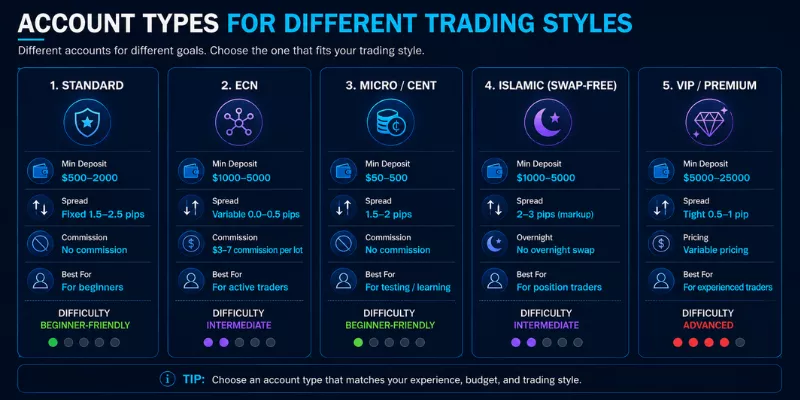
Different brokers offer different account types designed for different traders. A standard account might charge fixed spreads but is simple to understand. An ECN account has tighter spreads but charges commissions. A micro account lets you trade in smaller sizes. A cent account uses 0.01 lot units for testing with tiny position sizes. Picking the wrong account type can mean paying more than necessary or trading sizes that don't match your strategy.
What Each Account Type Is For
Standard accounts suit beginners. They have higher minimum deposits (often $500-2,000) but no hidden mechanics. You see the spread; it's usually fixed or semi-fixed, and you understand the cost structure immediately. No commissions, no confusing markup calculations.
ECN (Electronic Communication Network) accounts connect you directly to a pool of liquidity providers. Spreads are tighter—often 0.0-0.3 pips on major pairs—but you pay a commission per trade (typically $3-7 per side on a standard lot). ECN accounts are best for active traders who make many trades; the commission gets worth it because you save so much on spreads. Beginners usually don't trade frequently enough to benefit.
Cent accounts trade in cents instead of dollars. A standard lot is $100,000 notional. A cent lot is $1,000 notional. A micro account uses 0.01 lot units. These are perfect for testing. You can open a $500 cent account, trade 0.1 lots, and have realistic position sizing and risk management without needing a huge account.
Islamic accounts (swap-free) don't charge overnight financing for holding positions overnight. Instead of paying daily swap, you pay a markup on spreads. Good if you hold positions overnight frequently; otherwise, the spread increase isn't worth it.
Typical Account Types
| Account Type | Min Deposit | Spread (EUR/USD) | Commission | Best For |
|---|---|---|---|---|
| Standard/Fixed | $500 - $2,000 | 1.5 - 2.5 pips | None | Beginners, understanding basics |
| ECN | $1,000 - $5,000 | 0.0 - 0.5 pips | $3 - $7 per lot | Active/scalping traders |
| Micro/Cent | $50 - $500 | 1.5 - 2 pips | None | Testing, learning with small risk |
| Islamic (Swap-Free) | $1,000 - $5,000 | 2 - 3 pips (markup) | None or minimal | Overnight/position traders |
| VIP/Premium | $5,000 - $25,000 | 0.5 - 1 pip | Varies | Experienced traders, larger accounts |
Test different account types on demo before committing real money. With a standard account and 1 lot, does your trading psychology feel right? Does 0.1 lots on a micro account feel more comfortable? Does the cost structure make sense? Many beginners start with standard accounts and later switch to micro or ECN as they build capital and experience.
6. Minimum Deposit Requirements
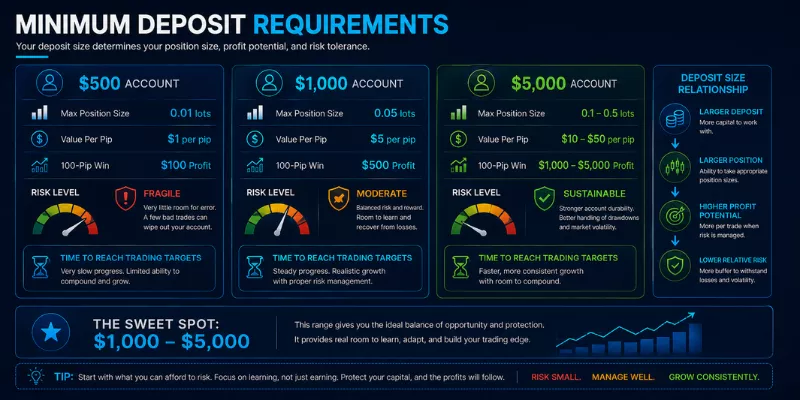
Minimum deposits range from $1 (some brokers) to $25,000 (some premium ECN brokers). A low minimum deposit sounds attractive, but what matters is whether you can trade meaningful sizes with that deposit. Opening a $100 account and trading micro lots ($1 per pip) means you need a 100-pip win to make $100. That's possible but slow. A $5,000 account trading 0.1 lots ($1 per pip) reaches $100 profit on a 100-pip win in half the time.
The true question isn't the minimum deposit—it's what deposit size makes sense for your trading frequency and strategy. Day traders need more capital to sustain multiple trades and daily risk limits. Swing traders holding positions for days or weeks can work with less because they take fewer trades.
Deposit Size vs. Position Sizing
A common beginner mistake is opening a $500 account and trading 1 lot ($100,000 notional). With 1:100 leverage on a standard account, you can do this, but a 50-pip loss wipes you out. Your account is now "locked" because you don't have enough margin to stay in the trade. A $5,000 account with the same strategy survives the 50-pip move comfortably.
The relationship between account size, position size, and risk management is tight. Most professionals risk 1-2% per trade. If you have $5,000 and risk 1% per trade, that's $50 per trade. If you risk that on a trade with a 50-pip stop, you can trade 0.01 lots ($1 per pip). With a $500 account and the same risk-management rules, you'd trade 0.001 lots—so small that you don't learn much.
Why Bigger Deposits Might Actually Be Smarter
A $5,000 deposit with 0.1 lot size (realistic risk per trade) is better for learning than a $500 deposit with micro lots (theoretical risk that you never feel). You want the emotional experience of real money to teach you discipline. Small micro-lot accounts don't trigger that. However, starting with more than you can afford to lose defeats the purpose.
Many brokers let you start small and add capital later. Open with $1,000, prove you can be disciplined, then add another $4,000. This way you learn with real money but don't risk your entire trading career if your first 100 trades go wrong.
7. Leverage Options & Risk
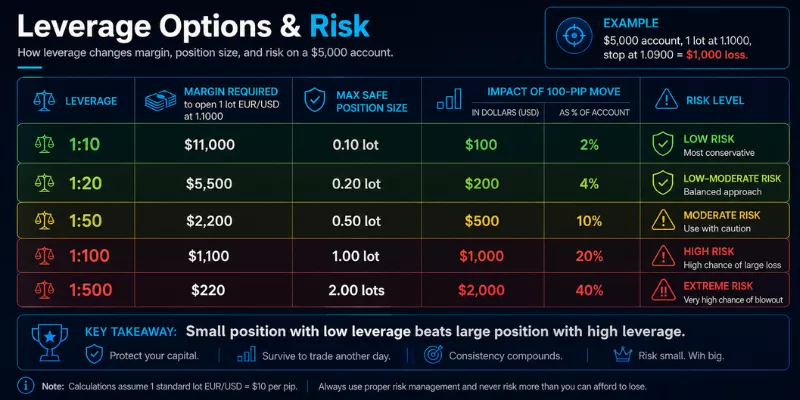
Leverage lets you control large positions with small deposits. 100:1 leverage means $1,000 of margin controls $100,000 of exposure. This sounds amazing until a 1% market move liquidates your account. Leverage is the reason most retail traders lose money, not because they have bad strategy—because they take positions too big for their account size.
Beginners should use low leverage and focus on position sizing instead. 1:10 or 1:20 leverage is safer and forces better risk management. You'll grow your account slower, but you'll still have an account to grow. High leverage (100:1 or higher) lets you take bigger risks and bigger rewards, but the path to blowing up is short.
Why Leverage Feels Necessary
Without leverage, a $1,000 account trading 0.01 lots ($1 per pip) needs a 1,000-pip move to make $1,000 profit. With real prices moving 50-200 pips per day, reaching 1,000-pip moves takes weeks or months. Using 10:1 leverage, you can trade 0.1 lots ($10 per pip) and reach your profit target in days. This speed is psychologically addictive.
The danger is that speed cuts both ways. A 100-pip loss with 10:1 leverage on 0.1 lots is a $100 loss. Take 10 consecutive losing trades and you've lost $1,000 from your $1,000 account. With 0.01 lots and no leverage, the same 100-pip losses cost $10 each; you need 100 losing trades to blow up.
The Right Leverage for Beginners
Start with 1:10 or 1:20 leverage and trade position sizes that feel small. If 0.1 lots feels tiny, that's correct—it should. You're learning, and learning with small positions means mistakes don't destroy your account. As you gain skill and confidence, gradually increase position size, not leverage.
| Leverage Ratio | Account Size | Safe Position Size | 100-pip Move Risk | Account Risk % | Suitable For |
|---|---|---|---|---|---|
| 1:10 | $5,000 | 0.5 lots | $500 | 10% | Beginners, learning |
| 1:20 | $5,000 | 1.0 lots | $1,000 | 20% | Conservative traders |
| 1:50 | $5,000 | 2.0 lots | $2,000 | 40% | Experienced traders |
| 1:100 | $5,000 | 0.5 lots | $500 | 10% | Very experienced, risk-aware |
| 1:500+ | $5,000 | 0.1 lots max | $100 | 2% | Scalpers only, high risk |
Calculate your margin usage before every trade. If your account is $5,000 and a 1-lot EUR/USD position uses 1,000 margin (at 1:100 leverage), you're using 20% of your margin on one trade. A 50-pip move against you is a 5% account loss, which is sustainable. A 10-lot position uses 200% of your margin and doesn't fit—don't force it. Your broker's margin calculator shows how much margin each position requires; use it.
8. Deposit & Withdrawal Methods
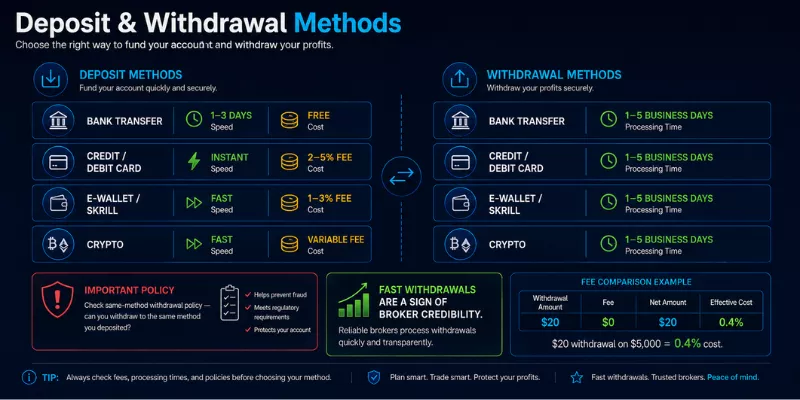
Deposits are usually fast and easy. Withdrawals reveal a broker's character. A transparent broker processes withdrawals quickly (2-5 business days) without asking questions. A problematic broker delays, requests excessive documentation, or finds reasons to hold your money. Withdrawal speed and reliability matter more than deposit speed because your profit is worthless if you can't get it out.
Deposit Methods
Most brokers accept bank transfers, credit/debit cards (Visa, Mastercard), and e-wallets (Skrill, Neteller, PayPal in some regions). Some accept crypto deposits. Card deposits are instant and convenient but carry a 2-5% fee. Bank transfers are free but take 1-3 business days. E-wallets are fast and cheap. Some brokers let you use multiple methods; try a small deposit first to see how the process feels.
Withdrawal Methods and Policies
Check whether the broker allows withdrawal to the same method you deposited from. Some brokers require you to withdraw to the same card or e-wallet you deposited with—which makes sense for AML/compliance but can be inconvenient if your card expired. A few brokers require you to withdraw profits to bank transfer while refunding deposits to your original method; clarify this before funding.
Ask about withdrawal fees. A $20 fee on a $5,000 withdrawal is 0.4%—meaningful. Some brokers charge per method (card withdrawals $20, bank transfer $10, e-wallet free). Others charge a flat percentage. One broker might charge $15 per withdrawal; another might have no fees. These add up to hundreds per year if you withdraw monthly.
Processing time matters too. A broker processing withdrawals in 1 business day is vastly better than one taking 5-7 days. During volatile markets or fast-moving news, having your cash accessible matters. A broker that delays withdrawals is holding your money interest-free while using it—that's a red flag.
Red Flags in Deposit/Withdrawal Policies
Be cautious of brokers that require a minimum withdrawal amount (e.g., $500 minimum) or maximum withdrawal percentage (e.g., withdraw max 50% per month). These restrictions are sometimes used by brokers facing cash flow issues. Legitimate brokers let you withdraw whenever you want without arbitrary limits.
Also watch for "welcome bonuses" that restrict withdrawals. Some brokers give $500 free credit with the condition that you can't withdraw until you've traded it away or met volume requirements. Read the fine print—sometimes the bonus is more restrictive than it seems.
9. Safety of Funds (Segregated Accounts)
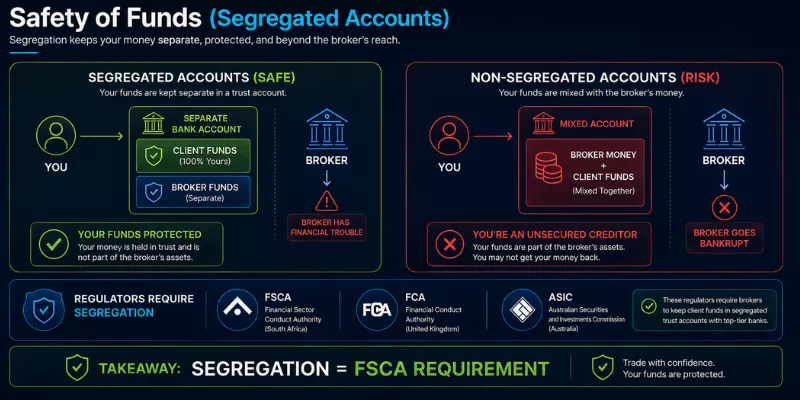
Segregated accounts mean your money sits in a separate bank account from the broker's business money. If the broker runs into financial trouble, your funds are protected—they can't be seized to pay the broker's debts. Non-segregated accounts mix client funds with the broker's operational money. If the broker goes bankrupt, you're an unsecured creditor waiting in line behind employees and major creditors.
Regulation requires segregation in most jurisdictions. FCA-regulated brokers must segregate. ASIC-regulated brokers must segregate. But the regulator and bank holding the money also matter. A broker regulated in a weak jurisdiction and holding your money in a small bank is riskier than a broker regulated in a strong jurisdiction and holding your money in a major bank.
How to Verify Fund Safety
Ask your broker directly: "Are client funds segregated? Which bank holds them?" A confident broker provides this information. Some publish regular segregation reports showing exactly how much client money they're holding and where. Others are vague. Vagueness is a warning sign.
Check the regulatory statement. The FCA publishes information about segregation requirements. ASIC's regulations are online. A broker saying "our funds are segregated" means nothing if their regulator doesn't require it. Verify that the regulator actually mandates segregation and that the broker complies.
Consider using multiple brokers. If you have $50,000 and split it between two regulated brokers, if one fails, you only lose $25,000 instead of everything. This feels paranoid, but it's actually prudent risk management.
10. Execution Speed & Slippage
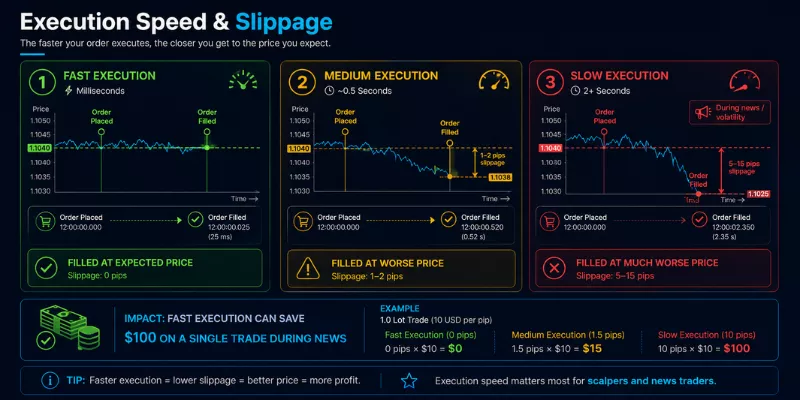
Execution speed is how quickly your order reaches the market and returns a fill price. Fast execution (milliseconds) reduces slippage—the difference between the price you requested and the price you received. Slow execution (seconds) means the market moves while your order is in transit, and you fill at a worse price.
During calm markets, slippage is tiny (1-2 pips). During fast news, slippage can be 5-20 pips or more. A broker with poor execution speed slips more often. A broker with good execution speed and robust servers slips less. This seems minor until you realize that consistent 5-pip slippage on each trade costs as much as 5 pips of profit.
Testing Execution on Demo
On demo, place market orders during volatile times (major news releases, market open) and watch whether your fill price matches what you expected. Some brokers show a requote screen if the price moves while your order processes—they're asking you to confirm a new price. This protects you but slows execution. Other brokers fill silently at whatever price resulted; watch for surprise slips.
Also test stop-losses. If you set a stop at 1.1000 and the market gaps down to 1.0995 during fast news, does the broker close you at 1.1000 (your stop price) or at 1.0995 (the market price)? A guaranteed stop closes at your requested price; a regular stop closes at market price, which might be much worse. Guaranteed stops cost extra; know which you're getting.
Why Execution Matters for Your Trading Style
Day traders and scalpers (who hold for minutes or seconds) are extremely sensitive to execution speed and slippage. A 5-pip slippage on a scalper's target of 10-pip profits means a 50% cut in profit—devastating. Swing traders and position traders holding positions for days or weeks care less because small slippages are noise compared to daily price moves.
If you plan to scalp, choose a broker famous for fast execution. If you plan to swing trade, execution speed is secondary to other factors like commissions and customer support. Different strategies demand different broker priorities.
11. Customer Support Quality
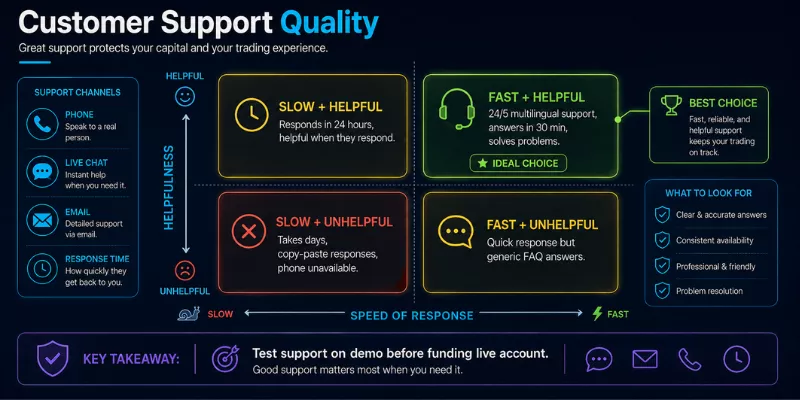
When something breaks—your platform crashes, you can't close a position, you can't log in—you need help immediately. A broker with 24/5 support and responsive staff (answering within 30 minutes) is a lifesaver. A broker with 9-5 support and a 24-hour response time is useless during a crisis on Wednesday evening.
The quality of support staff matters too. A response like "Try clearing your browser cache" is generic but helpful. A response like "Have you tried turning it off and on again?" is frustrating and useless. Good support staff explain the issue clearly and solve it; bad support repeats FAQs and closes your ticket.
What Support Should Cover
Good support can help with account setup, payment questions, technical platform issues, and complaint handling. They won't give trading advice (most brokers are legally prohibited), but they will answer questions about position sizing, margin requirements, and how the platform works. They'll explain why a trade was rejected and help you understand fees on your statement.
Test support before opening a real account. Email a simple question or use the live chat and see how fast and helpful the response is. If the demo support experience is poor, the live account experience will be worse (brokers prioritize live accounts, but if demo support is bad, imagine live support).
Local support matters. If you're in South Africa, having a South African support email or phone number is huge. International brokers with only US-based support might be 12+ hours behind your timezone. An issue at 5 PM SAST won't be seen until 5 AM EST, and the answer won't arrive until 3 PM SAST the next day.
Red Flags in Broker Support
Avoid brokers where you can't reach support by phone or email, only through chat. Avoid brokers that take longer than 24 hours to respond to emails. Avoid brokers that use generic AI responses or copy-paste answers. Good support is a sign of a broker that cares about the business long-term.
12. Education & Learning Resources
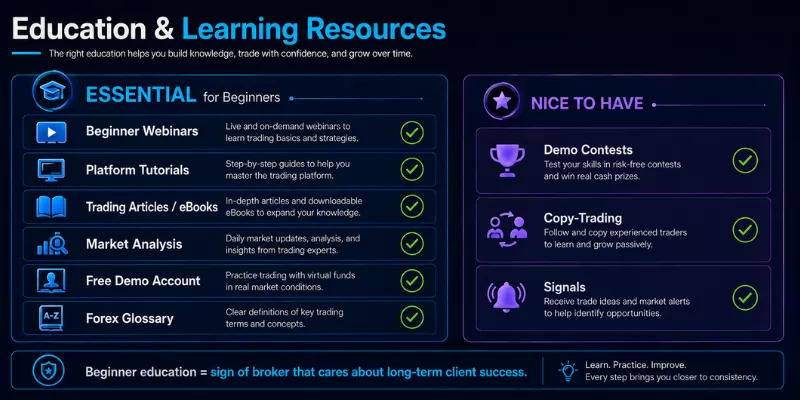
Brokers making money from commissions and spreads can afford to invest in education. They run webinars, publish articles, maintain video libraries, and offer market analysis. These resources are free and actually quite good at better brokers. Beginners benefit enormously from education; it reduces expensive mistakes.
Quality varies widely. A good broker provides:
- Beginner-focused webinars (not just advanced trading strategies)
- Video tutorials on how to use the platform
- Written guides explaining forex basics (pairs, leverage, margin, spreads)
- Daily market analysis or weekly outlook emails
- Free demo accounts for learning without risk
- Glossary of forex terms
Many brokers also offer trading contests (compete for prizes), copy-trading features (automatically copy other traders' positions), or signals (buy/sell recommendations). These can be useful but aren't essential.
What Beginners Actually Need
Don't get overwhelmed by too many resources. A beginner needs: (1) how to use this specific platform, (2) what margin and leverage mean, (3) risk management basics, and (4) simple trading strategies. A broker providing these four things is enough. A broker offering 100 video courses on advanced price action might have great education for experts but can confuse beginners.
Test the broker's education section before opening an account. If their website has no learning resources, that's a red flag. If they have resources but they're outdated (published in 2015) or poorly written, that reflects their quality standard.
13. Available Trading Instruments
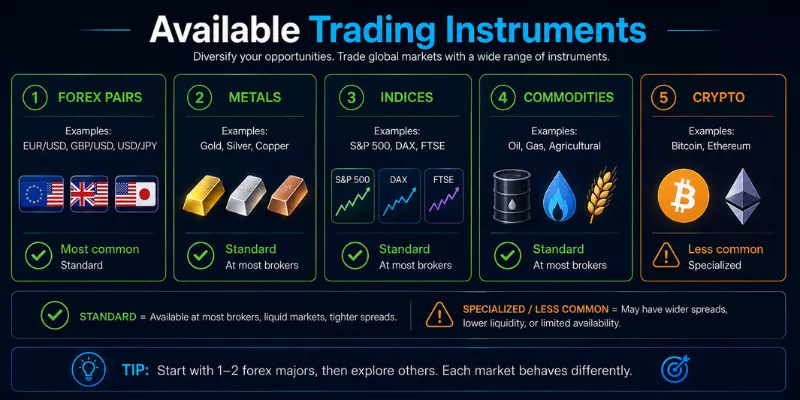
Most brokers offer forex pairs, metals (gold, silver), and indices (S&P 500, DAX, etc.). Some add cryptocurrencies, commodities (oil, gas), and stocks. Check whether the broker offers the markets you want to trade. If you want to trade UK100 (FTSE), make sure they offer it. If you want crypto, check if they do. Not all brokers offer all instruments.
Also check the contract specifications. Does EUR/USD trade in standard 100,000 unit lots? Are there 0.01 micro lots available? Can you trade EUR/USD at 1 AM when London isn't open, or only during liquid hours? Can you short-sell gold, or is it long-only? These details matter for your strategy.
Why Instrument Choice Matters
A trader specializing in gold might choose a broker offering tight spreads on gold (under 0.5 pips). A trader focused on forex pairs might prioritize a broker with good EUR/USD pricing. A diversified trader might want a broker offering everything but accept slightly wider spreads as the trade-off.
Beginners should keep it simple: focus on 1-2 major currency pairs (like EUR/USD and GBP/USD) from one broker before branching out. Once you master those, you can explore additional instruments or brokers specializing in those markets.
14. Bonuses, Promotions & Loyalty Rewards
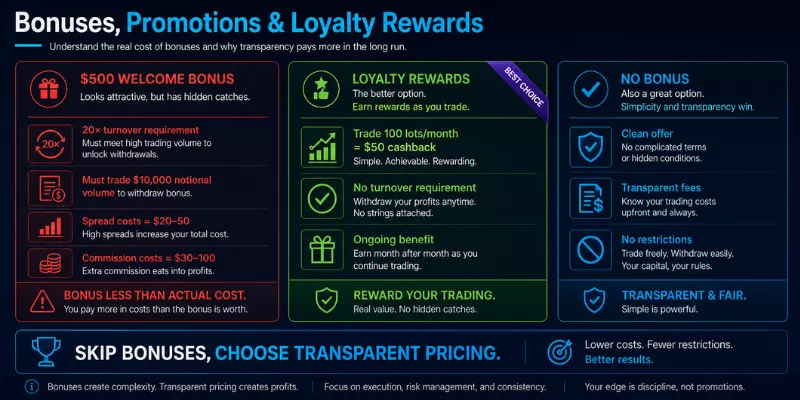
A $500 welcome bonus sounds amazing—double your $500 deposit instantly. The reality: you can't withdraw it immediately. The broker requires you to trade a certain volume (turnover requirement) before you can touch the bonus. Some bonuses require 20x turnover; some require 50x. If you deposit $500 and receive a $500 bonus with 20x turnover, you must trade $20,000 in notional volume before withdrawing.
Trading $20,000 notional volume on a $1,000 account doesn't take long if you scalp, but it takes time if you hold longer-term. During all that trading, you're also paying spreads. The spread cost might exceed the bonus value. Also, bonuses are "use it or lose it"—if you withdraw before meeting the turnover requirement, the bonus disappears.
When Bonuses Make Sense
A bonus makes sense if: (1) the turnover requirement is low (under 10x), (2) you plan to trade actively anyway, (3) you understand the bonus terms fully, and (4) losing the bonus won't upset you if you can't meet the requirement. A bonus that requires 50x turnover on a $500 deposit is essentially punishing you for being undercapitalized. Skip it.
Some brokers offer loyalty rewards instead of sign-up bonuses. Trade 100 lots per month and earn $50 cashback, for example. These are usually better than one-time bonuses because they don't have impossible turnover requirements. You're just getting paid slightly for your business.
Red Flags with Bonuses
Avoid brokers that make bonuses their main selling point. A broker highlighting bonuses over regulation, execution quality, or support is prioritizing recruitment over trader success. The best brokers attract traders with good service, not with free money. Also avoid brokers that restrict bonuses to new traders; if they're not offering loyalty rewards to existing clients, that's a sign they don't value long-term relationships.
15. Reputation & User Reviews
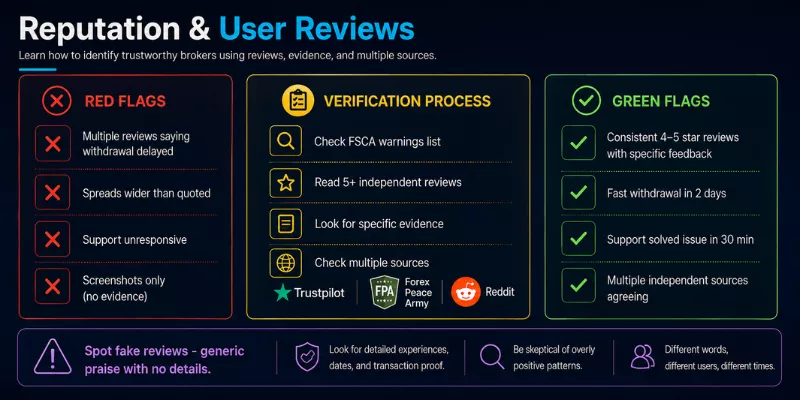
Before opening an account, spend 30 minutes reading trader reviews on independent platforms. Trustpilot, Forex Peace Army, and Reddit show real trader experiences. Pay attention to complaints about withdrawals being delayed, support being unhelpful, and spreads being wider than advertised. These are common red flags that repeat across reviewers.
Also look for broker warnings. The FSCA publishes a list of unregulated brokers operating in South Africa. The FCA publishes warnings about unregulated firms. Search your broker's name plus "scam" or "warning" and see what appears. Some results are fake competitors leaving bad reviews; real patterns will emerge from multiple independent sources.
How to Read Reviews Critically
One bad review doesn't mean anything—traders lose money and sometimes blame the broker unfairly. Multiple reviews saying "couldn't withdraw my money" or "spreads were much wider than quoted" or "customer support never responded" is a pattern. Five-star reviews saying "best broker ever" with no detail are probably fake.
Look for specific complaints with evidence: "I took a screenshot of the spread quoted, and it was 1.5 pips, but I filled at 2.3 pips during news." That's credible and specific. Compare complaints across reviews; if three independent reviewers mention the same issue, it's real.
Conclusion
Choosing the right forex broker isn't glamorous work, but it's some of the most important due diligence you'll do as a trader. A good broker handles the technical side reliably—fast execution, quick withdrawals, responsive support—so you can focus on what matters: improving your trading. A bad broker adds friction to every aspect: slow platform, wide spreads, poor support, delayed withdrawals. Over months of trading, that friction costs thousands.
The broker that floods social media with ads and offers extreme leverage is probably not the one you want. The broker with consistent positive reviews, transparent fees, reasonable leverage limits, and responsive support—even if less glamorous—is usually the better choice. Spend time on demo accounts with 2-3 brokers you're considering. Test the platform, email support, and withdrawal process. Then choose based on your complete experience, not on bonuses or spreads alone.
Remember: the broker is just a tool. The tool doesn't make or break your trading—your strategy and discipline do. But a bad tool sure can make things harder. Start with a good one.
You might also like:
- Best Forex Brokers in South Africa
- FSCA-Regulated Forex Brokers
- Forex Brokers with ZAR Accounts
- Best Forex Trading Tips
Frequently Asked Questions
Why is regulation the most crucial factor when choosing a Forex broker?
Regulation ensures the broker follows strict financial rules, protects client funds in segregated accounts, and operates transparently. A regulated broker reduces risks of fraud, unfair pricing, and withdrawal issues, giving beginners a much safer and more reliable trading environment from the start.
How do spreads and fees affect a trader's profitability?
Spreads and fees determine how much you pay each time you open a trade. Lower spreads reduce trading costs, especially for active traders. Understanding commissions, swap rates, and hidden charges helps you avoid unnecessary expenses and improve your overall long-term profitability.
What trading platforms should beginners look for in a Forex broker?
Beginners should choose brokers offering stable, user-friendly platforms like MT4, MT5, or cTrader. These platforms include essential charting tools, indicators, mobile apps, and automated trading options. A reliable platform improves execution quality and makes learning the markets much easier.
Why is execution speed important when selecting a Forex broker?
Execution speed determines how quickly your trades are filled. Faster execution reduces slippage, improves accuracy, and ensures you receive the price you expect. This is especially important for scalpers and news traders who need smooth, frustration-free trading conditions.
What should I check regarding deposit and withdrawal options?
Check whether the broker offers fast, low-cost, and convenient payment methods like cards, e-wallets, or local transfers. A trustworthy broker processes withdrawals quickly, with clear policies and no hidden fees. Withdrawal reliability is one of the strongest signs of broker credibility.
Why do leverage options matter when choosing a Forex broker?
Leverage determines how much market exposure you control. Higher leverage offers bigger potential profits but significantly increases risk. Beginners should use moderate leverage and choose brokers that provide flexible settings, risk-management tools, and clear explanations of how leverage impacts each trade.
What role does customer support play in choosing a broker?
Good customer support helps beginners resolve technical problems, verify accounts, understand fees, and handle platform issues quickly. Brokers offering 24/5 or 24/7 multilingual support via chat, email, or phone provide a smoother and more secure trading experience, especially during emergencies.
Why should beginners evaluate a broker's available account types?
Different account types cater to different trading styles and budgets. Beginners benefit from standard or cent accounts, which offer low entry costs. ECN accounts suit experienced traders. Choosing the right account ensures lower risk and more suitable trading conditions for your strategy.
How important are educational resources when selecting a Forex broker?
Educational resources help beginners learn faster and make more confident decisions. Brokers offering webinars, tutorials, eBooks, market analysis, and demo accounts provide essential guidance. Quality education reduces costly mistakes and builds a stronger foundation before trading with real money.
Why should I review a broker's reputation before opening an account?
A broker's reputation reflects real trader experiences across withdrawals, customer service, platform reliability, and fairness. Checking reviews on trusted platforms helps you avoid scams and unstable brokers. A strong, positive reputation indicates a safer and more dependable long-term trading partner.
You Might Also Like




Recommended brokers