



A fixed forex spread offers a set difference between the buy and sell prices during the periods covered by your broker’s terms. A variable spread changes with market conditions.
A fixed spread gives you an idea of what each trade will cost, while a variable spread may be cheaper when there is plenty of activity in the market. However, the spread is only part of the expense. Commission, the size of your position and the price at which your order is filled all affect what you pay.
Frequent trades, news announcements, and rand pairs can make small spread differences expensive. A broker's lowest quoted spread says little about what you might pay throughout the day.
In our guide, we look at how both pricing methods work, calculate what you could pay and explain which option makes sense for different trading strategies in South Africa.
What is a forex spread?
When you open a forex trade, you will notice two prices for the same currency pair. One is what you pay to buy, and the other is what you receive when selling. The gap between these prices is called the spread, and it forms part of your trading costs.
When a broker quotes EUR/USD at 1.08490/1.08510, you can sell at the first price or buy at the second. You pay attention to the difference because it forms part of your trading costs. In this example, the spread is 0.00020, equivalent to 2 pips. Here is how you can look at it:
| EUR/USD quote | Hypothetical price |
|---|---|
| Bid (sell) | 1.08490 |
| Ask (buy) | 1.08510 |
| Spread | 2 pips |
Two traders can pay very different amounts for exactly the same EUR/USD spread. A trader buying one standard lot (€100,000) pays USD 20 on a two-pip spread. Someone buying 0.10 lots pays USD 2. Both have the same two-pip gap between the buying and selling price.
Every trade starts with a small disadvantage because the buying and selling prices are different. If you buy and immediately sell before the price changes, you lose the spread. Any commission or difference in execution price could increase that loss.
When you buy, you pay the ask price and sell at the bid price when closing the trade. If you open a sell position, it works the other way around.
For yen pairs, pip conventions differ. The cash amount can also depend on the account currency and contract specification. Check the instrument details on your platform when you calculate a position’s cost.
How do fixed spreads work?
With fixed spreads, the cost of entering a forex trade is easier to calculate because the broker has already set the gap between its buy and sell prices. EUR/USD and GBP/USD are priced individually, and the rates apply during the hours and account conditions stated by the broker.
Imagine a fixed-spread EUR/USD account quoted at 1.5 pips. At one standard lot, the spread expense is USD 15. At 0.10 lots, the same quoted spread equates to USD 1.50. Your initial cost estimate is straightforward because the stated width is known in advance.
Fixed spreads can be appealing to you when:
- You trade regularly: A familiar quoted spread makes it easier to calculate the cost of repeated entries and exits.
- You prefer predictable costs: A set width helps with trade plans during the broker’s specified hours.
- You monitor several currency pairs: Published fixed quotes offer a consistent reference for the pairs covered by the account.
Fixed spreads can be more expensive, particularly when market activity is high, and variable spreads narrow. Paying 1.5 pips instead of 0.6 pips on 20 standard-lot trades would mean an extra USD 180 in spread costs, assuming identical execution. Commission charges would still need to be considered.
You may know the spread before placing a trade, but the final execution price can still differ from what you requested. Brokers have their own rules for handling orders, including price changes, requotes, and rejections.
Fixed spreads may also be restricted to particular trading sessions, as explained in the broker's terms.
Fixed vs Variable Spreads: Quick Answer
Fixed spreads offer more predictable quoted costs under a broker’s stated conditions. Variable spreads can be narrower during liquid market sessions, but may widen during volatility. The cheaper choice depends on the spread, commission, execution and the currency pair you trade.
| Feature | Fixed Spread | Variable Spread |
|---|---|---|
| Pricing | Predetermined under specified terms | Changes with market conditions |
| Cost planning | Easier to estimate | Depends on typical session quotes |
| Active sessions | May cost more than variable quotes | Can narrow when liquidity improves |
| Major news | Execution restrictions may apply | May widen sharply |
| Always cheapest? | No | No |
On This Page
- What is a forex spread?
- How do fixed spreads work?
- How do variable spreads work?
- Fixed vs variable spreads: Key differences
- Fixed vs variable spreads: Which costs less?
- Which spread is suitable for your trading style?
- How should South African traders compare forex brokers?
- How do you check a broker’s typical spread against its minimum spread?
- What happens to your spread and stop-loss during volatility?
- Final verdict: Fixed or variable spreads?
- Frequently Asked Questions
How do variable spreads work?
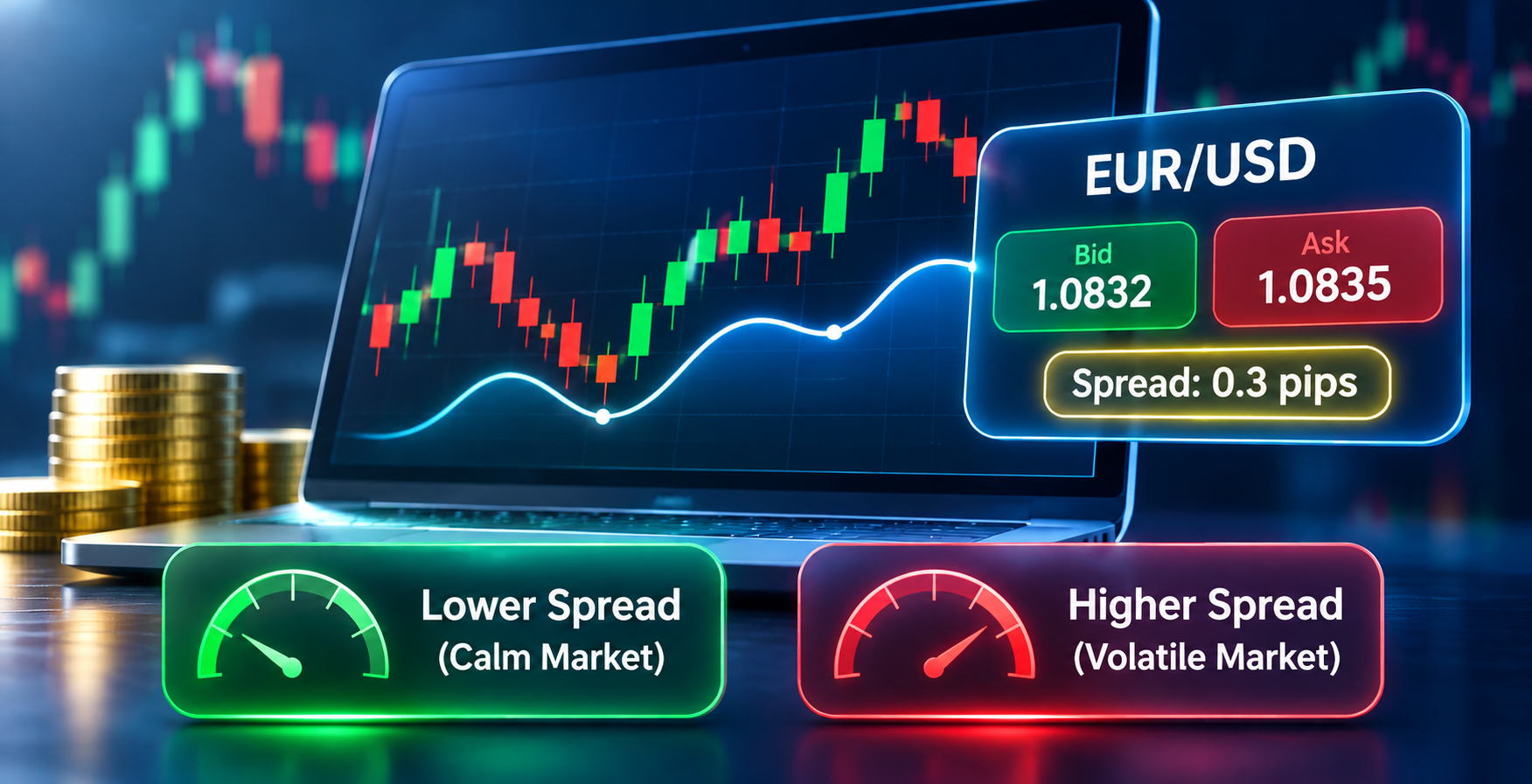
The spread on a variable spread account is not fixed beforehand. It can become narrower when there is plenty of buying and selling activity in the forex market. During slower sessions, or when currency prices change unexpectedly, the difference between the two quoted prices can increase.
Trading EUR/USD during the London and New York sessions may mean paying a smaller spread than during less active hours.
An announcement on US interest rates or inflation can cause abrupt price moves and wider quotes. Your variable spread can change within seconds, even when your trade size is unchanged.
You may prefer variable spreads if:
- You mainly buy and sell popular currencies, where high trading volumes can bring the buying and selling prices closer together.
- You have certain hours when you prefer to trade, making it easier to see what your usual spread costs are.
- You would rather have the opportunity to pay a smaller spread than pay a fixed rate throughout the trading session.
A broker might advertise variable spreads from 0.0 or 0.2 pips. The word “from” refers to a possible minimum, not a typical transaction. Check the average quoted spread over a disclosed measurement period and the commission attached to the same account.
Standard and smaller contract sizes do not necessarily have identical spreads. Before choosing an account, look at the pricing for the instruments you plan to trade and the hours you prefer. The broker's lowest published rate may only be available under particular market conditions.
Fixed vs variable spreads: Key differences
Whichever spread type you choose, the difference between the buying and selling prices forms part of your trading costs. What changes is how the spread is priced and how much you may pay when placing an order.
| Factor | Fixed spread | Variable spread |
|---|---|---|
| Quoted width | Predetermined under specified terms | Changes with market conditions |
| Liquid sessions | Can exceed the available variable quote | Can narrow when liquidity improves |
| Economic announcements | Execution terms and restrictions still apply | Can widen sharply |
| Commissions | Depend on the account | Depend on the account |
| Order execution | Requotes or slippage are possible | Slippage and price changes are possible |
| Cost planning | Easier estimate of the quoted spread | Estimate depends on observed quotes |
Fixed spreads make it easier to work out trading expenses beforehand, provided the broker's conditions apply. Variable spreads can be cheaper when the forex market has plenty of liquidity, and buying and selling prices are closer together.
The distinction is important during active trading. A trader who places 30 positions in a week can spend a substantial amount on spreads even when each trade lasts a short time.
If you open two positions and hold each one for several days, overnight finance charges become another consideration.
Neither pricing model identifies the quality of the broker’s execution. What a broker quotes and what you eventually pay can differ.
The spread is part of the calculation, but commission and the price at which your trade is completed also affect your expenses. The broker's account agreement and execution terms provide relevant information.
Fixed vs variable spreads: Which costs less?

Calculate the spread expense using the size of your position, then include the account commission. For a standard EUR/USD lot, one pip equals USD 10 under the usual contract specification.
- Spread expense = Spread in pips × Cash amount per pip
- Transaction expense = Spread expense + Round-trip commission
The calculations are illustrative, excluding slippage, financing and currency conversion charges.
Example: One EUR/USD trade
Assume you open and close one standard EUR/USD lot. The fixed account has a 1.5-pip spread and no separate commission. The variable account charges USD 7 in total for entry and exit. The spread on the variable account changes between two market conditions.
| Market condition | Account | Spread | Spread expense | Commission | Total expense |
|---|---|---|---|---|---|
| Calm | Fixed | 1.5 pips | $15 | $0 | $15 |
| Calm | Variable | 0.6 pips | $6 | $7 | $13 |
| Volatile | Fixed | 1.5 pips | $15 | $0 | $15 |
| Volatile | Variable | 3.0 pips | $30 | $7 | $37 |
In the calm market example, the variable account costs USD 13 against USD 15 for the fixed account. During the volatile example, the variable expense increases to USD 37.
The fixed figures assume that the quoted width is available and that the position executes at the intended prices. Actual trades can produce a different result.
Trading 0.10 lots of EUR/USD with a 1.5-pip spread would cost USD 1.50 in spread charges. Commission is another consideration, as brokers may calculate fees differently for positions below one standard lot. Some also charge a minimum amount per transaction.
Costs beyond the spread
When a broker lists commission at USD 3.50 per side, double it to see what opening and closing a standard lot costs. In this case, the full commission is USD 7. Another broker might show the USD 7 figure from the start, while some base the fee on how many currency units you trade.
Your final trade price can change through slippage, and overnight trades may attract financing costs.
A ZAR account can also face currency conversion charges when the broker calculates a transaction in US dollars or another foreign currency. The financing adjustment can be a credit in certain circumstances, subject to the instrument and account terms.
A tight spread can look like the cheaper deal, but the full trading cost is the figure to compare. Use the same trade size and contract terms for each broker, otherwise you are comparing different trades and the numbers tell you very little.
Which spread is suitable for your trading style?

Your typical trade duration and preferred market session help determine the suitable spread model. Frequent entries place greater emphasis on transaction expenses; longer positions can place greater emphasis on financing and price risk.
| Trading style | Possible preference | Main cost to examine |
|---|---|---|
| Beginner | Fixed quote for predictable estimates | Spread and execution policy |
| Scalper | Variable during liquid sessions | Spread, commission, and slippage |
| Day trader | Either, based on actual trade hours | Typical session spread and total fees |
| News trader | Neither offers a universal advantage | Spread widening and order execution |
| Swing trader | Either, based on account terms | Spread and overnight financing |
For an EUR/USD scalper, half a pip is not a small difference. On a standard lot, 0.5 pips works out to USD 5 on every completed trade, and commission still needs to be paid on top of that.
Across 15 completed trades, that becomes USD 75 under identical spread assumptions. Frequent traders therefore pay close regard to typical spreads, not merely the minimum displayed in an advert.
Day traders should consider the hours of trade. A variable account can provide narrow quotes during active market sessions and noticeably wider quotes during quiet periods. Fixed pricing can make initial estimates more predictable, subject to the broker’s fixed-spread hours.
News traders face another concern. Order execution and stop-loss prices can change during sudden market moves, whatever the advertised spread arrangement.
If you hold positions for days, include financing expenses in the comparison. A small saving on the initial spread can be outweighed by several nights of financing.
Use a demo account to practise the numbers, especially if spreads and commission are still new to you. Bear in mind that an order placed on a live account may not be filled at exactly the same price as a demo order.
Before choosing an account, work out what your preferred pairs would cost during the hours you expect to trade.
How should South African traders compare forex brokers?
Start your cost comparison with the forex pairs that are likely to appear in your own trades. EUR/USD pricing is not much help when most of your trading is in USD/ZAR. Compare the spread and commission on those pairs, then check the account currency and how the broker handles orders.
The FSCA has an online search for authorised financial services providers. Search for the legal entity in your client agreement and verify the FSP number and services covered by the authorisation.
A broker brand can involve more than one legal entity. For an OTC derivative, check the identity and regulatory status of the actual product provider as well as the intermediary.
Take these four actions when you compare accounts:
- Check the entity and licence. Match the legal name in your agreement with the FSCA record and confirm the relevant authorisation.
- Compare one pair at a time. Check the fixed and variable spreads for EUR/USD or USD/ZAR on the account you plan to use.
- Calculate the complete transaction. Add entry and exit commissions, the cash cost of the spread, and applicable conversion or financing charges.
- Read the execution policy. Check what happens to your orders during price gaps, slippage and major economic announcements.
Fixed and variable accounts price forex trades differently, and each option has areas where it may work in your favour and others where it may cost you more.
Fixed vs variable spreads pros and cons
| Pros | Cons |
|---|---|
| Fixed spreads simplify estimates of initial transaction expenses. | Fixed quotes can exceed variable quotes during liquid sessions. |
| Variable spreads can narrow during active market hours. | Variable spreads can widen during major economic announcements. |
| Commission schedules allow you to calculate total trade costs. | Commission charges can cancel out a narrow spread. |
| ZAR-denominated accounts can simplify rand-based account reports. | Conversion charges can still apply to foreign-currency transactions. |
You can compare forex brokers on SA Shares and review the account terms offered to South African clients. Pay close regard to the legal entity that provides your account, especially where a broker group has both local and offshore companies.
How do you check a broker’s typical spread against its minimum spread?
A minimum spread shows the narrowest quote that a broker advertises for an account or currency pair. It can appear during a short period of favourable liquidity.
A typical or average spread describes quoted prices across a defined sample. Enquire about the measurement period and check whether the data cover the hours in which you trade.
Suppose the EUR/USD quotes available to you at five observation times show spreads of 0.5, 0.7, 0.9, 1.2, and 2.2 pips. The arithmetic average is 1.1 pips, despite a minimum of 0.5 pips. The example is hypothetical.
Using five observations makes the calculation easier to follow, although future costs could look very different.
One spread check tells you very little. Use the same forex pair and trade size on every account and take readings at the same times over several trading sessions. Note when major economic news is due and when rollover takes place; otherwise, an unusually wide spread could give you the wrong impression.
South Africa does not change clocks during the year, but London and New York do. Their forex session times therefore change in SAST at certain points of the year.
A one-week record can highlight differences between accounts, but it cannot establish a long-term average or execution standard. Check the broker’s average spread statistics alongside your observations.
When you have actual transaction records, compare the expected quote against the execution price as a separate exercise.
The account with the smallest minimum spread might still have a higher average spread during your chosen hours. Your recorded quotes, the broker’s commission terms, and actual order outcomes provide a firmer basis for your decision.
What happens to your spread and stop-loss during volatility?
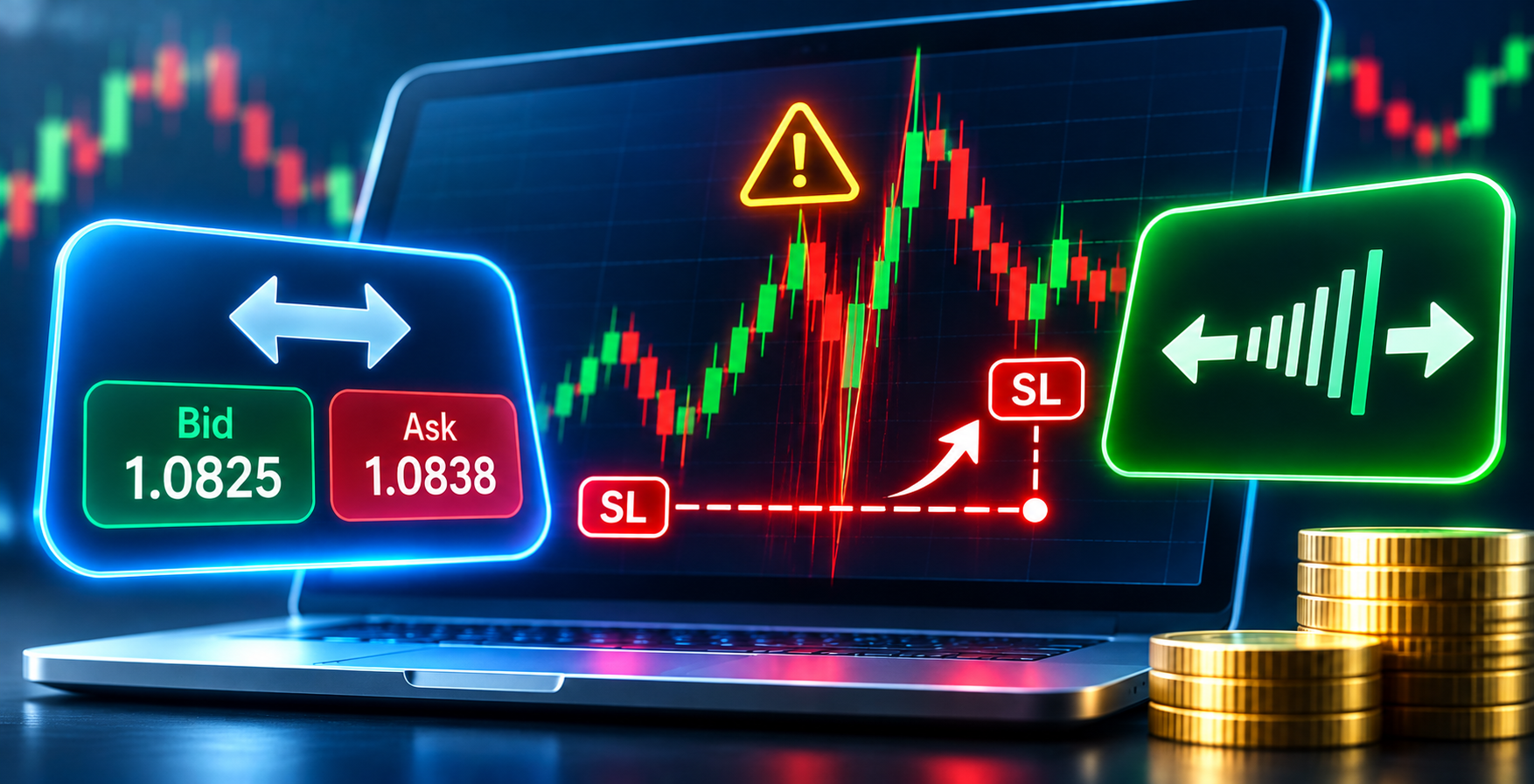
A spread can widen when market prices move sharply or when fewer counterparties offer quotes. The effect extends beyond the transaction expense on a new order. It can also change the price at which an open position closes.
A long EUR/USD position closes at the bid price. A short position closes at the ask price. If the bid and ask move farther apart, the price relevant to your exit can move against you even when the midpoint between the quotes changes very little.
The platform’s stop-trigger rules determine exactly when an order activates.
Consider a hypothetical EUR/USD market with a bid of 1.10000 and an ask of 1.10010, a one-pip spread. If the bid moves to 1.09970 while the ask stays at 1.10010, the spread becomes four pips.
A long position now has a bid exit quote three pips below the original bid. A sell stop tied to that bid could activate if the specified trigger level is reached.
Stop-loss orders also face execution risk. A standard stop generally becomes an instruction to transact when its trigger is met, and a volatile market can produce a fill beyond the stop level. Check whether your broker offers a guaranteed stop, what fee applies, and which instruments qualify.
A fixed-spread arrangement reduces uncertainty about the quoted gap under its terms, but sharp moves can still affect fills, requotes, and order acceptance.
Before you trade major announcements, inspect the order policy for your account and calculate the financial effect of a wider spread on your normal trade size.
Conclusion
Choose a fixed spread if you prefer predictable quoted transaction costs during the broker’s specified periods. Choose a variable spread if the quotes available during your normal sessions, together with commission and execution, produce lower expenses.
A spread comparison becomes is meaningful when you calculate the cash expense for your usual position size and currency pair. Include the broker’s conditions during volatile markets since the quoted gap can affect both entries and exits.
Frequently asked questions
Are fixed spreads always cheaper than variable spreads?
Fixed spreads can cost more than variable spreads during liquid periods. The result depends on the account’s quoted width, commission, and execution conditions. Compare the total cost of a completed transaction on the same pair and position size. An attractive fixed quote is worthwhile when its actual expense matches your strategy.
Can fixed spreads change during major forex news?
A broker can offer fixed spreads during specified hours or under defined conditions. Economic announcements can also affect order acceptance, execution prices, and available liquidity. Review the pricing schedule and the broker’s execution policy before placing an order near a major release. The spread terms determine the quoted width.
Are variable spreads suitable for scalping?
Variable spreads can be suitable for scalping when your normal session offers narrow quotes and competitive execution. Include the per-side commission in every cost calculation. A fraction of a pip becomes significant across repeated positions, especially if slippage increases the expense. Monitor typical costs for your trade times.
Do zero-spread forex accounts have transaction fees?
A zero-spread account can charge commission on the entry and exit of each trade. The advertised zero figure can also describe a minimum quote instead of a price available throughout the session. Check the typical spread, minimum commission, and contract size to calculate the actual expense for your position.
How do USD/ZAR spreads differ from EUR/USD spreads?
USD/ZAR generally has wider quoted spreads than EUR/USD because liquidity differs between the pairs. Their quote currencies also change the cash amount of a pip. Check the broker’s instrument specification and position size, then calculate the spread expense in rand. Compare monetary costs, not pip figures in isolation.
How can I verify a forex broker in South Africa?
Check the financial services provider on the FSCA’s official register. Match the legal entity and licence number to your client agreement, and inspect the categories of authorised services. If another entity provides the forex product, establish its regulatory status separately. Authorisation cannot protect a leveraged position against market losses.
You Might Also Like




Recommended brokers