
Money can leave a crypto exchange within minutes or take several business days, based on whether the withdrawal leaves as ZAR or cryptocurrency. Bank cut-off periods, RTC limits, security controls, and blockchain confirmation can each extend the final receipt time.
Crypto withdrawal times in South Africa differ noticeably across Luno, VALR, AltCoinTrader, OVEX, and Cape Crypto. ZAR withdrawals depend on the exchange release schedule and the recipient bank, while Bitcoin withdrawals add network confirmation after the exchange releases the transaction.
You must separate those stages when comparing exchanges because the exchange does not control the final arrival time.
Are crypto withdrawal fees fixed in South Africa?
Not always. Some exchanges charge a fixed Bitcoin withdrawal fee, while others use dynamic fees that change with network conditions. Always check the final withdrawal screen before confirming the transaction.

🏆10 Best Forex Brokers in South Africa
| Rank | Broker | Broker Review | Regulators | Minimum Deposit | Visit Broker |
|---|---|---|---|---|---|
| 🥇 |  | Read Review | ASIC, FSA, CBI, BVI, FSCA, FRSA, CySEC, ISA, JFSA | $100 | Visit Now |
| 🥈 |  | Read Review | FSCA, FCA, DFSA, FSA, CMA | $0 | Visit Now |
| 🥉 |  | Read Review | FSCA, FSC, CYSEC, DFSA, CMA, FSC, FSA | $5 | Visit Now |
| 4 |  | Read Review | ASIC, CySEC, FSA, SCB | $0 | Visit Now |
| 5 |  | Read Review | BVI FSC | $0 | Visit Now |
| 6 |  | Read Review | FSA, FSC, FSCA, ASIC, CMA | $20 | Visit Now |
| 7 |  | Read Review | Exness is a globally regulated broker, holding multiple licenses from respected financial regulators around the world. | $10 | Visit Now |
| 8 |  | Read Review | ASIC, CySEC, FSCA, FSA, FSC, CMA | $100 | Visit Now |
| 9 |  | Read Review | FSC | $10 | Visit Now |
| 10 |  | Read Review | FSA, CySEC, FSCA, FSC | $10 | Visit Now |


What happens if I use the wrong crypto network when withdrawing?
Using the wrong blockchain network can delay the transfer or, in some cases, cause permanent loss of funds. Always make sure the network selected on the exchange matches the network supported by the receiving wallet.
Withdrawal times and fees across five top exchanges for South Africans
The table below compares the main ZAR route, bank settlement expectation, Bitcoin timing, and withdrawal charge for each exchange. Fees can change, while crypto charges can react to network demand; the confirmation screen provides the final fee before approval.
| Exchange | ZAR processing | Expected bank arrival | ZAR fee | Bitcoin processing | Bitcoin fee | Main timing caveat |
|---|---|---|---|---|---|---|
| Luno | Paid RTC route below R250,000 is available 24/7 | Same day; Standard Bank can reflect in about 15 minutes during its weekday and Saturday window | Normal R0; paid RTC R20; non-RTC R80 | Target release for 99% of sends is under 1 minute | Dynamic | Bank route and blockchain confirmation |
| VALR | Paid RTC withdrawals below R250,000 can process 24/7 except Sundays and South African holidays | RTC bank transfer follows automated release; regular withdrawals take 1 to 2 business days | First 30 regular withdrawals per month R0 for individuals, then R8.50; paid RTC R30 | External transfer follows authorisation, security, compliance, and wallet controls | Variable; displayed before approval | Bank fraud review can add up to 2 hours |
| AltCoinTrader | Standard batches at 09:00, 13:00, and 16:00 on business days; paid route below R250,000 every 5 to 15 minutes | Paid route can take up to 24 hours; other-bank transfers can take up to 72 hours | R16 plus 0.5%, with the percentage portion capped at R95; paid route costs an extra R60 or R140 | Crypto release follows security approval and network selection | 0.00012 BTC | Bank, security, and network delays |
| OVEX | Weekday batch schedule applies | Bank latency can extend receipt to 2 business days | R60; R100 minimum withdrawal | No scheduled crypto batch; security review can extend exchange processing to 3 hours | 0.00015 BTC | Two live ZAR schedule entries differ |
| Cape Crypto | One weekday batch in the 15:00 to 16:00 period | 24 to 48 hours under standard South African bank settlement | R8.50 regular; R50 paid RTC route | No scheduled crypto batch after security conditions are met | Dynamic; fee page displays 0.0005 BTC as the on-chain reference | Identity, 2FA, bank settlement, and network confirmation |
The table shows why a single “withdrawal time” can be misleading. Exchange release and final receipt are separate events. ZAR can leave the exchange before the bank credits the account, while Bitcoin can appear on-chain before the destination wallet credits the balance.
What a fair withdrawal comparison should measure
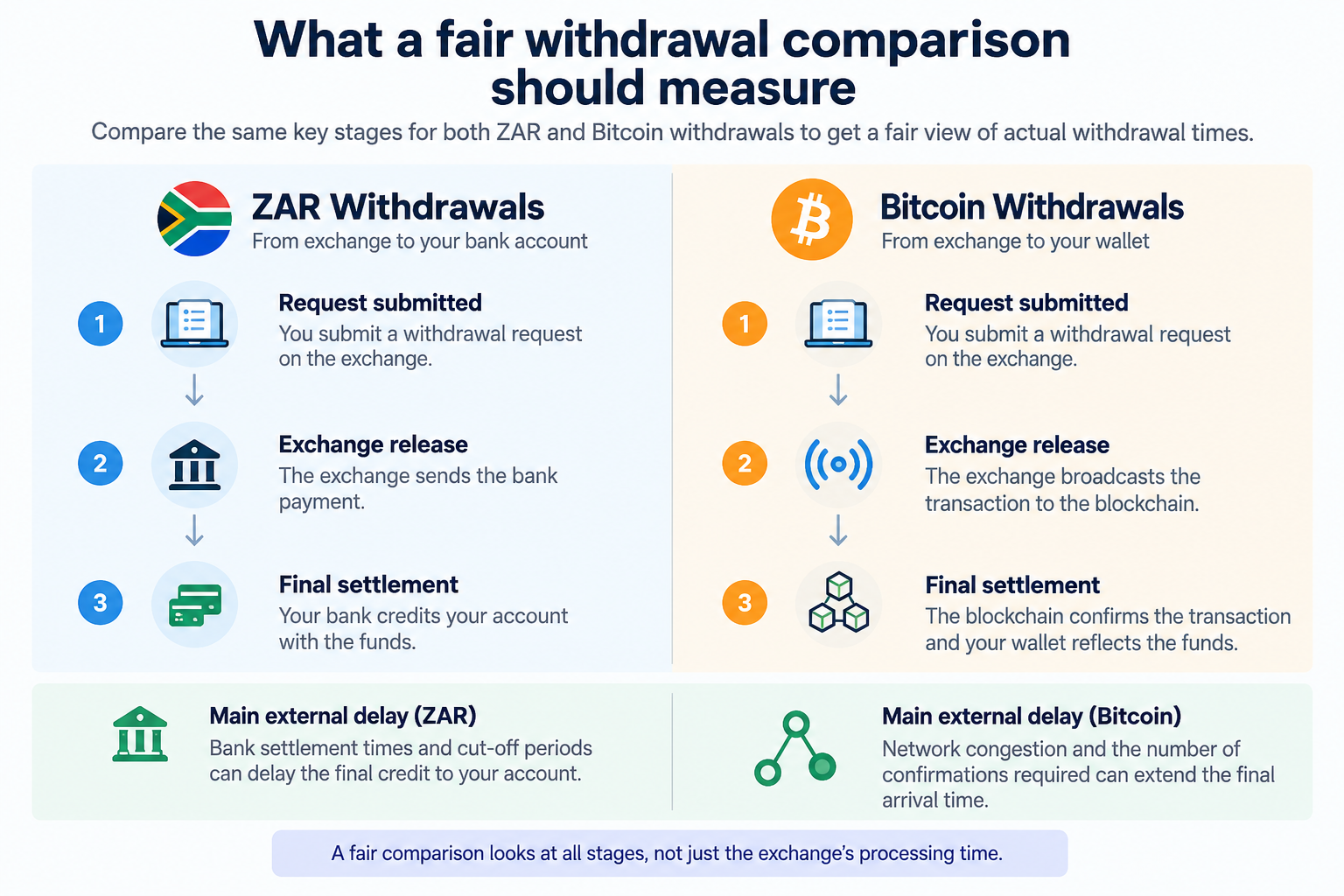
ZAR timing has three checkpoints, namely withdrawal request, exchange release, and bank credit.
Bitcoin has three equivalent checkpoints, namely withdrawal request, first transaction ID, and first blockchain confirmation. These records identify whether a delay began at the exchange, bank, or blockchain stage.
A Bitcoin transaction ID confirms that the transfer is visible on-chain. The destination wallet can still wait for one or more confirmations before credit, but the exchange-release stage has ended.
Account security can distort a comparison when verification is incomplete. A new bank account, crypto address, password change, compliance review, or incomplete beneficiary information can delay release.
| Withdrawal Stage | ZAR Withdrawal | Bitcoin Withdrawal | What It Tells You |
|---|---|---|---|
| Request submitted | Withdrawal requested | Withdrawal requested | When the process officially started |
| Exchange release | Exchange sends the bank payment | Exchange broadcasts the transaction | Whether the exchange has finished processing |
| Final settlement | Bank credits your account | Blockchain confirms the transaction | When the funds have actually arrived |
| Main external delay | Bank settlement and cut-off times | Network congestion and confirmations | Delays outside the exchange’s direct control |
Luno withdrawal times
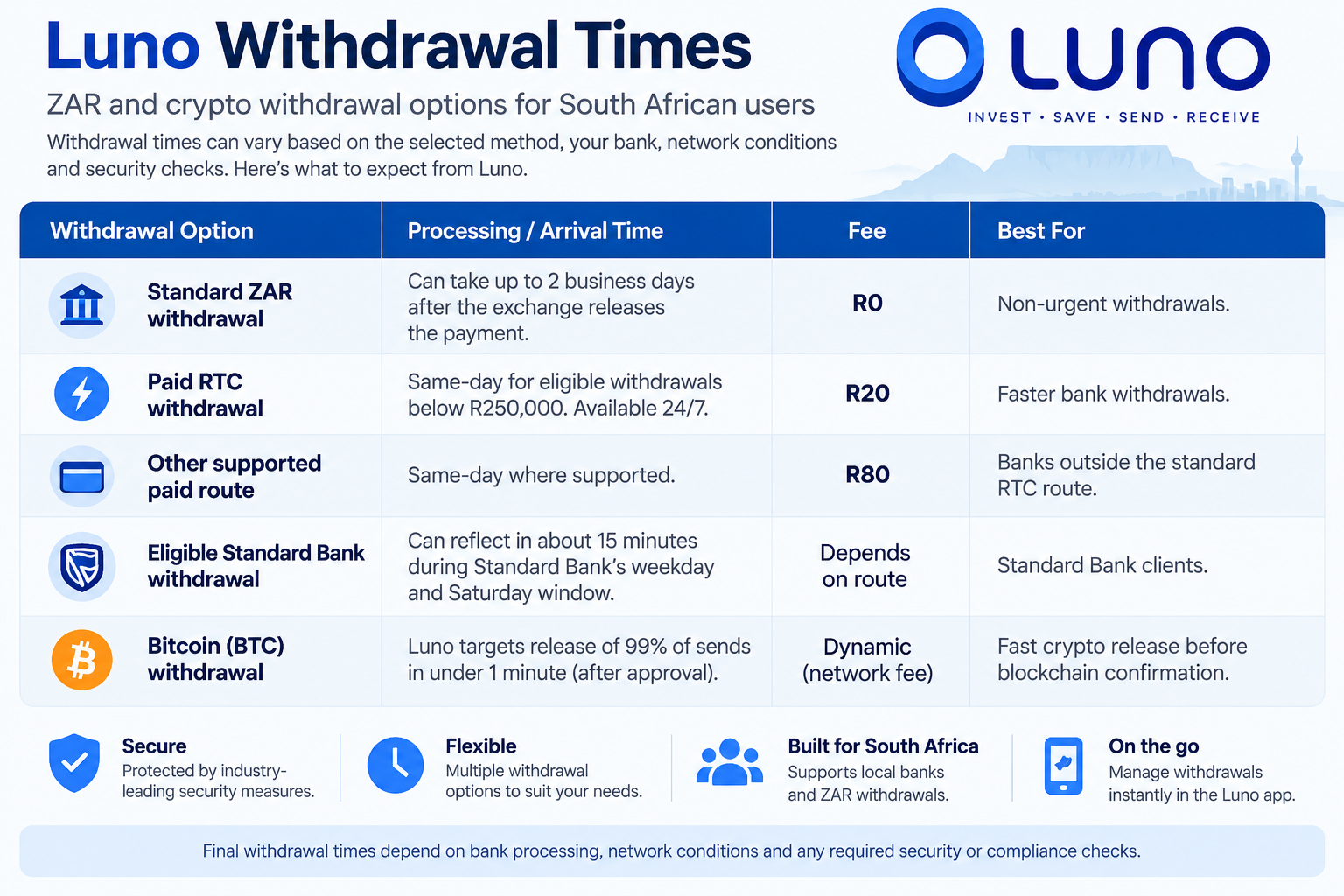
Luno gives South African clients a free normal ZAR withdrawal and a paid RTC route. Normal withdrawals can take up to 2 business days after release.
Paid RTC withdrawals below R250,000 are processed 24/7 and are due in the bank account on the same day. The charge is R20 for an RTC bank and R80 for another supported bank.
Standard Bank clients have a different path because Luno banks with Standard Bank. Eligible withdrawals can reflect in about 15 minutes between 08:00 and 17:45 from Monday to Saturday.
A Standard Bank result should not become a benchmark for another bank because interbank settlement changes the route.
Bitcoin leaves under a separate process. Luno targets release of 99% of crypto sends in under 1 minute. Blockchain confirmation then depends on Bitcoin network conditions.
Crypto send fees are dynamic and appear before final approval, while account security controls can delay a send before broadcast.
| Luno Withdrawal Route | Processing / Arrival | Fee | Best For |
|---|---|---|---|
| Normal ZAR withdrawal | Can take up to 2 business days after release | R0 | Non-urgent withdrawals |
| RTC withdrawal | Same-day for eligible withdrawals below R250,000 | R20 for RTC bank | Faster bank withdrawals |
| Other supported paid route | Same-day where supported | R80 | Banks outside the standard RTC route |
| Eligible Standard Bank withdrawal | Around 15 minutes during the available window | Depends on route | Standard Bank clients |
| Bitcoin withdrawal | Luno targets release of 99% of sends in under 1 minute | Dynamic | Fast crypto release before blockchain confirmation |
VALR withdrawal times
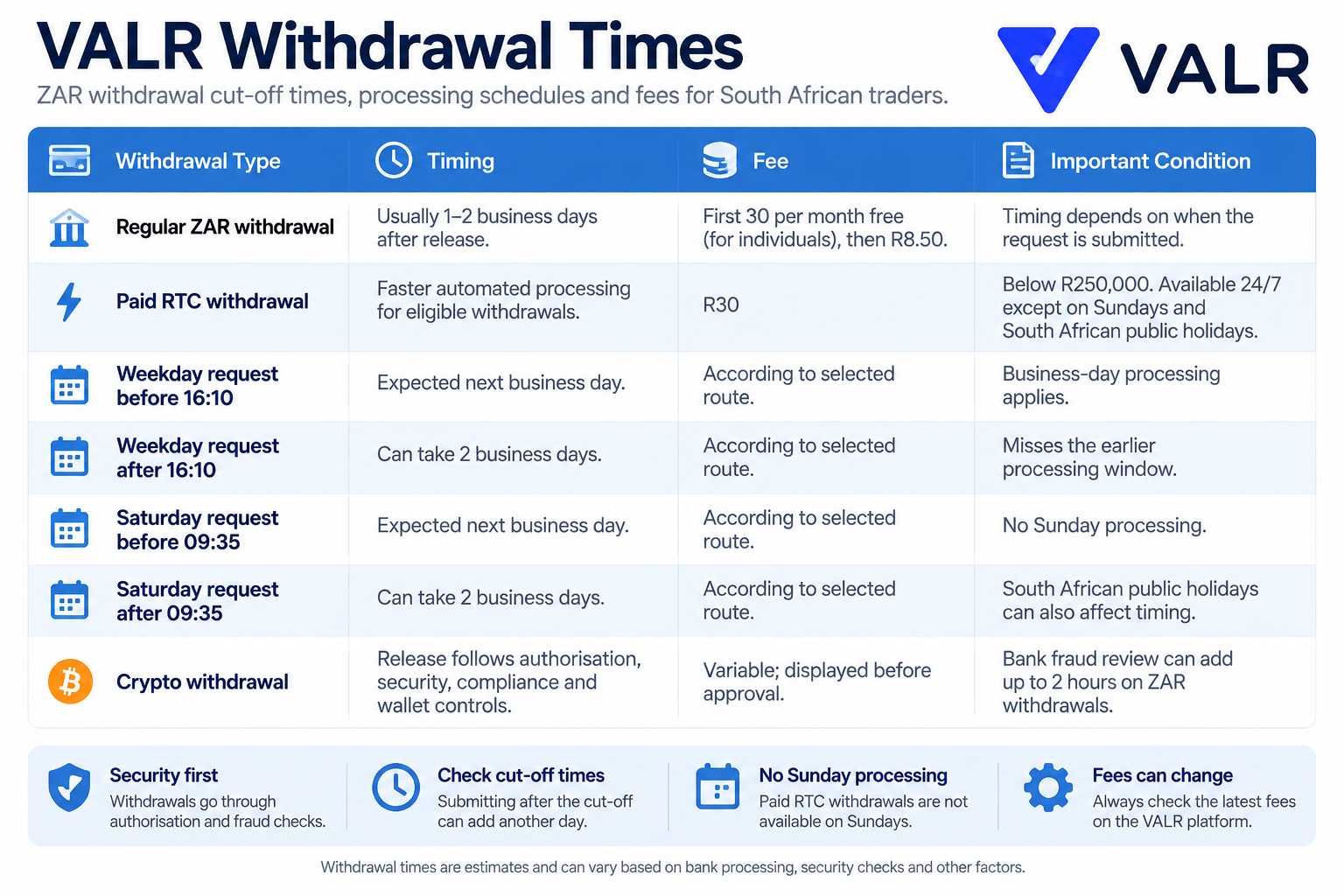
VALR supports regular ZAR withdrawals and a paid RTC route through Blitz processing. An eligible paid RTC withdrawal below R250,000 can process from Monday to Saturday, with no processing on Sundays or South African holidays.
Standard Bank withdrawals follow the same automated bank route during the available period.
Regular withdrawals take longer. A weekday request before 16:10 is expected on the next business day, while a later request can take 2 business days. A Saturday request before 09:35 is expected on the next business day, while a later Saturday request can take 2 business days.
Individual accounts receive 30 free regular ZAR withdrawals per calendar month, after which the fee is R8.50. The paid RTC route costs R30.
Crypto withdrawal fees vary and appear before approval. A fixed Bitcoin release time is not promised because external transfers also face authorisation, recipient data, security, cold storage, and blockchain conditions.
| Withdrawal Type | Timing | Fee | Important Condition |
|---|---|---|---|
| Regular ZAR withdrawal | Usually 1–2 business days | First 30 per month free, then R8.50 | Timing depends on request cut-off |
| Paid RTC withdrawal | Automated faster processing | R30 | Below R250,000 |
| Weekday request before 16:10 | Expected next business day | According to selected route | Business-day processing applies |
| Weekday request after 16:10 | Can take 2 business days | According to selected route | Misses the earlier processing window |
| Saturday request before 09:35 | Expected next business day | According to selected route | No Sunday processing |
| Saturday request after 09:35 | Can take 2 business days | According to selected route | South African holidays can also affect timing |
AltCoinTrader withdrawal times
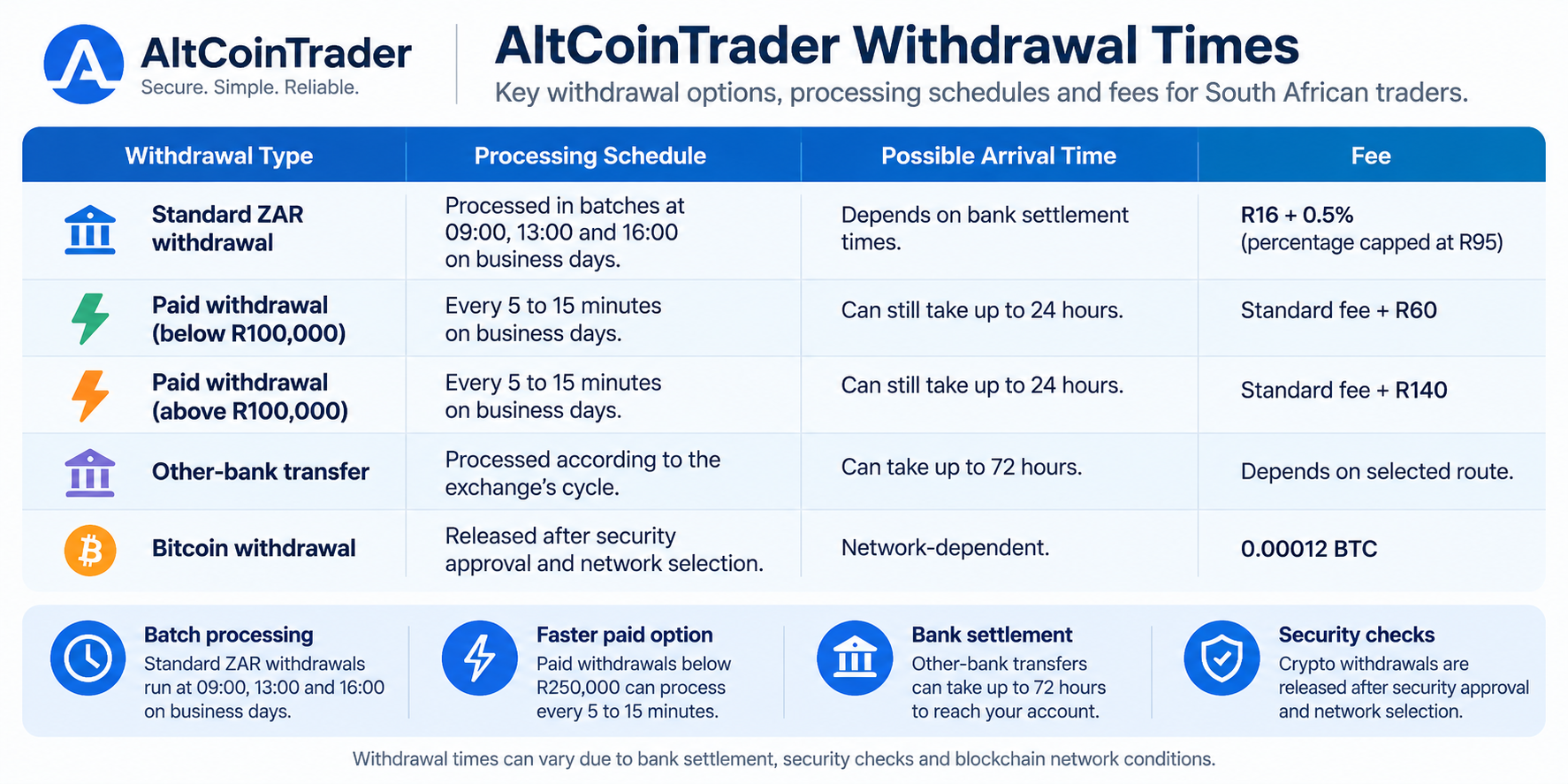
AltCoinTrader processes standard ZAR withdrawals at 09:00, 13:00, and 16:00 from Monday to Friday. Standard requests are not processed on Saturdays, Sundays, or South African holidays. A request not confirmed before 15:00 is not processed until the next business day.
A paid bank route handles eligible withdrawals below R250,000 every 5 to 15 minutes. Bank settlement can still extend receipt to 24 hours, while a transfer to another bank can take up to 72 hours in some cases.
The normal fee is R16 plus 0.5%, with the percentage component capped at R95. The paid route costs an extra R60 below R100,000 or R140 above R100,000.
Bitcoin withdrawals require account verification, the correct network, the correct wallet address, and final security approval. The current BTC withdrawal charge is 0.00012 BTC. A password or bank-detail change can also trigger a 24-hour security hold on certain withdrawal functions.
| Withdrawal Route | Processing Schedule | Possible Arrival Time | Fee |
|---|---|---|---|
| Standard ZAR | 09:00, 13:00 and 16:00 on business days | Depends on bank settlement | R16 + 0.5%, percentage capped at R95 |
| Paid withdrawal below R100,000 | Every 5–15 minutes | Can still take up to 24 hours | Standard fee + R60 |
| Paid withdrawal above R100,000 | Every 5–15 minutes | Can still take up to 24 hours | Standard fee + R140 |
| Other-bank transfer | Depends on processing cycle | Can take up to 72 hours | Depends on selected route |
| Bitcoin withdrawal | After security approval | Network-dependent | 0.00012 BTC |
OVEX withdrawal times
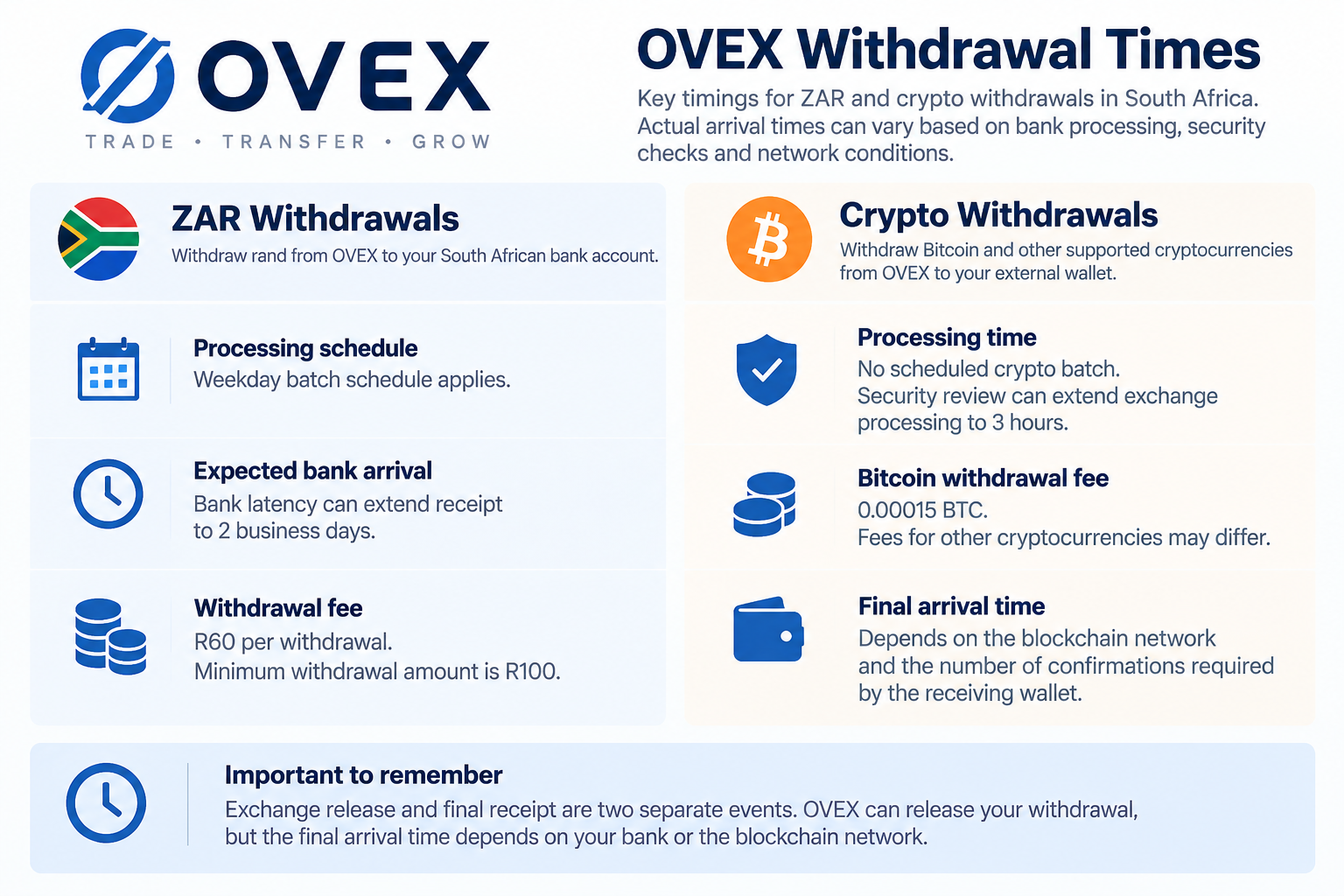
OVEX processes ZAR withdrawals in weekday batches. Bank latency can extend a fiat withdrawal to 2 business days. The ZAR withdrawal charge is R60, and the minimum is R100. OVEX also requires 2FA and email confirmation before a fiat withdrawal can proceed.
Crypto withdrawals have no scheduled batch, while enhanced security controls can extend the exchange stage to 3 hours. Network congestion can then extend confirmation time. The current Bitcoin withdrawal charge is 0.00015 BTC, with a 0.0003 BTC withdrawal minimum.
| Cause of Delay | Affects ZAR | Affects Crypto | Typical Reason |
|---|---|---|---|
| Security review | ✓ | ✓ | New bank details, wallet address, password change or fraud checks |
| Bank settlement | ✓ | — | Exchange has paid, but the recipient bank has not credited the account |
| Cut-off times | ✓ | — | Withdrawal misses an EFT or processing window |
| Blockchain congestion | — | ✓ | High transaction demand or slower confirmations |
| Travel Rule checks | — | ✓ | Missing or inconsistent sender or beneficiary information |
| Account verification | ✓ | ✓ | Identity, 2FA or beneficiary checks are incomplete |
Cape Crypto withdrawal times
Cape Crypto processes ZAR withdrawals once per weekday. The fee schedule shows a 15:00 to 16:00 window, while the withdrawal guide shows 15:30. South African bank settlement can take 24 to 48 hours after release.
The regular bank withdrawal fee is R8.50, while the paid RTC route costs R50. The minimum ZAR withdrawal is R20, and the standard 24-hour limit is R100,000 unless a higher account limit applies.
Crypto withdrawals require identity verification and 2FA. Crypto withdrawals have no scheduled daily batch after the required controls are satisfied, while blockchain settlement follows exchange release. Bitcoin can leave through the on-chain network or Lightning where available.
The fee schedule treats the on-chain Bitcoin charge as dynamic and displays 0.0005 BTC as its reference, while Lightning has a separate dynamic charge.
What can delay a withdrawal?
Five causes explain most delays:
- Exchange security controls: A new address, new bank details, password change, fraud review, or account restriction can delay release.
- Bank settlement: An exchange can release ZAR before the recipient bank credits the account.
- Cut-off periods: Regular EFT and RTGS routes can move a withdrawal to the next business day.
- Blockchain congestion: Bitcoin confirmation depends on block space, transaction demand, and the fee attached to the transaction.
- Travel Rule information: South African crypto transfers require prescribed originator and beneficiary information under FIC Directive 9.
Travel Rule compliance can create additional checks before a crypto transfer leaves an exchange. Incomplete or inconsistent recipient details can delay release, especially when the destination is another regulated provider. Self-hosted wallet transfers can also require ownership or beneficiary information.
South African crypto asset service providers that perform regulated financial services require FSCA authorisation.
You should verify an exchange in the FSCA provider search before a deposit or withdrawal, since licence status can change, and a website claim is not a substitute for the regulator’s record.
How to reduce avoidable withdrawal delays
Complete identity checks, bank verification, 2FA, and wallet address setup before the day funds must be transferred. A new beneficiary or security change can trigger a hold period, even when the bank route has an RTC option.
Confirm the cryptocurrency and blockchain network before approval, then compare the destination wallet address character by character. A small test transfer can reduce address risk when the fee does not make the test uneconomic.
Bank withdrawal timing can vary with the exchange schedule, destination bank, transaction size, weekends, and South African holidays. A paid RTC route can reduce bank delays, but the extra charge should be weighed against the urgency of the transfer.
Conclusion
Luno and VALR offer paid RTC routes for eligible ZAR withdrawals, while AltCoinTrader offers a paid route with release cycles every 5 to 15 minutes. OVEX and Cape Crypto rely more heavily on scheduled fiat batches, which can extend the time before bank settlement begins.
Bitcoin follows a different timing model because exchange release is the first stage, followed by network confirmation. Luno gives a specific release target; OVEX gives a security-window estimate, while VALR, AltCoinTrader, and Cape Crypto focus more on authorisation, fees, and network conditions.
You should compare bank route, withdrawal charge, account controls, crypto network, and final settlement rules before a withdrawal decision.
Frequently asked questions
Which exchanges support same-day ZAR withdrawals?
Luno and VALR both support paid RTC routes for eligible South African bank accounts, while Luno gives same-day receipt for eligible payments. AltCoinTrader also offers a paid route, but bank settlement can extend receipt to 24 hours.
Which exchange has the lowest ZAR withdrawal fee?
Luno charges R0 for a normal withdrawal. VALR gives clients 30 free withdrawals per calendar month, then charges R8.50. Cape Crypto charges R8.50 for a regular bank withdrawal, while AltCoinTrader and OVEX charge more under current fee schedules.
Which exchange has the lowest Bitcoin withdrawal fee?
Luno, VALR, and Cape Crypto have dynamic or variable crypto charges. AltCoinTrader currently charges 0.00012 BTC, while OVEX charges 0.00015 BTC. The confirmation screen provides the decisive fee check before transfer approval.
Does a Bitcoin transaction ID mean the withdrawal is complete?
A transaction ID means the transfer has reached the blockchain and can be tracked independently. Final credit still depends on blockchain confirmation and the destination wallet’s deposit policy, which can require more than one confirmation before funds become spendable.
Can a South African bank receive Bitcoin directly?
A normal South African bank account receives ZAR, not an on-chain Bitcoin transfer. Crypto must first be sold for rand through an eligible exchange before a bank withdrawal. A self-custody wallet or crypto provider can receive the Bitcoin itself.
How long do crypto withdrawals usually take in South Africa?
Crypto withdrawals can leave an exchange within minutes, but the final arrival time depends on the blockchain network, congestion, security checks and how many confirmations the receiving wallet requires.
Which South African crypto exchange has the fastest ZAR withdrawals?
Luno and VALR both offer faster paid RTC withdrawal options for eligible South African bank accounts. AltCoinTrader also supports an accelerated withdrawal route, although final bank settlement can still take longer.
Can I withdraw crypto directly into my South African bank account?
No. A normal South African bank account receives rand, not Bitcoin or other cryptocurrencies. You first need to sell the crypto for ZAR on an exchange and then withdraw the rand to your bank account.
Why is my crypto withdrawal taking longer than expected?
Delays can come from account verification, security reviews, new wallet addresses, Travel Rule checks, blockchain congestion or the receiving wallet waiting for additional network confirmations.
Do crypto exchanges process withdrawals on weekends?
Crypto withdrawals can often be processed over weekends because blockchains operate continuously, but ZAR withdrawals may depend on the exchange’s banking route, cut-off times, weekends and South African public holidays.
You Might Also Like




Recommended brokers