A low commission can still result in a higher final cost. Crypto trading fees in South Africa can include an exchange charge, the gap between buy and sell prices, a ZAR deposit charge, a ZAR withdrawal charge, and a blockchain transfer charge.
The payment route and trade screen can change the rand amount paid even on the same platform and for the same crypto asset.
We used Luno, VALR, AltCoinTrader, Cape Crypto, and OVEX for our comparison. Four offer order books or simplified retail purchase routes, while OVEX follows a request-for-quote model with a variable spread.
Fixed charges must be separated from quote-dependent costs. Crypto assets can lose substantial market value, and lower charges do not remove investment, custody, fraud, or blockchain risk.
Do crypto platforms charge different fees for buying and selling?
Yes. Some platforms use separate maker and taker fees, while others build part of the cost into the spread. The fee can also change depending on order type, trading volume, and the crypto pair being traded. Always compare the full buy-and-sell cost, not just the headline rate.

🏆10 Best Forex Brokers in South Africa
| Rank | Broker | Broker Review | Regulators | Minimum Deposit | Visit Broker |
|---|---|---|---|---|---|
| 🥇 |  | Read Review | ASIC, FSA, CBI, BVI, FSCA, FRSA, CySEC, ISA, JFSA | $100 | Visit Now |
| 🥈 |  | Read Review | FSCA, FCA, DFSA, FSA, CMA | $0 | Visit Now |
| 🥉 |  | Read Review | FSCA, FSC, CYSEC, DFSA, CMA, FSC, FSA | $5 | Visit Now |
| 4 |  | Read Review | ASIC, CySEC, FSA, SCB | $0 | Visit Now |
| 5 |  | Read Review | BVI FSC | $0 | Visit Now |
| 6 |  | Read Review | FSA, FSC, FSCA, ASIC, CMA | $20 | Visit Now |
| 7 |  | Read Review | Exness is a globally regulated broker, holding multiple licenses from respected financial regulators around the world. | $10 | Visit Now |
| 8 |  | Read Review | ASIC, CySEC, FSCA, FSA, FSC, CMA | $100 | Visit Now |
| 9 |  | Read Review | FSC | $10 | Visit Now |
| 10 |  | Read Review | FSA, CySEC, FSCA, FSC | $10 | Visit Now |


Can ZAR funding affect crypto trading costs?
Yes. South African traders should check whether a platform accepts direct ZAR deposits and withdrawals, which payment methods are supported, and whether conversion fees apply. Using a platform that requires currency conversion can add extra costs before you even place a crypto trade.
Crypto fee comparison for South African traders
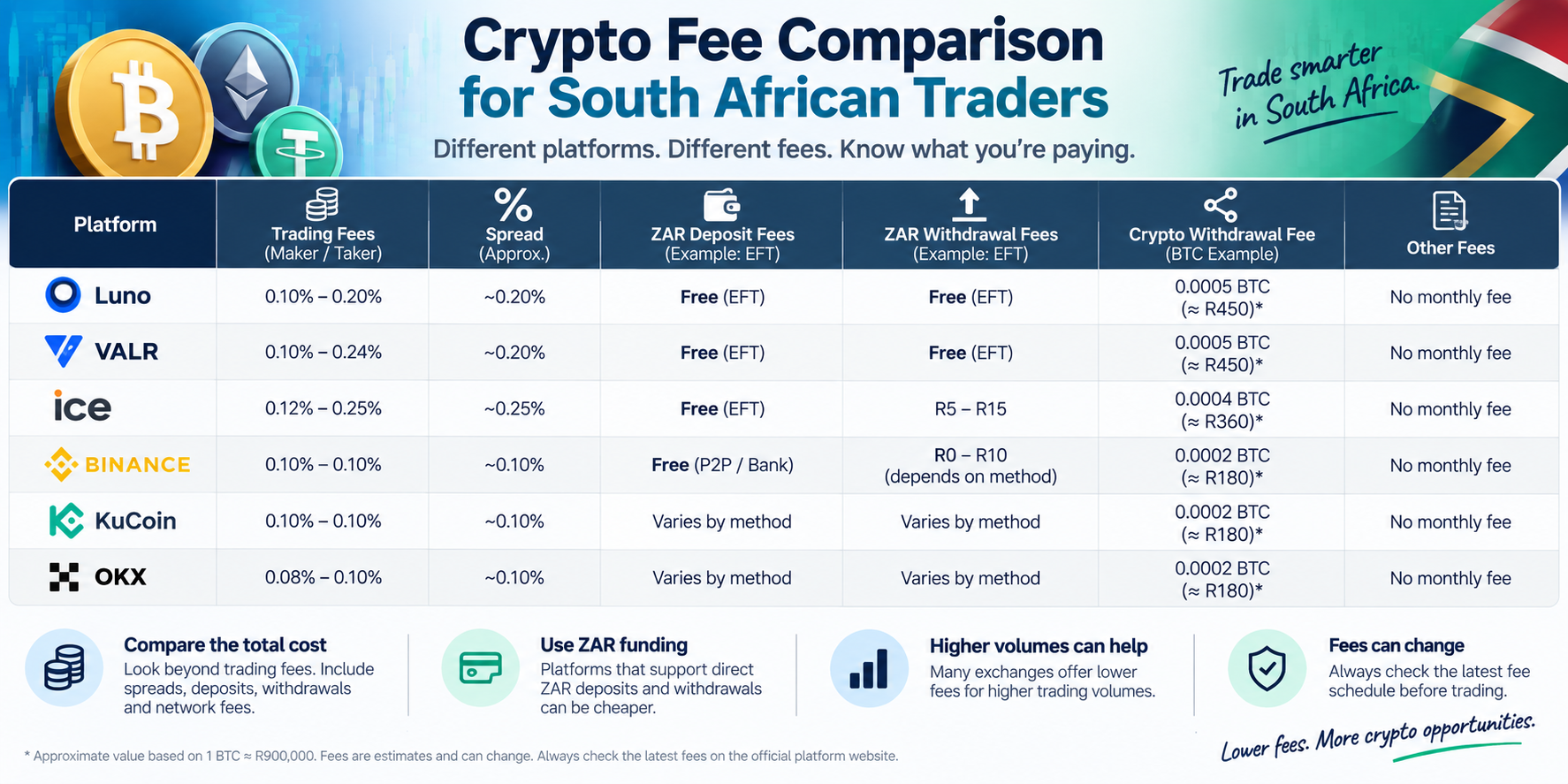
This table focuses on standard retail routes and Bitcoin. A maker order enters an order book without immediate execution, while a taker order executes against an available order. Quote-led services set a transaction through a live rate instead.
| Platform | Standard trade model | Entry trade charge | Simple purchase route | ZAR deposit | ZAR withdrawal | BTC/network withdrawal | FSCA FSP |
|---|---|---|---|---|---|---|---|
| Luno | Maker/taker exchange | Tier 1 BTC/ZAR: 0.40% maker; 0.60% taker | Portfolio purchase/sale: 2%; card purchase: 3.9% | EFT R0; instant 1.4%; Capitec Pay R9 above R1,000 | Normal R0; express R20 at RTC banks or R80 at other supported banks | Dynamic quote before approval | 53314 |
| VALR | Maker/taker spot exchange | Tier 1 fiat pair: 0.180% maker; 0.350% taker | Simple Buy/Sell/Swap: 1.6% | EFT R0; card 3.9% | First 30 normal withdrawals per month R0 for individuals, then R8.50; rapid R30 | Variable quote before approval | 53308 |
| AltCoinTrader | Maker/taker exchange | Tier 1: 0.50% maker; 0.60% taker | Easy Buy/Sell: 1.5% | Standard ZAR 0.5%, capped at R95; other methods differ | R16 + 0.5%, percentage portion capped at R95; instant R60-R140 | Asset-dependent; confirm before approval | 53614 |
| Cape Crypto | Maker/taker exchange | Taker 0.07%; maker receives 20% of the trade fee | Simplified purchase/sale: 0.6% | Regular bank deposit R0 | Regular R8.50; rapid R50 | Bitcoin on-chain dynamic, base BTC 0.0005; Lightning dynamic, base 250 sats | 53746 |
| OVEX | Request for quote | 0% direct RFQ trade fee | RFQ quote includes a variable spread | Platform deposit fee R0 | ZAR R60 | BTC 0.00015 | 53922 |
A single percentage cannot identify the cheapest route for every transaction. Luno, VALR, AltCoinTrader, and Cape Crypto have fixed charges for standard exchange or simplified purchase routes, while the OVEX spread depends on its live RFQ price. Deposit method and exit route can also change the final result.
What creates the total cost of a crypto trade?
Your final crypto purchase cost can be higher than the trade commission alone. Here are five cost areas that you must check:
- Trade charge: Maker, taker, instant purchase, or quote-based charges can apply when an order executes.
- Spread: The gap between available buy and sell prices can affect the effective purchase price.
- ZAR deposit charge: EFT, card, and instant bank routes can have different platform or bank charges.
- ZAR withdrawal charge: Standard bank payouts and rapid payout routes can have fixed or percentage charges.
- Crypto withdrawal charge: Bitcoin and other blockchain transfers can have fixed, variable, or network-linked charges.
Spread is not automatically an extra platform fee. An order book spread reflects the gap between buy and sell prices, while an RFQ service can incorporate commercial cost into its quoted rate.
Fees by crypto platform
The sections below separate order book trades from simpler purchase screens. An EFT deposit followed by a taker order has a different cost path from a card purchase followed by a BTC transfer to a private wallet.
Luno fees
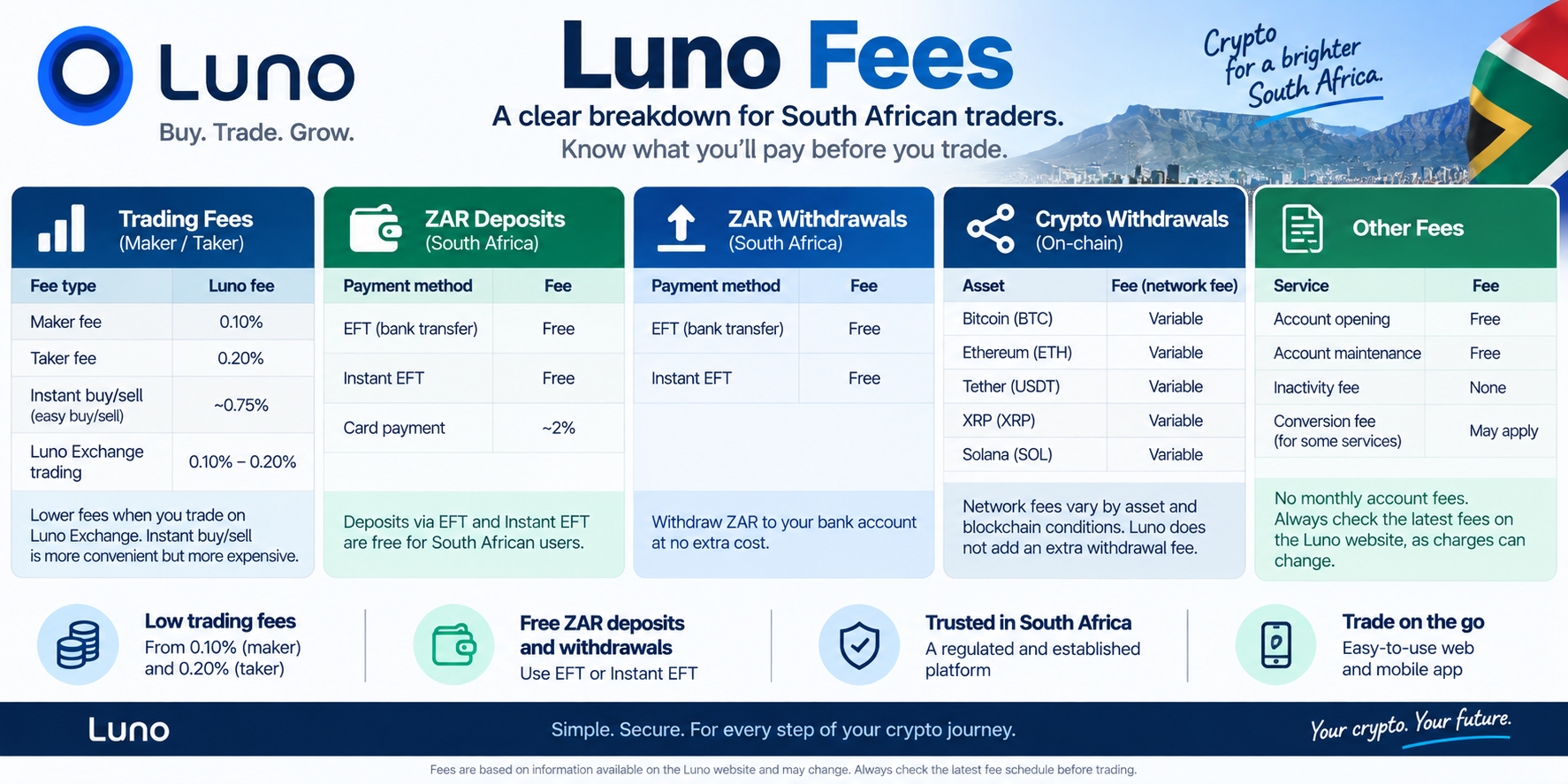
Luno Tier 1 covers 30-day exchange volumes from R0 to R20,000. BTC/ZAR has a 0.40% maker fee and 0.60% taker fee. Portfolio purchases and sales cost 2%, while a direct card purchase costs 3.9%. EFT deposits and normal ZAR withdrawals cost R0.
Instant deposits cost 1.4%, while Capitec Pay costs R9 above R1,000. Express withdrawals cost R20 at RTC banks and R80 at other supported banks. A crypto send has a dynamic charge shown before approval.
VALR fees
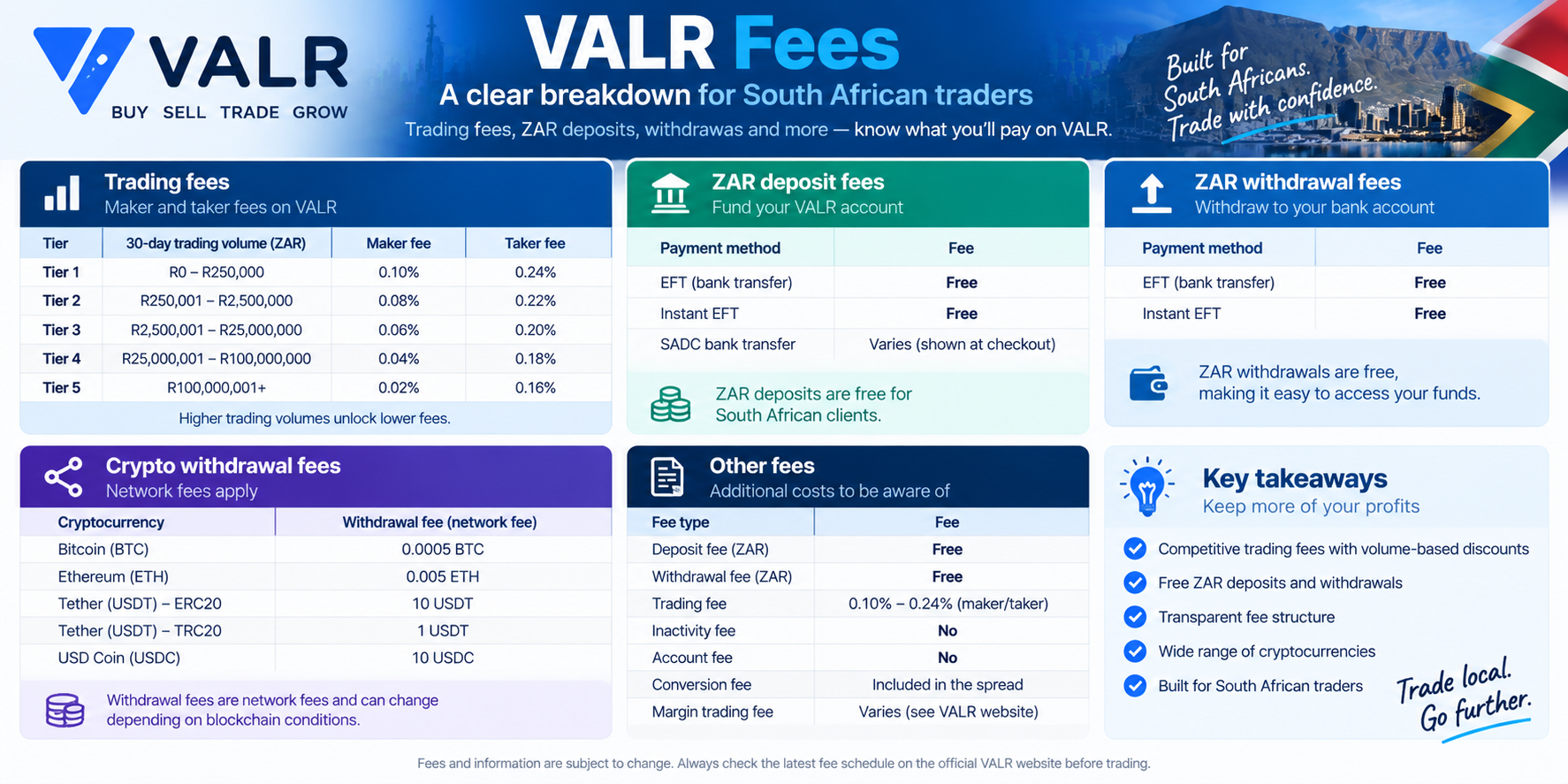
VALR Tier 1 spot fiat pairs have a 0.180% maker fee and a 0.350% taker fee. Simple Buy/Sell/Swap and Auto-Buy cost 1.6%. ZAR EFT deposits cost R0, while card deposits cost 3.9%. Individuals receive 30 normal ZAR withdrawals per calendar month at R0, then R8.50 each.
A rapid ZAR withdrawal costs R30. External crypto withdrawals have variable charges based on the asset and blockchain activity, and the exact figure can be reviewed before approval. Transfers between VALR accounts cost R0.
AltCoinTrader fees
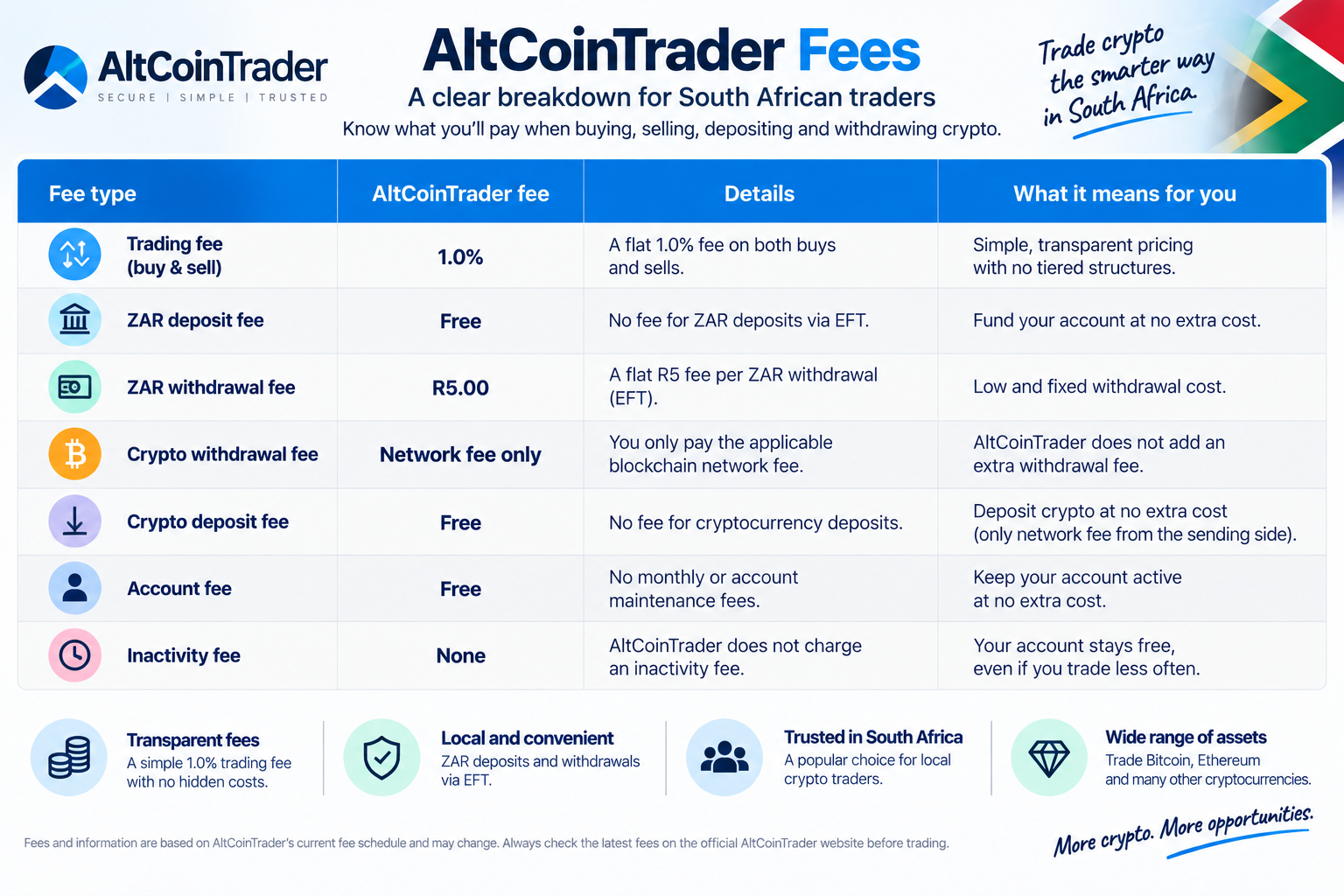
AltCoinTrader Tier 1 covers 30-day volumes from R0 to R100,000, with a 0.50% maker fee and 0.60% taker fee. Easy Buy/Sell costs 1.5%. A standard ZAR deposit costs 0.5%, capped at R95. Capitec Pay via Stitch costs 2%, capped at R95; Absa Pay costs 2.5%, and local cards cost 5%.
A standard ZAR withdrawal costs R16 plus 0.5%, with the percentage portion capped at R95; instant withdrawals cost R60-R140.
Cape Crypto fees
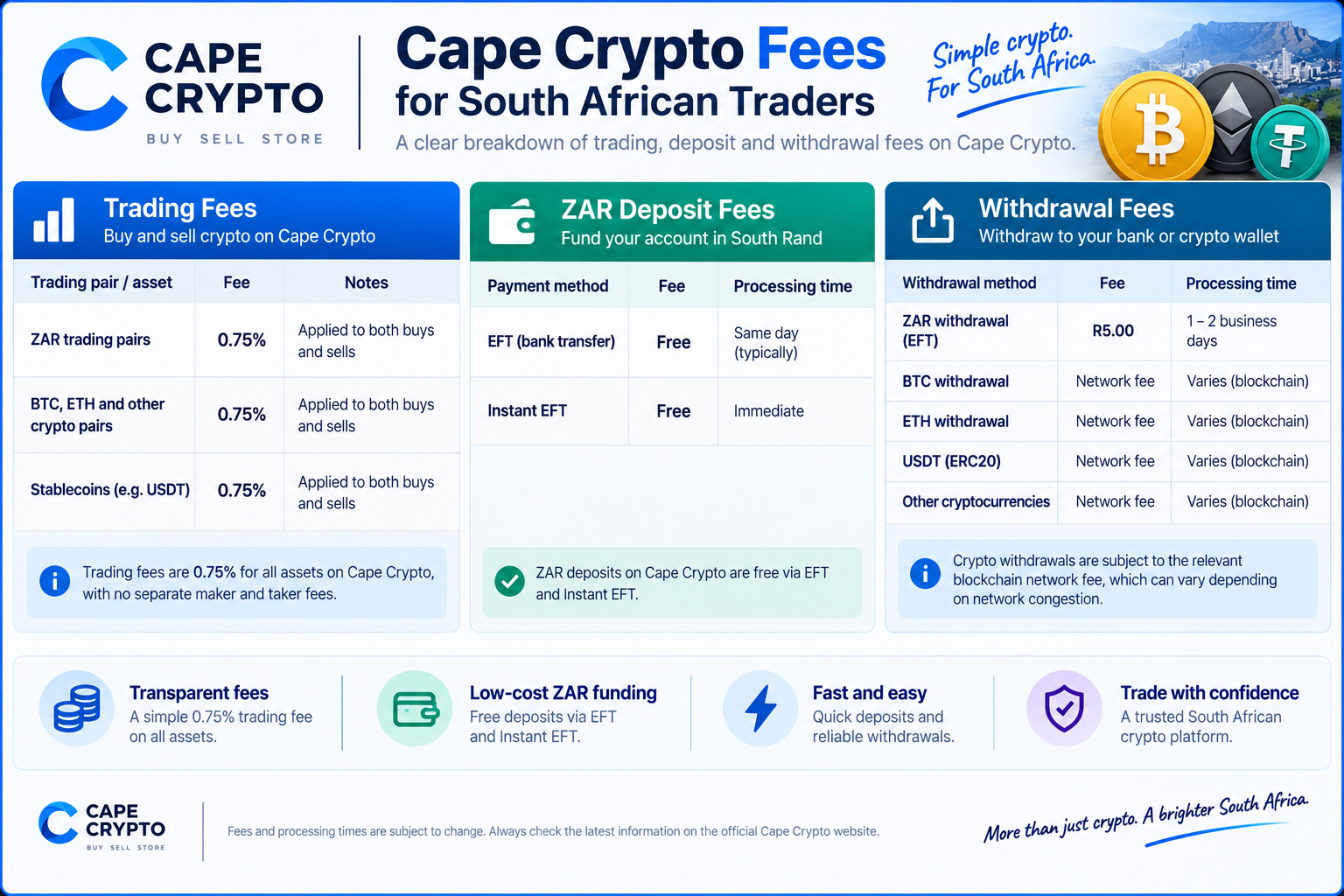
Cape Crypto has a 0.07% taker charge, while a maker receives 20% of the trade fee. Its simplified purchase and sale route costs 0.6%. A regular ZAR bank deposit costs R0, a regular withdrawal costs R8.50, and a rapid withdrawal costs R50.
Bitcoin on-chain withdrawals are dynamic, with BTC 0.0005 as the base figure; Lightning withdrawals are dynamic, with a 250-sat base. The app can adjust crypto withdrawal charges when network demand changes, which makes the approval screen the final check.
OVEX fees
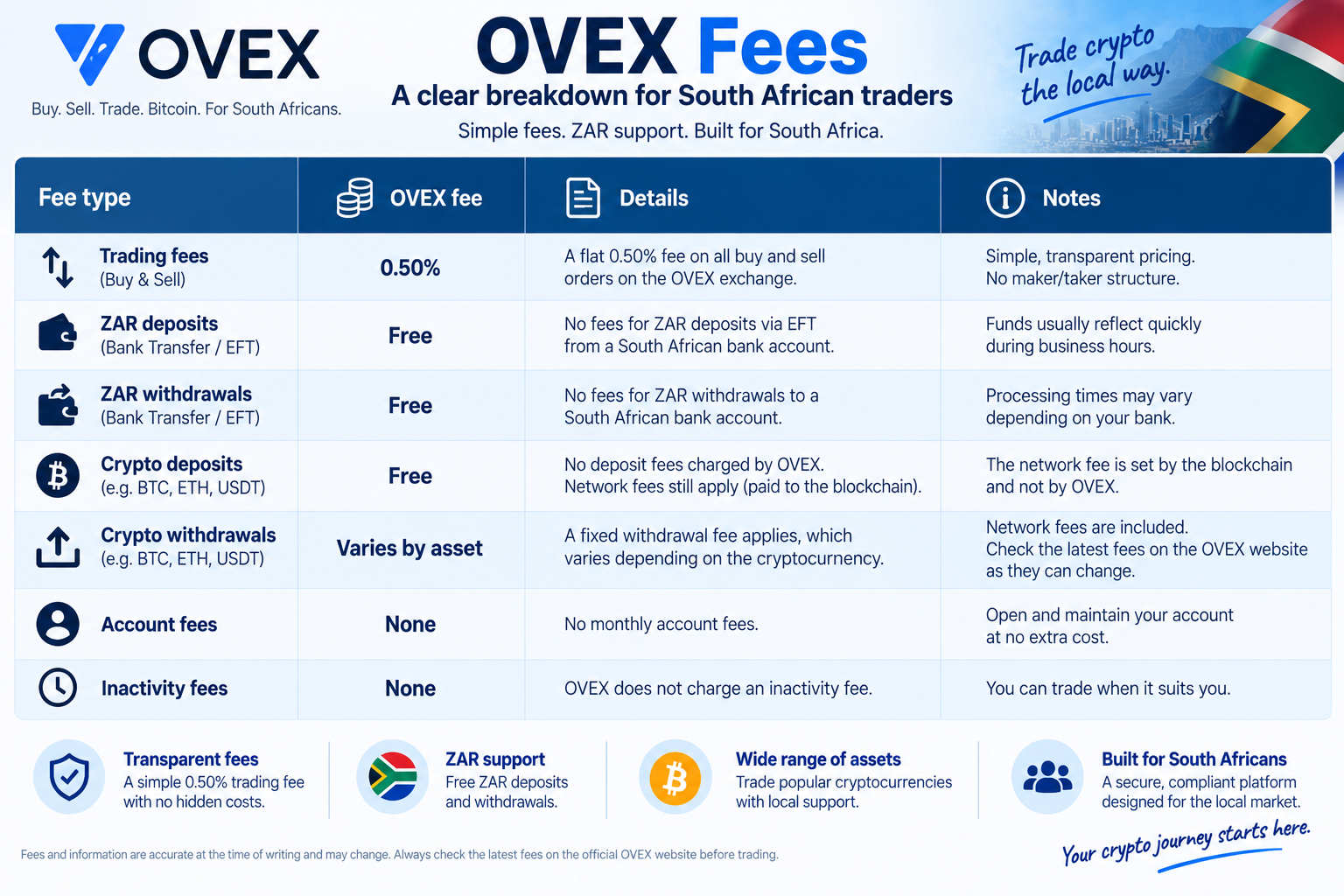
OVEX charges 0% as a direct RFQ trade fee and places trade costs in a variable spread. ZAR deposits are not subject to a platform charge, while a ZAR withdrawal costs R60. A Bitcoin network withdrawal costs BTC 0.00015, with BTC 0.0003 as both the deposit and withdrawal minimum.
The RFQ trade quote is inclusive, which means the quoted BTC amount should be compared with the rand amount offered instead of a maker or taker percentage.
What R10,000 can cost before crypto leaves the platform
A R10,000 example shows how the routes differ, while variable spread and blockchain quotes are left unfixed. The figures below calculate verified percentage charges against R10,000. Each line is a component calculation, not a guaranteed final invoice.
Platform Standard ZAR deposit on R10,000 Maker route on R10,000 Taker route on R10,000 Simpler purchase route on R10,000 ZAR exit example Crypto exit
| Luno | R0 by EFT | R40 | R60 | R200 from portfolio; R390 by card purchase | R0 normal | Dynamic |
|---|---|---|---|---|---|---|
| VALR | R0 by EFT | R18 | R35 | R160 Simple Buy/Sell/Swap | R0 within first 30 normal individual withdrawals; then R8.50 | Variable |
| AltCoinTrader | R50 standard ZAR deposit | R50 | R60 | R150 Easy Buy/Sell | R66 on a R10,000 standard withdrawal | Asset-dependent |
| Cape Crypto | R0 regular bank deposit | Maker reward applies | R7 | R60 simplified purchase/sale | R8.50 regular | BTC on-chain dynamic; base BTC 0.0005 |
| OVEX | R0 platform deposit charge | Not applicable | Not applicable | R0 direct RFQ fee; spread varies | R60 | BTC 0.00015 |
Cape Crypto shows a 0.07% taker charge, equal to R7 on R10,000, while VALR has the lowest Tier 1 taker percentage among Luno, VALR, and AltCoinTrader at 0.350%, equal to R35.
Cape Crypto’s fee page has an older revision stamp, and its crypto withdrawal charge can change in-app. AltCoinTrader also charges R50 on a R10,000 standard ZAR deposit before bank costs.
OVEX cannot be ranked from a trade percentage because its live spread affects the BTC amount in the RFQ. Network-dependent withdrawals create the same limitations. You must compare the rand paid, crypto received, and exit charge at the same point in time.
How to reduce crypto transaction costs
Here are five checks that can reduce avoidable charges without extra transactions merely to qualify for a lower tier:
1. Compare EFT, card, and instant deposit charges before payment, since the deposit route can create a cost before the crypto order enters the trade screen.
2. Compare the exchange interface with the simplified purchase route since convenience charges can exceed entry-tier maker or taker charges.
3. Compare the final crypto amount with a contemporaneous reference price since a low commission can coexist with a wider spread or weaker execution price.
4. Check the crypto transfer charge and network before purchasing if self-custody is planned, since a withdrawal can materially change a smaller transaction’s total cost.
5. Calculate each charge in rand for your transaction size and current fee tier, since percentage differences become larger as the transaction amount increases.
A cheaper network fee does not justify using a blockchain that the receiving wallet does not support. Trading into another cryptocurrency purely to qualify for lower fees can also mean extra trading costs, additional tax records, and exposure to price changes.
What to check besides fees
Fee size is one factor in a crypto platform decision. You must also review regulatory status, liquidity, custody arrangements, withdrawal controls, and supported networks.
- FSCA status: Verify the provider and FSP number through the FSCA search before making your first deposit.
- Liquidity: Review order book depth where relevant because larger market orders can experience greater slippage.
- Custody: Check wallet controls, withdrawal security, supported networks, and transfer limits before a crypto transfer.
- Fee terms: Recheck trade and withdrawal screens immediately before approval when a charge is variable.
Each provider in our guide has a South African FSP number. However, FSCA authorisation does not guarantee protection against market loss, fraud, operational failure, or blockchain risk. South African CASPs require FSCA authorisation for regulated financial services.
Conclusion
The lowest quoted percentage does not always result in the lowest total cost when depositing rand, buying crypto, or withdrawing funds. You must compare the deposit charge, execution price, trade commission, ZAR exit cost, and blockchain transfer charge for the transaction you intend to make.
Check the trade and withdrawal screens before approval because spread, network cost, and account tier can change the amount paid. Lower charges reduce friction, but crypto still has substantial capital risk and requires careful provider, wallet, and network checks.
Frequently asked questions
Which South African crypto platform has the lowest trading fee?
Cape Crypto has the lowest fixed taker percentage in our comparison at 0.07%. VALR has the lowest entry-tier taker rate among Luno, VALR, and AltCoinTrader at 0.350%. OVEX has a 0% direct RFQ trade fee, but its variable spread affects the quoted crypto amount, which prevents a direct percentage comparison.
Does a spread apply as well as a trade fee?
A spread can affect a transaction even when a separate commission applies. Order book platforms have a gap between buy and sell prices, while an RFQ service can place commercial cost inside the quoted rate. Compare the crypto amount received with the rand amount paid before approval.
Why can a crypto withdrawal charge change?
Blockchain demand can alter network-linked costs. Luno applies a dynamic crypto send charge, VALR quotes a variable external wallet charge, and Cape Crypto can adjust its Bitcoin withdrawal charge in-app. OVEX currently charges BTC 0.00015 on the Bitcoin network.
Are ZAR deposits free?
ZAR deposit charges differ by platform and payment method. Standard EFT costs R0 at Luno and VALR; a regular bank deposit costs R0 at Cape Crypto, and OVEX has zero platform deposit fees. AltCoinTrader charges 0.5%, capped at R95, before possible bank charges.
Are ZAR withdrawals free?
Luno charges R0 for a normal ZAR withdrawal. VALR gives individual clients 30 normal withdrawals per calendar month at R0, then charges R8.50. AltCoinTrader charges R16 plus 0.5%, with the percentage portion capped at R95. Cape Crypto charges R8.50 for a regular withdrawal, while OVEX charges R60.
Do higher trade volumes reduce crypto exchange fees?
Higher 30-day volume can reduce exchange charges at Luno, VALR, and AltCoinTrader. Each platform has separate tiers and maker/taker rates. A lower rate should not prompt extra trades merely to qualify, since extra transactions can create added cost and market exposure.
What fees do South Africans pay when trading cryptocurrency?
Crypto trading costs can include maker and taker fees, spreads, ZAR deposit or withdrawal charges, cryptocurrency withdrawal fees, and blockchain network fees. The total cost varies between exchanges and can also depend on your trading volume, payment method, cryptocurrency, and whether you use instant-buy or exchange trading.
Which crypto trading fee is most important to compare?
The trading fee is important, but it should not be checked on its own. Compare the effective spread, maker and taker fees, deposit charges, withdrawal costs, and network fees together. A platform advertising a low trading fee can still be more expensive once its other charges are included.
Are crypto deposits and withdrawals free in South Africa?
Not always. Some South African crypto platforms offer free ZAR deposits through selected methods, while others charge for certain payment options. Crypto withdrawals can also attract platform and blockchain network fees. Check the fee schedule for your preferred deposit and withdrawal method before transferring funds.
Are crypto trading fees lower for high-volume traders?
They can be. Many crypto exchanges use tiered pricing where maker and taker fees decrease as a trader’s 30-day trading volume increases. This can make a significant difference for active traders, while occasional investors should focus more on the standard fee tier and the total cost of each transaction.
You Might Also Like




Recommended brokers