A CFD and a share purchase can offer exposure to the same company, but the cost paths differ greatly. A CFD can require less cash at entry because leverage applies, while a direct share purchase provides legal ownership of the security.
The cheaper route depends on trade size, time in market, broker charges, currency, and tax-related costs.
When you compare CFD and share trading costs in South Africa, commission is just one factor to evaluate. Spreads, overnight finance, foreign exchange conversion, Securities Transfer Tax, settlement charges, account fees, and dividend treatment can change the final amount.
CFDs also amplify losses through leverage; cost and risk also require thorough review.
Are CFDs cheaper to trade than shares in South Africa?
It depends on how you trade. CFDs may have lower upfront capital requirements but can include spreads, commissions, and overnight financing charges. Direct share trading can involve brokerage fees, exchange-related charges, and taxes. For longer-term investors, recurring CFD financing costs can make direct share ownership more cost-effective.

🏆10 Best Forex Brokers in South Africa
| Rank | Broker | Broker Review | Regulators | Minimum Deposit | Visit Broker |
|---|---|---|---|---|---|
| 🥇 |  | Read Review | ASIC, FSA, CBI, BVI, FSCA, FRSA, CySEC, ISA, JFSA | $100 | Visit Now |
| 🥈 |  | Read Review | FSCA, FCA, DFSA, FSA, CMA | $0 | Visit Now |
| 🥉 |  | Read Review | FSCA, FSC, CYSEC, DFSA, CMA, FSC, FSA | $5 | Visit Now |
| 4 |  | Read Review | ASIC, CySEC, FSA, SCB | $0 | Visit Now |
| 5 |  | Read Review | BVI FSC | $0 | Visit Now |
| 6 |  | Read Review | FSA, FSC, FSCA, ASIC, CMA | $20 | Visit Now |
| 7 |  | Read Review | Exness is a globally regulated broker, holding multiple licenses from respected financial regulators around the world. | $10 | Visit Now |
| 8 |  | Read Review | ASIC, CySEC, FSCA, FSA, FSC, CMA | $100 | Visit Now |
| 9 |  | Read Review | FSC | $10 | Visit Now |
| 10 |  | Read Review | FSA, CySEC, FSCA, FSC | $10 | Visit Now |


What costs should South Africans compare before trading CFDs or shares?
Compare brokerage or commission charges, spreads, overnight financing, currency conversion fees, platform costs, and applicable taxes or exchange-related charges. Also consider how long you plan to hold the position. A cost that looks small on a short-term CFD trade can become significant when the position remains open for weeks or months.
CFDs vs shares: The main cost differences
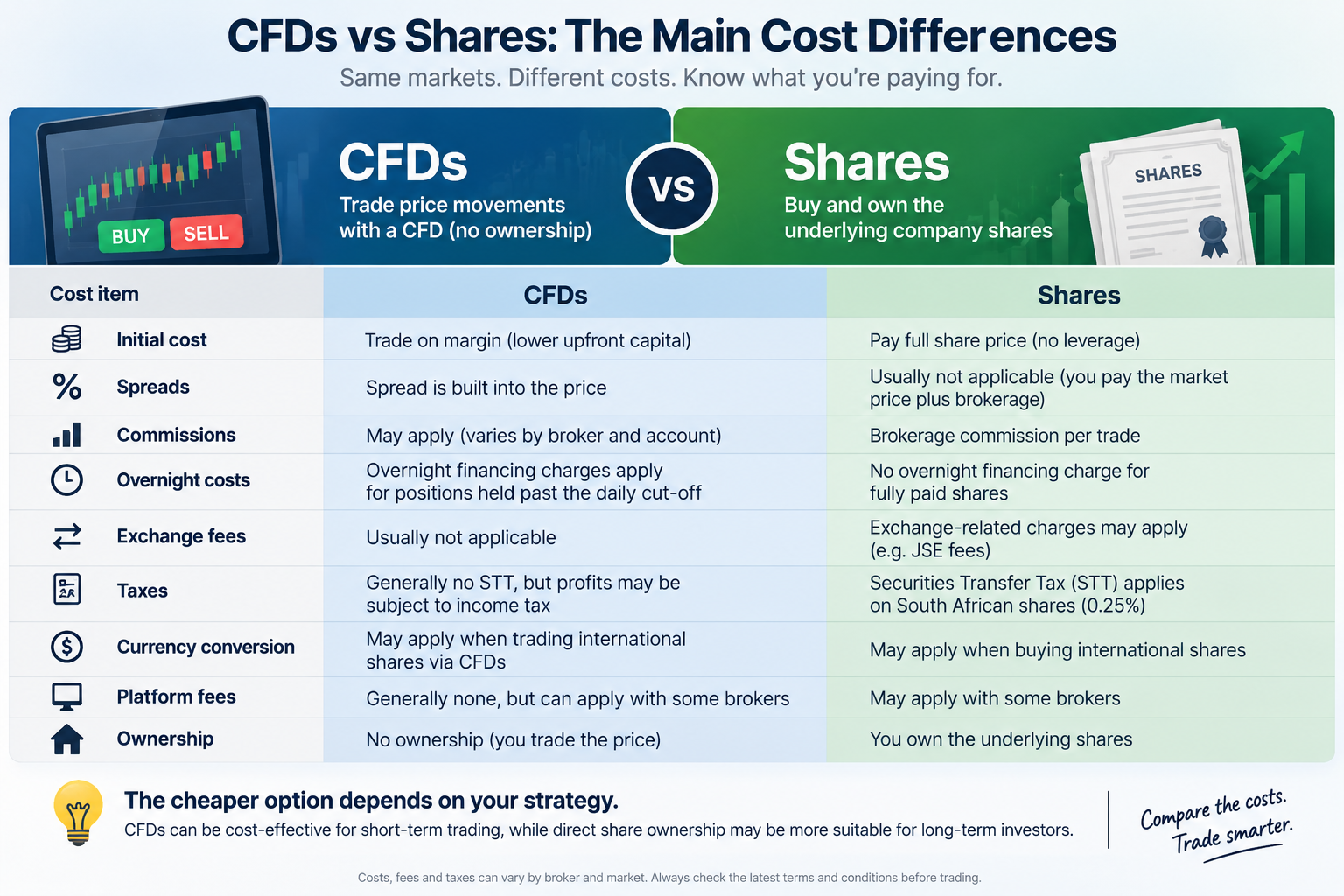
CFDs often appeal to short-term traders because leverage reduces the cash deposit required to open a position. Direct shares can be easier to assess over a longer period because there is no daily CFD finance charge on a cash-funded share purchase.
However, broker fees still differ, and a share account can include monthly, custody, settlement, or data charges. The table below separates each cost category before the detailed comparison.
Cost CFD Direct shares Why it affects the result
Spread Market spread, or provider spread on non-share CFDs Market bid-offer spread Wider spreads raise entry and exit cost
| Commission | Common on share CFDs | Common on share purchases and sales | Percentage fees can rise with trade size |
|---|---|---|---|
| Overnight finance | Can apply after the daily cut-off | None on a cash-funded purchase | Time in market can raise CFD cost |
| Forex conversion | Can apply to foreign-currency profit, fees, or cash | Can apply when rand becomes foreign currency | Offshore exposure can add a second cost layer |
| STT and settlement | CFD client does not acquire the share | STT and settlement charges can apply | Direct ownership creates share-transfer costs |
| Ownership and dividends | Price exposure, with dividend adjustments | Shareholder rights and dividend receipts | Economic treatment differs beyond fees |
Therefore, a short CFD can require less cash upfront without a lower total cost. A longer trade can produce a very different result once overnight finance enters the calculation.
What does it cost to open and close a CFD or share trade?
The first comparison should cover both sides of the transaction. A fee that looks low at entry appears again at exit when a broker charges commissions per side.
Spread cost also affects both routes because the buy price and sell price differ, even where a CFD provider applies no extra spread to a share CFD.
Spreads and commissions
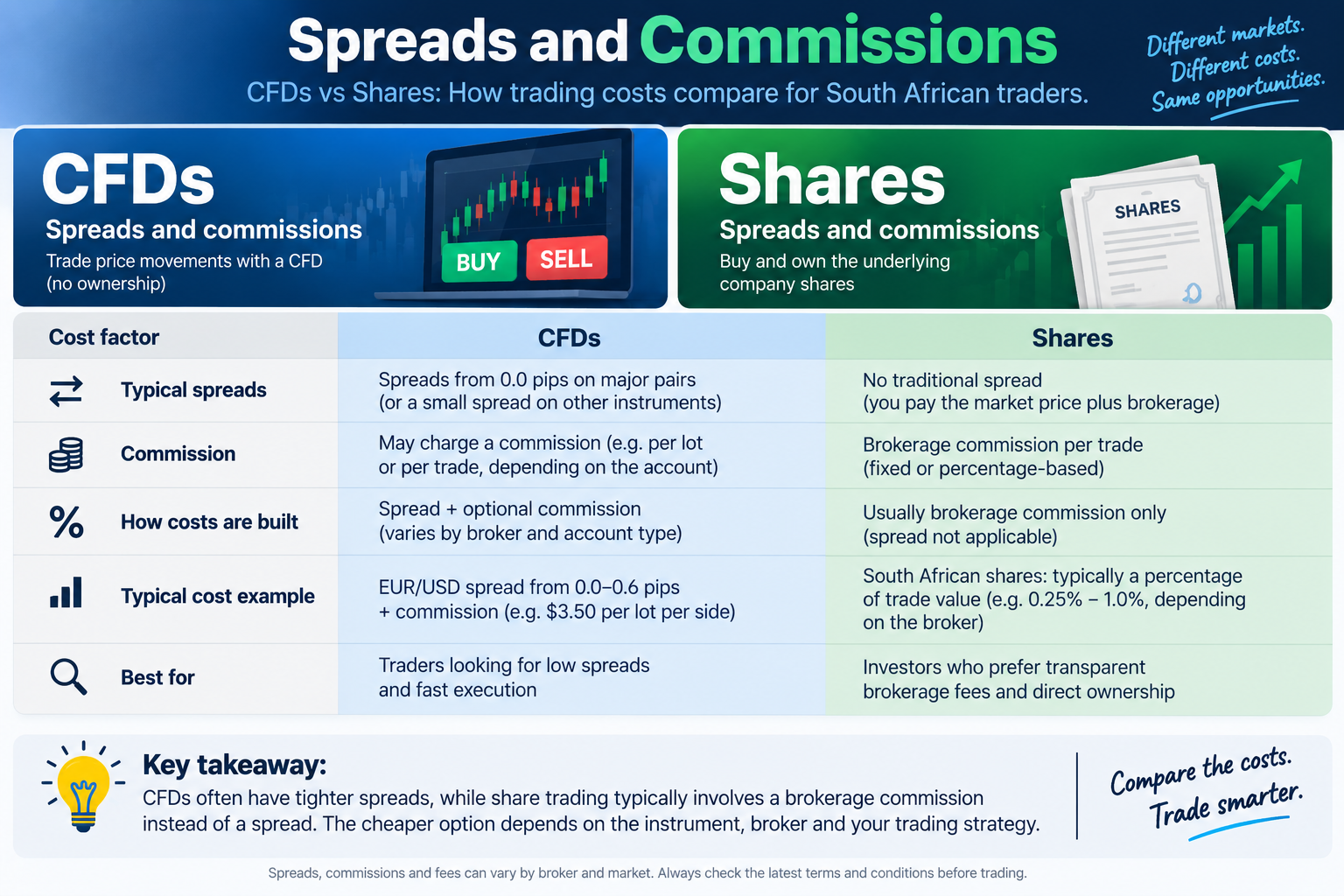
South African share CFDs can charge commission instead of a provider-added spread. For example, IG charges 0.20% per side on South African share CFDs, with a R50 online minimum.
A R50,000 position at that rate produces R100 commission at entry and another R100 at exit before overnight finance or extra services.
Direct-share brokerage differs by platform. EasyEquities charges 0.25% per transaction, while Standard Bank Online Share Trading uses a different brokerage structure with its own minimum charges and account fees.
| Cost item | CFDs | Direct shares | What to compare |
|---|---|---|---|
| Spread | Can apply directly or be built into pricing | Market bid-offer spread applies | Effective entry and exit cost |
| Commission | Often charged per side on share CFDs | Brokerage charged per transaction | Percentage rate and minimum fee |
| Minimum charge | Can materially affect small trades | Can materially affect small trades | Effective cost on your actual trade size |
| Entry and exit | Commission may apply twice | Brokerage may apply twice | Round-trip cost, not only opening cost |
| Best suited to | Often short-term trading | Often longer holding periods | Match the fee model to trade duration |
South African share-trading charges
A direct JSE share purchase can include more than brokerage:
- Brokerage applies to the purchase and, in many fee models, to the later sale.
- Securities Transfer Tax applies at 0.25% to a taxable share transfer.
- Settlement and investor-protection charges can apply to purchases, sales, or both.
- Account, custody, data, or order fees can alter the cost for a given investor.
Securities Transfer Tax is 0.25% on the transfer of a security, and listed share platforms can recover the amount from the buyer.
Current EasyEquities ZAR charges include 0.25% brokerage, 0.0795% settlement and administration, and 0.00031% for the investor-protection levy and administration, before applicable VAT.
Minimum commissions require a separate check. A R50 minimum on a R2,000 trade equals 2.5% before the exit fee, while the same R50 on a R50,000 trade equals 0.1%. Thus, small positions can face a high effective percentage cost even when the quoted rate looks low.
| Charge | When it may apply | Why it matters |
|---|---|---|
| Brokerage | Buy and sell transactions | Main visible trading charge |
| Securities Transfer Tax | Taxable share purchases | Adds to acquisition cost |
| Settlement charge | Depending on platform and transaction | Small individually, but still part of total cost |
| Investor-protection levy | Certain JSE-related transactions | Adds another statutory charge |
| Account fee | Monthly or annual on some platforms | Matters more for smaller portfolios |
| Custody fee | Some brokers or account types | Can increase long-term holding cost |
| Market-data fee | Optional or required on some platforms | Relevant for active traders |
| Currency conversion | Offshore shares | Can materially affect international investing costs |
How overnight finance changes CFD costs
Cash CFDs can incur an overnight finance charge after the provider cut-off. The charge links to the notional exposure, not merely the deposit you made into the account, which is why leverage can create a cost that grows over time.
A common share-CFD formula is:
- Notional exposure × annual finance rate ÷ day basis × nights held
- For example, with IG, ZAR share CFDs combine a 6.90% annual indication rate for the week of 24 to 30 August 2026 with a 3% administration charge on long share CFDs. On R50,000 of exposure, the combined 9.90% annual rate equals about R13.56 per night on a 365-day basis.
- An intraday CFD closed before the finance cut-off avoids that nightly charge under this fee model. A 30-night position would add about R406.85, subject to rate changes and the provider's treatment of weekends.
- A cash-funded share purchase has no equivalent nightly CFD charge but borrowed money or a separate credit facility can create its own finance cost.
| Holding period | Main CFD cost pressure | What traders should watch |
|---|---|---|
| Intraday | Spread and commission | Position must close before the finance cut-off |
| 1–5 nights | Financing starts accumulating | Annual finance rate and weekend treatment |
| Several weeks | Overnight finance can become significant | Total finance versus original commission saving |
| Several months | Financing may dominate transaction costs | Whether direct share ownership would be cheaper |
| Leveraged position | Finance applies to notional exposure | Cost is not based only on deposited margin |
How currency conversion affects offshore costs
Foreign shares introduce currency conversion for South African investors because the rand must be exchanged for the market currency.
A direct offshore share account can convert rand into dollars, pounds, euros, or another currency before the purchase. A CFD account can instead convert profit, loss, commission, finance charges, or dividend adjustments back into the account currency.
You should check three details before making an offshore comparison:
- The Forex spread or conversion percentage applied to each transfer.
- The point at which the currency conversion takes place.
- Whether the fee applies to cash, profit, loss, or charges.
Current examples show how the method changes the result. EasyEquities charges a 0.5% EasyFX transfer fee, while the displayed fixed exchange rate is set 0.7% above the WM/Reuters mid spot rate for the relevant window.
IG South Africa has a standard 0.5% CFD currency conversion charge under its default conversion method.
Ownership, dividends, and South African tax-related costs
Share ownership vs CFD exposure
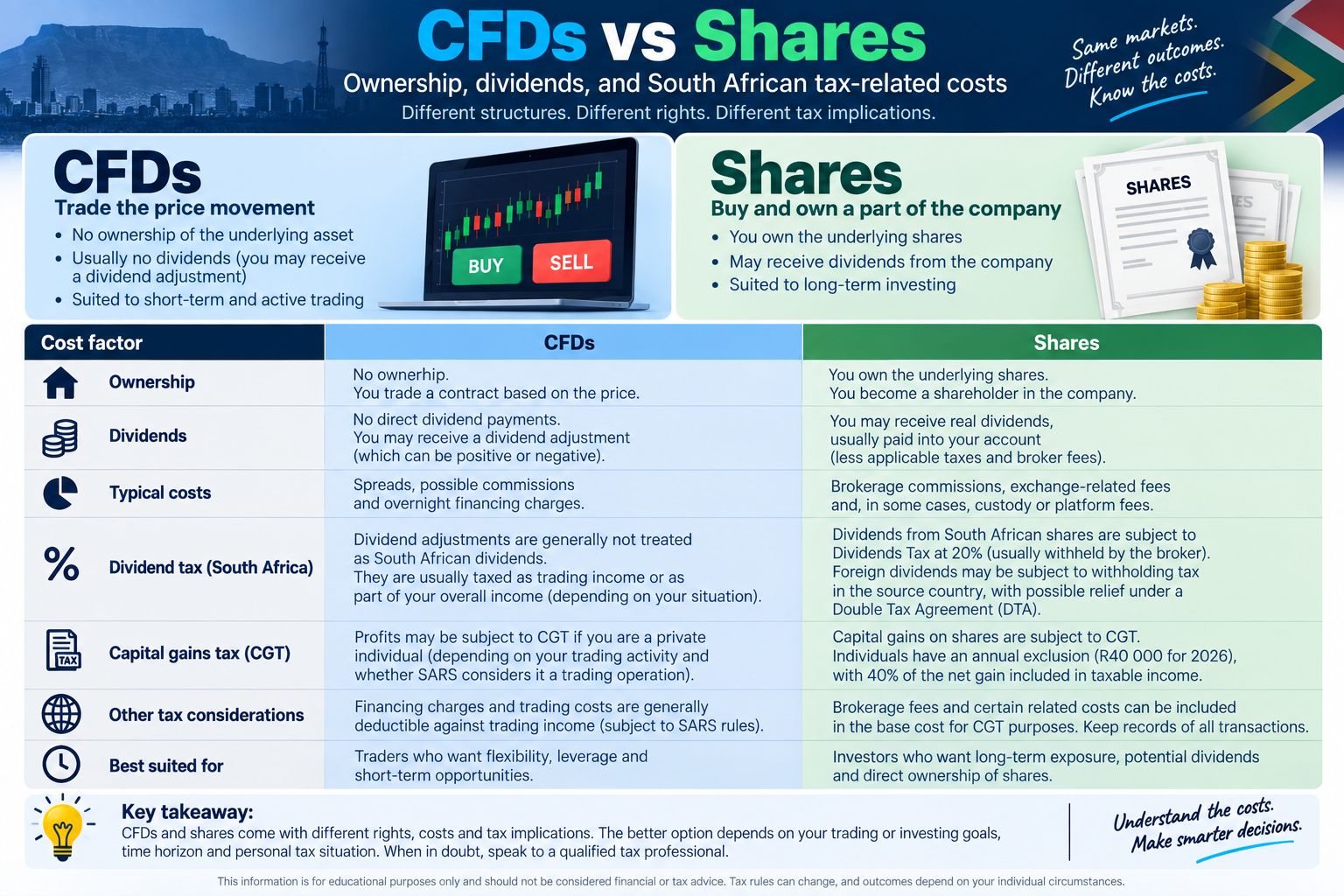
A direct share purchase gives the investor ownership of the security. Ordinary JSE shares can include voting rights, dividend entitlement when a company declares a dividend, and a claim on residual economic interest after senior claims.
A share CFD provides price exposure without legal ownership of the underlying share. Dividend events can still affect the CFD account through a cash adjustment. A long share CFD position can receive a dividend adjustment, while a short position can face a debit.
Thus, ownership changes more than the fee schedule. A shareholder can vote where the share class permits it, while a CFD trader has a contract with the provider and no shareholder vote. Corporate actions, dividend treatment, and broker terms can also differ.
STT and dividends tax
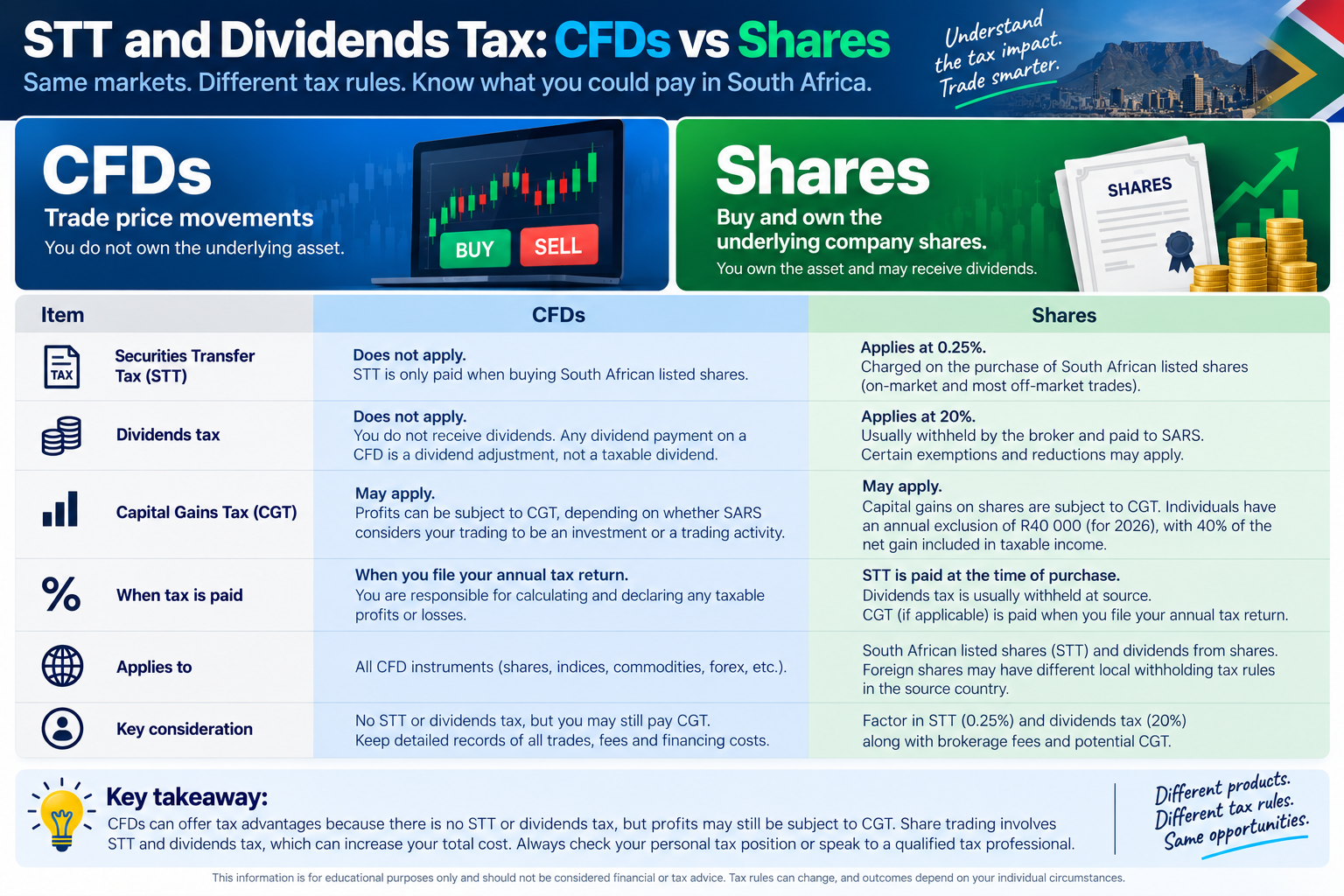
Securities Transfer Tax applies at 0.25% to transfers of securities. A standard CFD does not transfer the underlying share to the trader; the CFD client does not acquire the security through the derivative transaction in the same manner as a direct-share buyer.
South African dividends paid to individuals generally face 20% dividends tax, subject to exemptions or reduced treaty rates where relevant.
A CFD dividend adjustment is not the same legal event as a shareholder dividend, and tax treatment can depend on the taxpayer's facts, trade pattern, and circumstances.
SAShares does not provide personal tax advice. A taxpayer with frequent trades, offshore exposure, or uncertainty over revenue versus capital treatment should speak to a registered tax professional.
Practical Example: R50,000 CFD vs share costs over one day and 30 days
Consider R50,000 of exposure to a South African share, with no price change across the example. The calculation below isolates current transaction rates and CFD financing.
Market spread, slippage, optional services, and account-specific waivers are excluded because those items can change by security, time, and account.
| Cost component | CFD: Same day | CFD: 30 nights | Shares: Same day | Shares: 30 days |
|---|---|---|---|---|
| Entry commission | R100.00 | R100.00 | R125.00 | R125.00 |
| Exit commission | R100.00 | R100.00 | R125.00 | R125.00 |
| Overnight finance | R0.00 | R406.85 | R0.00 | R0.00 |
| STT on purchase | R0.00 | R0.00 | R125.00 | R125.00 |
| Settlement and IPL | R0.00 | R0.00 | R79.81 | R79.81 |
| Estimated cost before VAT and spread | R200.00 | R606.85 | R454.81 | R454.81 |
Inputs for the CFD side on IG are 0.20% commission per side and a 9.90% annual long-position finance assumption for ZAR exposure, based on the 24 to 30 August 2026 indication rate plus the 3% administration charge.
Share-side inputs are 0.25% brokerage, 0.25% STT, 0.0795% settlement and administration, and 0.00031% investor protection levy and administration.
The result is not a broker league table but shows the effect of time. The CFD starts with lower transaction costs in this example, but 30 nights of finance move it above the direct share figure before VAT, spread, slippage, optional fees, or platform charges.
A different broker, rate week, trade size, or market can reverse the outcome.
When is each route likely to cost less?
Cost depends on the intended trade, not on the product label. Four profiles show where you could expect the most cost pressure:
- An intraday CFD trader can avoid overnight finance but still faces spread or commission.
- A multi-day CFD trader can see daily finance exceed the initial commission difference.
- A long-term cash-share investor faces entry costs without a daily CFD finance debit.
- An offshore investor can face forex charges on either route through different conversion methods.
Leverage also changes risk. A smaller cash deposit does not mean a smaller market exposure, and losses can rise rapidly if the share price moves against the CFD position. Your cost comparison should include risk capacity, trade duration, liquidity, and broker regulation.
South African traders should also verify a provider's regulatory status before an account deposit. The FSCA offers an authorised FSP search and a regulated entity register.
Conclusion
CFDs and direct shares create different cost paths. CFDs can reduce the cash deposit at entry, but leverage raises risk, and overnight finance can become significant as days pass.
Direct shares can add STT, settlement charges, brokerage, and account costs, while ownership gives shareholder rights that a CFD does not provide.
Compare the total cost from entry to exit before you choose. SAShares broker guides and fee comparisons can help you assess regulated providers, current charges, and product terms without dependence on one headline fee.
Frequently asked questions
Are CFDs cheaper than shares in South Africa?
CFDs are not cheaper in every case because a short CFD trade can have lower upfront transaction charges under some fee schedules, while overnight finance can raise the cost over several days. Share purchases can include brokerage, STT, settlement charges, account fees, and forex costs.
Do you pay Securities Transfer Tax on CFDs?
Securities Transfer Tax applies to transfers of securities at 0.25%. A standard CFD does not transfer the underlying share to the CFD trader; the derivative transaction differs from a direct share purchase. Tax consequences can still arise elsewhere.
Do CFDs pay dividends?
CFD traders do not become shareholders; a CFD does not pay a shareholder dividend in the legal sense. A provider can apply a dividend adjustment to a share CFD when the underlying company passes its ex-dividend date.
Which fees should you compare before a trade?
Compare the spread, commission, overnight finance, forex conversion, tax and statutory charges, and account or custody fees. Check minimum charges as well, because a fixed minimum can turn a low headline percentage into a high effective cost on a small trade.
Do CFDs have higher fees than buying shares?
Not always. CFD trading costs usually come from spreads, commissions, and overnight financing, while direct share trading may involve brokerage, exchange-related charges, and taxes. The cheaper option depends heavily on the broker, position size, market, and how long you keep the trade open.
Why do overnight fees matter when trading share CFDs?
Share CFDs are leveraged products, and positions held overnight can attract daily financing charges. These costs can build up when a position remains open for several weeks or months. This makes overnight financing particularly important when comparing CFDs with buying and holding the underlying shares directly.
Are there currency conversion fees when South Africans trade international shares?
There can be. South African traders buying overseas shares or trading international share CFDs may face currency conversion costs when moving between ZAR and currencies such as USD, GBP, or EUR. The actual cost depends on the broker’s account currency, conversion rate, and fee structure.
Is CFD trading cheaper for short-term traders in South Africa?
CFDs can be cost-effective for short-term trading because traders can gain market exposure without paying the full value of the underlying shares. However, leverage does not automatically make a trade cheaper. Spreads, commissions, financing, and frequent trading costs still need to be calculated before comparing the two.
Is share trading cheaper for long-term investors?
Direct share ownership can be more suitable for long-term investors because there is generally no daily leveraged financing charge simply for continuing to own fully paid shares. Investors should still consider brokerage, platform fees, taxes, currency conversion, and other charges when calculating their total investment cost.
Does leverage reduce the cost of CFD trading?
Leverage reduces the amount of capital required to open a CFD position, but it does not necessarily reduce the cost or risk of the trade. You are still gaining exposure to a larger position, and financing charges may be calculated on that exposure. Leverage also magnifies losses when the market moves against you.
You Might Also Like




Recommended brokers