
Traders who compare CFD vs forex brokers in South Africa often focus on the label first, but the label tells you less than the account terms.
Many brokers offer forex in addition to CFDs on indices, commodities, shares, and other markets, which means the two categories overlap. The real choice is between a forex-led offer and a broader multi-asset offer.
Cost structure, leverage, asset range, regulation, deposit methods, and trade style should drive your decision. A currency-focused trader can have different priorities from someone who trades forex, gold, indices, and share CFDs.
The sections below compare each factor and end with a decision framework for South African traders.
Is CFD trading better than forex trading for South African traders?
Neither is automatically better. Forex may suit traders who mainly focus on currency pairs, while CFD trading can be better for those who want access to forex, indices, commodities, shares, and other markets from one account. The better choice depends on trading costs, regulation, leverage, platform quality, and the markets you actually plan to trade.

🏆10 Best Forex Brokers in South Africa
| Rank | Broker | Broker Review | Regulators | Minimum Deposit | Visit Broker |
|---|---|---|---|---|---|
| 🥇 |  | Read Review | ASIC, FSA, CBI, BVI, FSCA, FRSA, CySEC, ISA, JFSA | $100 | Visit Now |
| 🥈 |  | Read Review | FSCA, FCA, DFSA, FSA, CMA | $0 | Visit Now |
| 🥉 |  | Read Review | FSCA, FSC, CYSEC, DFSA, CMA, FSC, FSA | $5 | Visit Now |
| 4 |  | Read Review | ASIC, CySEC, FSA, SCB | $0 | Visit Now |
| 5 |  | Read Review | BVI FSC | $0 | Visit Now |
| 6 |  | Read Review | FSA, FSC, FSCA, ASIC, CMA | $20 | Visit Now |
| 7 |  | Read Review | Exness is a globally regulated broker, holding multiple licenses from respected financial regulators around the world. | $10 | Visit Now |
| 8 |  | Read Review | ASIC, CySEC, FSCA, FSA, FSC, CMA | $100 | Visit Now |
| 9 |  | Read Review | FSC | $10 | Visit Now |
| 10 |  | Read Review | FSA, CySEC, FSCA, FSC | $10 | Visit Now |


Are CFD and forex brokers regulated in South Africa?
Yes, brokers offering services to South African traders may be regulated by the Financial Sector Conduct Authority, but you should always check the exact legal entity and FSP number. Some international brokers operate through offshore entities, so the protections, leverage limits, and account terms can differ depending on which company holds your trading account.
CFD brokers vs forex brokers: Key differences
A forex-focused broker has currency pairs near the core of its offer. A multi-asset CFD broker spreads its product range across several markets. However, neither label guarantees lower costs, higher leverage, or a safer account.
| Factor | Forex-focused broker | Multi-asset CFD broker |
|---|---|---|
| Primary focus | Currency pairs | Several asset classes |
| Currency depth | Often wider | Depends on broker |
| Other markets | Often narrower | Usually wider |
| Price model | Spread or spread plus commission | Differs by asset and account |
| Leverage | Differs by entity and product | Differs by entity and product |
| Overnight charge | Can apply | Can apply |
| SA regulatory check | Verify exact legal entity | Verify exact legal entity |
| Suitable for | Currency-led trade plans | Multi-market trade plans |
The broad split is specialisation versus range. Cost and risk still depend on the exact account, product, and legal entity, which is why a category label should never decide the choice by itself.
How CFD and forex broker costs compare
Broker costs can look simple on a product page, then change once trade frequency, position size, overnight exposure, and currency conversion are calculated. You should compare the total cost of the same trade under the same account conditions.
| Cost | Forex-focused broker | Multi-asset CFD broker | What traders should check |
|---|---|---|---|
| Spread | Often central to forex pricing | Varies across each asset class | Typical spread on the markets you actually trade |
| Commission | May apply on Raw/ECN-style accounts | Can vary by product and account | Cost per lot or transaction |
| Overnight finance | Can apply to positions held overnight | Common across leveraged CFD markets | Long and short overnight rates |
| Currency conversion | Can apply when account and instrument currencies differ | More likely across international markets | Conversion rate and additional fees |
| Deposit fee | Broker dependent | Broker dependent | ZAR funding charges |
| Withdrawal fee | Broker dependent | Broker dependent | Bank and broker withdrawal costs |
| Inactivity fee | May apply | May apply | When the fee starts and how much it costs |
Spreads and commissions
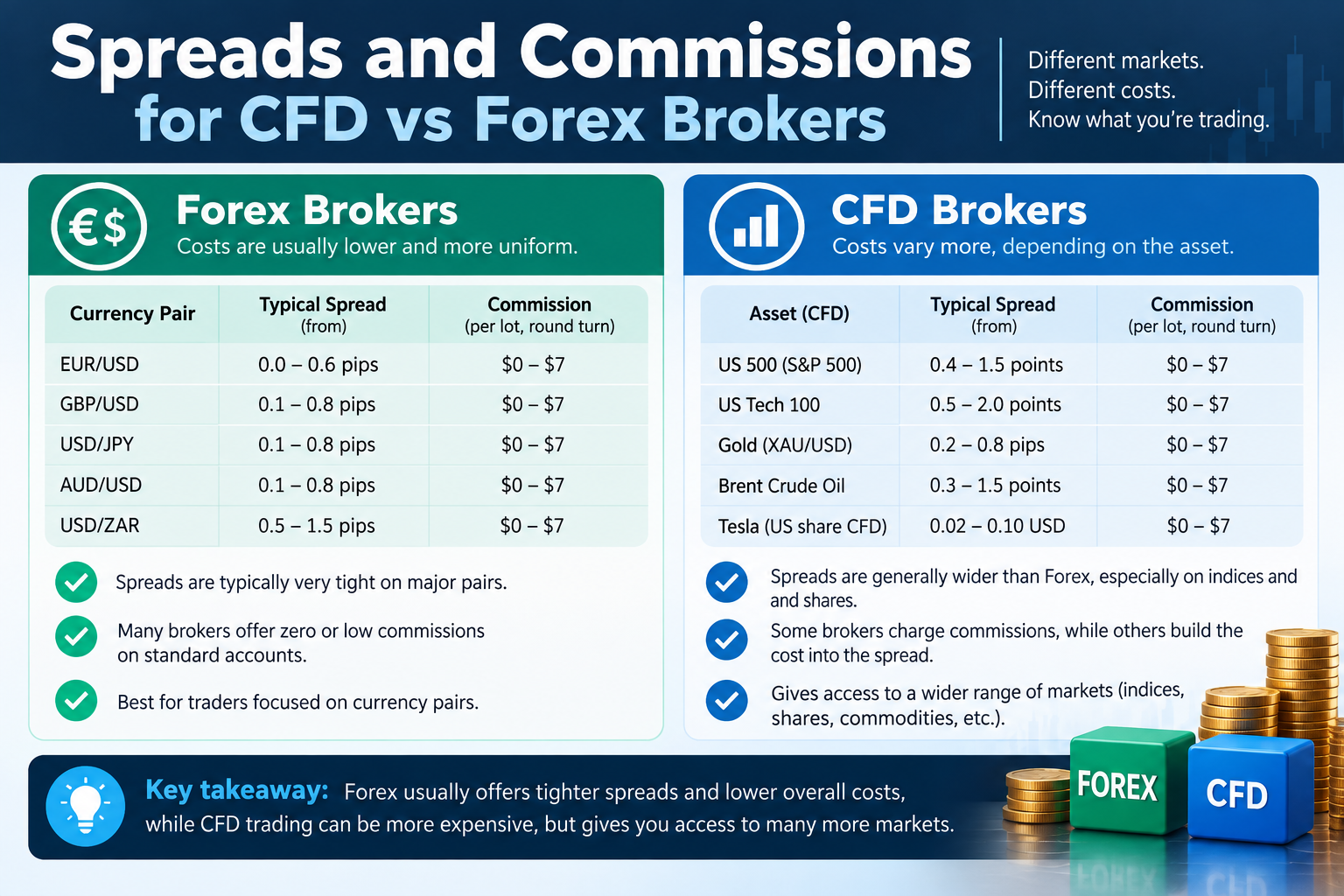
A spread is the gap between the buy and sell price. Some accounts earn revenue through that gap, while other accounts quote a narrower spread and add a separate commission. Zero commission does not mean zero cost, and a low spread does not prove that the final trade cost is lower.
For example, account A quotes a wider spread with no separate commission, while account B quotes a narrower spread plus a commission per lot.
A trader who opens and closes many positions should compare the round-trip cost on the same currency pair and position size. The lower-cost option can change with trade frequency, trade size, and account type.
Overnight finance charges and other fees
A position held past the broker's daily cut-off can incur an overnight finance charge. The amount can differ by instrument, direction, account type, and day. Currency conversion can also add cost when the account currency differs from the currency tied to the instrument.
Deposit fees, withdrawal fees, inactivity fees, and platform charges can affect the result as well.
A South African trader who deposits rand should check whether the broker accepts ZAR directly, whether conversion applies, and which withdrawal route sends money back to the chosen bank account.
Leverage and required account equity: Where risk differs
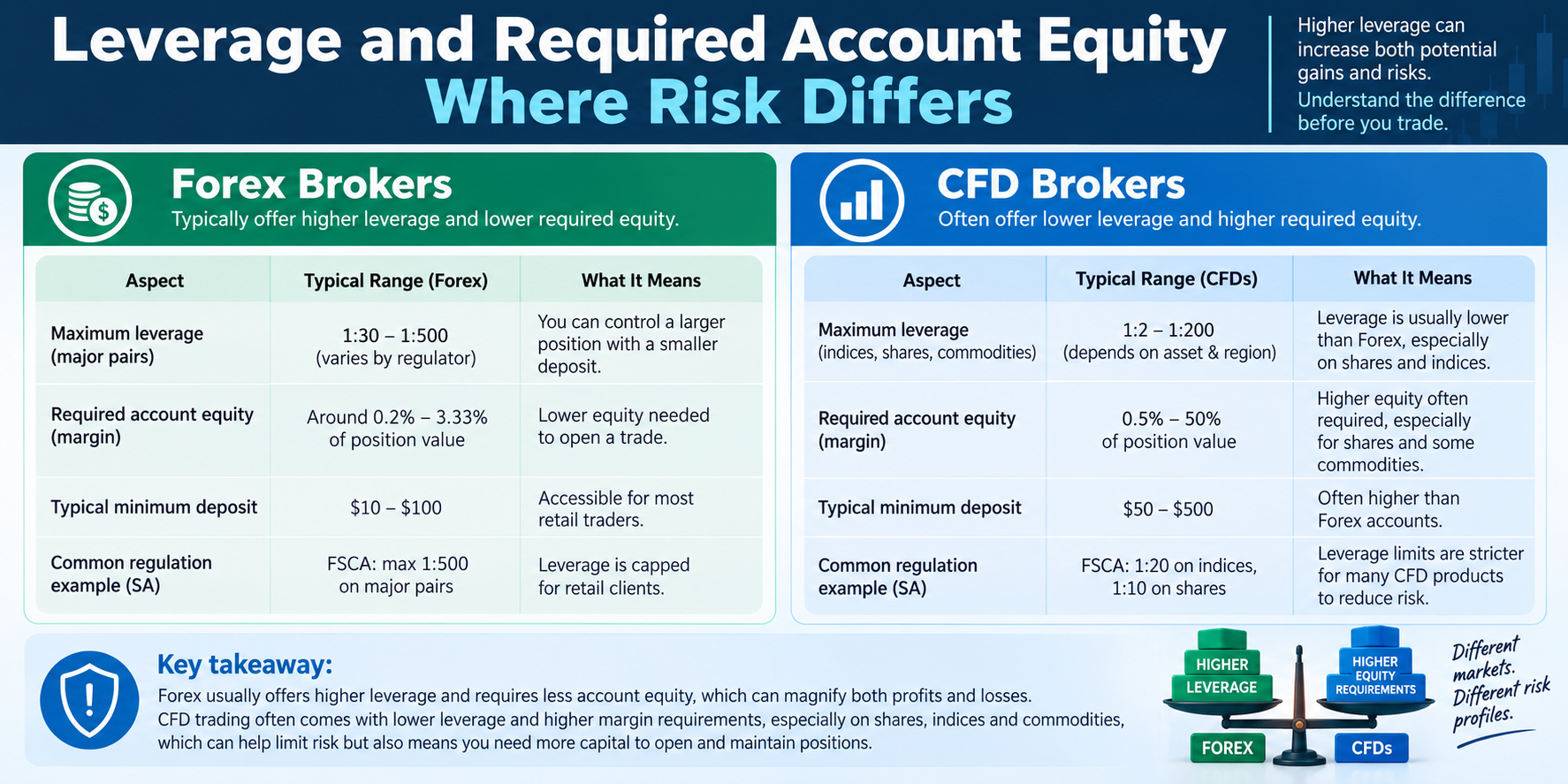
Leverage lets you control a larger market exposure with less cash posted against the position. Greater leverage amplifies both profit and loss.
Therefore, a small price move can have a larger effect on your account equity when the exposure is high. The maximum ratio shown by a broker should never become a target by default.
Required account equity can differ by asset, account type, client classification, and legal entity. A forex pair can have one requirement, while an index or share CFD has another.
Broker labels do not settle the issue, and you must compare the exact contract terms, liquidation rules, stop-out policy, and risk controls tied to the account under review.
Risk note: Leverage amplifies gains and losses, and a higher ratio does not improve account quality. Check the required account equity, liquidation rules, stop-out terms, and the negative balance policy for the exact entity that holds the account. Position size should follow a defined risk limit, not the broker's maximum ratio.
| Factor | What it means | Why it matters |
|---|---|---|
| Maximum leverage | Largest exposure allowed relative to account equity | Higher leverage can magnify losses quickly |
| Required account equity | Capital required to maintain a position | Can vary significantly between instruments |
| Stop-out level | Point where the broker may automatically close positions | Affects how much room a losing position has |
| Margin call level | Threshold where additional funds may be required | Helps traders understand when account pressure increases |
| Negative balance protection | Limits losses beyond available account funds where applicable | Important during sharp market moves |
| Instrument-specific leverage | Different leverage limits for forex, shares, indices and commodities | Advertised maximum leverage may not apply to every market |
Markets and instruments: Forex focus vs multi-asset range
A forex-focused broker usually devotes more of its product range to currency pairs. The offer can include major, minor, exotic, and rand-linked pairs, plus tools aimed at currency analysis.
The same broker can also offer CFDs on other asset classes, which is why “forex broker” does not mean “forex products and nothing else”.
A broader CFD broker can place currencies beside equity indices, commodities, shares, and other reference markets under one account.
Range differs widely between providers. A large catalogue has little benefit if you have no plan for those markets, while a narrow currency range can frustrate someone who wants several asset classes.
A trader who focuses on EUR/USD, GBP/USD, and USD/ZAR could prefer deeper currency choice and a forex-led price model.
Another trader who wants currencies, gold, equity indices, and share CFDs could prefer a multi-asset range. The right fit follows the trade plan, not the promotional label.
| Market | Forex-focused broker | Multi-asset CFD broker |
|---|---|---|
| Major forex pairs | Usually strong | Usually available |
| Minor forex pairs | Often broad | Broker dependent |
| Exotic forex pairs | Often stronger selection | May be more limited |
| ZAR forex pairs | Broker dependent | Broker dependent |
| Gold and silver | Common | Common |
| Indices | Often available | Usually a core market |
| Share CFDs | May be limited | Usually much broader |
| Commodities | Often available | Usually broad |
| Cryptocurrency CFDs | Broker and jurisdiction dependent | Broker and jurisdiction dependent |
Regulation and broker safety in South Africa
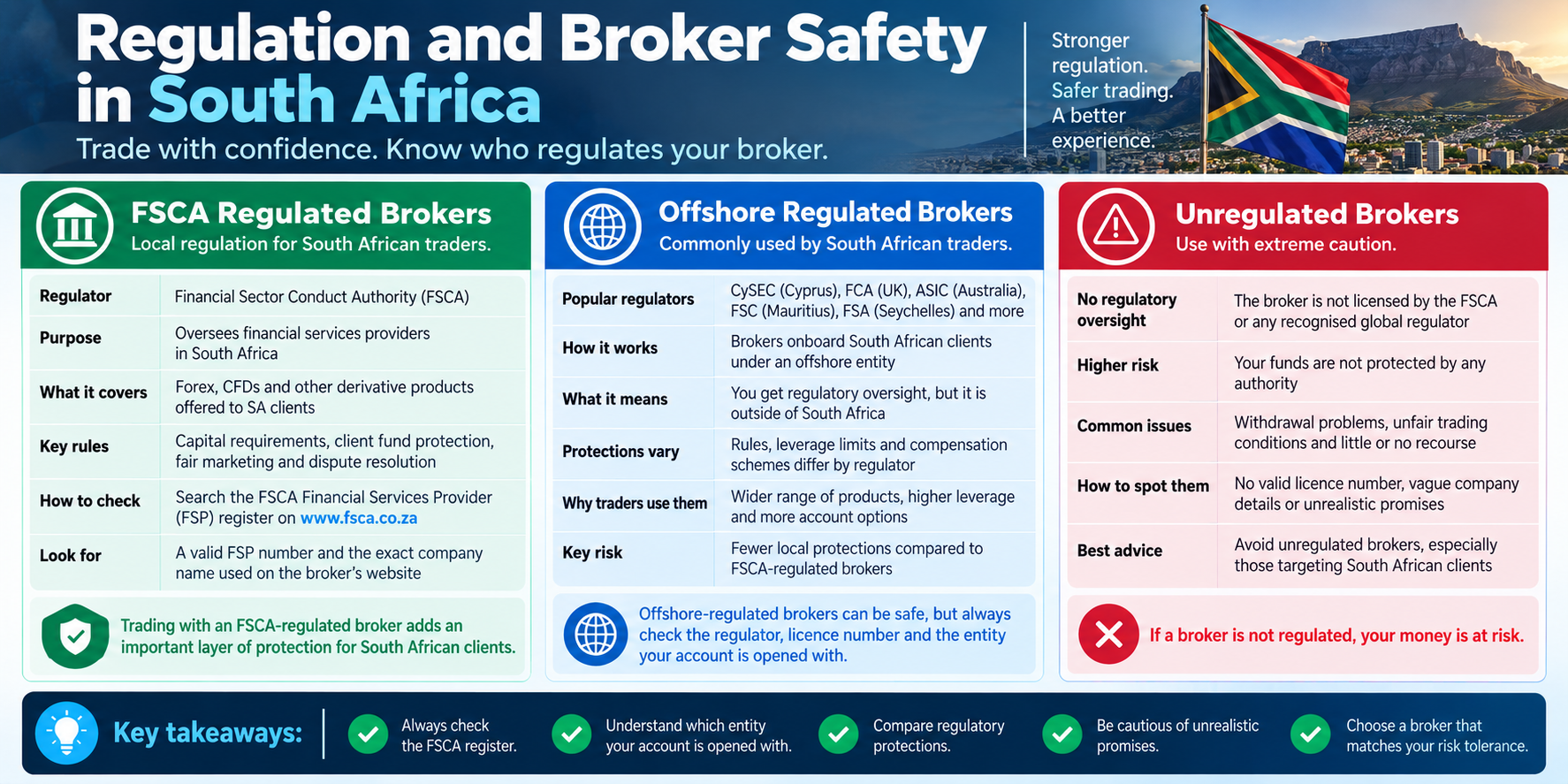
The Financial Sector Conduct Authority regulates market conduct across South Africa's financial sector. Its public FSP search lets consumers check a financial services provider by name or FSP number.
You should match the legal entity on the account documents with the entity recorded by the regulator, not rely on a brand name by itself.
CFD activity can also fall under the over-the-counter derivatives framework. Conduct Standard 1 of 2018 sets criteria for authorisation as an OTC derivatives provider.
Where a provider acts as principal and originates, issues, sells, or makes a market in OTC derivatives, the relevant ODP status should be checked for the activity offered.
A basic verification should cover four points:
- Legal entity: Match the broker's legal entity with the FSCA's authorised provider database.
- FSP details: Confirm that the stated FSP number matches the exact legal entity.
- Product scope: Check whether the authorised product scope covers the account under review.
- ODP status: Confirm relevant ODP authorisation where the provider's OTC derivative activity requires it.
Regulation does not remove market loss risk, poor trade decisions, or product risk. It does, however, give you a route to verify who stands behind the account and which permissions apply.
SAShares' FSCA-regulated broker comparison can help narrow the research list before the trader checks each legal entity directly.
| Regulatory check | What to verify | Why it matters |
|---|---|---|
| Legal entity | Company named in the Client Agreement | Determines which company actually holds the account |
| FSP number | Exact number against FSCA records | Confirms the claimed South African authorisation |
| Product permissions | Whether the authorised scope covers the service offered | An FSP licence does not automatically cover every activity |
| ODP status | Relevant OTC derivatives authorisation where required | Particularly important for CFD providers acting as principal |
| Client fund arrangements | How and where client funds are held | Helps assess operational safeguards |
| Offshore entity | Whether the account is actually opened outside South Africa | Regulatory protections can differ by entity |
| Complaints process | Which regulator or dispute route applies | Important if a dispute occurs |
Which broker type is suitable for you? A decision framework
The choice becomes easier once the trader starts with the intended markets, cost profile, risk limits, and regulatory preference. The table below links common priorities to a likely route:
| Trader priority | Likely fit | Why | What to verify |
|---|---|---|---|
| Mainly currency pairs | Forex-focused broker | Greater forex focus | Pair range and total cost |
| Forex plus indices, commodities, and shares | Multi-asset CFD broker | Wider market range | Asset catalogue and contract terms |
| Lowest forex trade cost | Compare both | Label does not set cost | Spread, commission, and overnight charge |
| Higher leverage | Compare both | Terms differ by entity | Exposure limit and risk controls |
| ZAR deposits and withdrawals | Compare both | Account terms differ | Conversion fee and transfer route |
| SA regulatory fit | Compare exact entities | Brand structure can differ | FSP and relevant ODP status |
When is a forex-focused broker suitable?
A forex-led account can fit a trader whose plan prioritises currency pairs, whose research concentrates on forex, and whose cost review prioritises currency spreads and commissions. Extra asset classes have little purpose when the trader has no strategy for those markets.
When is a multi-asset CFD broker suitable?
A multi-asset account can fit a trader who wants currencies beside indices, commodities, and share CFDs on one platform. The broader range can reduce reliance on several broker accounts, provided the price terms and product rules fit the trader's plan.
Price structure must still be directly compared in either route. SAShares' forex broker comparison and cost-focused broker guides can provide an initial shortlist, while the final check should focus on the exact account, legal entity, and product terms.
How to compare a broker before you open an account
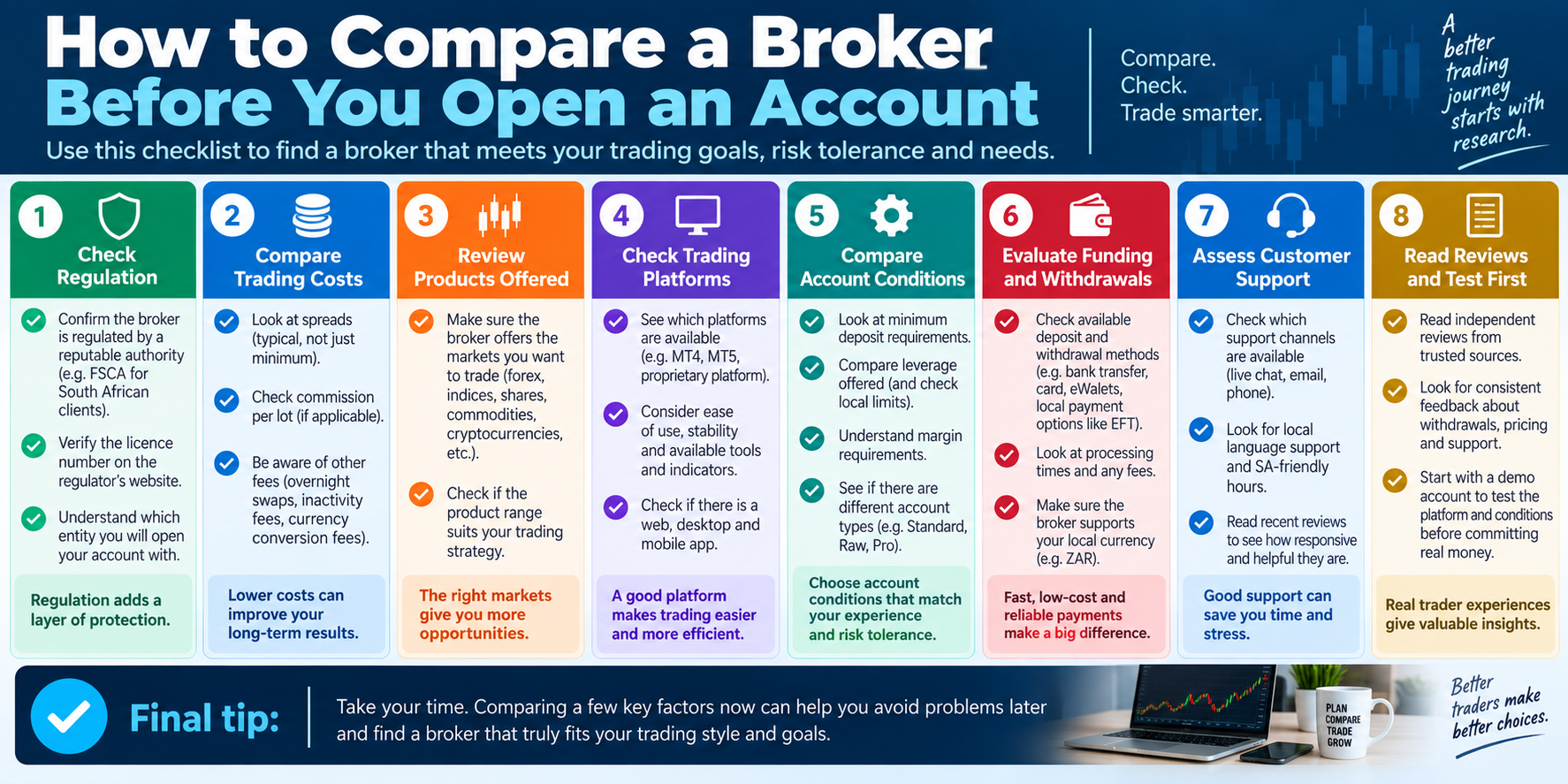
A broker comparison should test the account against your own plan. Six checks cover most of the decision:
- Regulated entity: Verify the company name, FSP details, and relevant permissions.
- Total trade cost: Compare spread, commission, overnight charges, and conversion costs.
- Markets: Confirm the currency pairs and other assets in the trade plan.
- Leverage: Check exposure ratios, required account equity, stop-out rules, and risk controls.
- Deposits and withdrawals: Check ZAR options, conversion charges, routes, and timeframes.
- Platform and support: Review order types, execution information, risk tools, and local support.
Compare like with like. A spread from one account type should not be set beside a commission from another jurisdiction with different product terms. The legal entity, account type, base currency, and trade size should match as closely as possible before any cost conclusion is drawn.
| Check | Questions to ask before opening the account |
|---|---|
| Regulation | Which legal entity will hold my account? Is that exact entity authorised? |
| Trading costs | What will one complete trade cost after spread and commission? |
| Overnight costs | What happens if I keep the position open overnight or over a weekend? |
| Markets | Does the broker offer the forex pairs and CFD markets I actually plan to trade? |
| Leverage | What leverage applies to my account and specific instruments? |
| Risk controls | What are the margin-call, stop-out and negative-balance rules? |
| ZAR funding | Can I deposit and withdraw directly in rand? |
| Currency conversion | When will my funds or trading profits be converted? |
| Withdrawals | Which method is used and are there broker or bank charges? |
| Platform | Does it support the order types and tools my strategy requires? |
| Support | Is assistance available when the markets I trade are open? |
Conclusion
A forex-focused broker can fit a trader who concentrates on currency pairs and wants a forex-led price structure.
A multi-asset CFD broker can fit someone who wants currencies beside indices, commodities, shares, or other markets. Neither category wins by default. Total cost, leverage terms, product range, deposit routes, and the exact regulated entity decide the fit.
SAShares can narrow the research path, but your final choice should follow the account documents and regulator records.
Next move: Compare SAShares broker reviews, then verify the legal entity, price terms, and deposit rules before you open an account.
Frequently asked questions for South African traders
Can one broker offer both forex and CFDs?
Yes. A broker can offer currency pairs alongside CFDs on indices, commodities, shares, and other markets. The label “forex broker” often describes the main commercial focus, not an exclusive product boundary. Check the product catalogue, account terms, and legal entity before a decision on whether the offer fits a currency-led or multi-asset trade plan.
Does a ZAR account remove currency conversion costs?
A ZAR account can reduce conversion at the deposit or withdrawal stage, but it does not guarantee zero currency conversion cost. An instrument tied to another currency can still create conversion effects or broker charges. Check the account base currency, contract specification, conversion method, and withdrawal terms before a comparison of rand-based accounts.
Can South Africans trade through offshore forex or CFD brokers?
South African residents can trade through offshore broker accounts subject to broker eligibility and South African exchange-control rules. Current South African Reserve Bank guidance indicates residents must fund online international broker accounts through the permitted allowance framework and an Authorised Dealer. The guidance also bars South African credit, debit, and virtual cards from that deposit route.
Is higher leverage suitable for beginner traders?
Higher leverage is usually unsuitable as a main broker selection factor for a beginner. It increases market exposure relative to account equity and can accelerate losses after an adverse price move. A beginner should prioritise regulated status, understandable costs, defined risk limits, suitable order controls, and a product range that matches a simple trade plan.
Is forex trading considered CFD trading in South Africa?
Often, yes. Many retail brokers provide forex trading through CFDs or similar leveraged OTC derivative products rather than giving traders ownership of the underlying currencies. Traders should check the broker’s contract specifications and legal documents to understand exactly what product they are trading.
Which is cheaper to trade: forex or CFDs?
Forex can have very competitive spreads, particularly on major pairs such as EUR/USD, but it is not automatically cheaper. CFD costs vary by instrument and may include spreads, commissions, overnight financing, and currency conversion charges. Compare the total cost of the specific instruments you intend to trade.
Do CFD and forex brokers offer ZAR trading accounts?
Some brokers offer ZAR-denominated accounts, while others only support currencies such as USD, EUR, or GBP. A ZAR account can reduce unnecessary conversion when depositing and withdrawing rand, but it does not necessarily eliminate currency conversion costs when trading instruments denominated in another currency.
Which is better for beginners in South Africa: CFDs or forex?
Beginners may find focusing on a smaller number of major forex pairs easier than immediately trading several CFD markets. However, the product label matters less than choosing a properly regulated broker, understanding trading costs and leverage, using sensible position sizes, and learning how losses are controlled before risking real money.
What should South Africans check before choosing a CFD or forex broker?
Start with the exact legal entity and its regulatory status, including applicable FSCA authorisation. Then compare spreads, commissions, overnight fees, leverage, available markets, ZAR funding, withdrawal terms, platforms, and risk controls. The best broker is the one whose actual account conditions match your trading strategy.
What is the main difference between a CFD broker and a forex broker?
A forex broker mainly focuses on currency pairs, while a CFD broker typically provides access to a wider range of markets, including forex, indices, commodities, shares, and sometimes cryptocurrencies. In practice, the categories often overlap, so South African traders should compare the actual products, costs, regulation, and account terms rather than the broker’s label alone.
You Might Also Like




Recommended brokers