South Africa has a formal regulatory route for crypto asset financial services under the Financial Advisory and Intermediary Services Act, or FAIS.
A platform that accepts South African clients is not automatically an authorised local Crypto Asset Service Provider, which makes the legal entity behind an account crucial.
Investors who compare the best CASP brokers in South Africa should check FSCA authorisation, the FSP number, rand deposits and withdrawals, custody, fees, and the South African entity.
Crypto prices can change significantly in a short period, and FSCA authorisation does not protect an investor from market loss, fraud, cyber incidents, or operational failure.
What is the best Crypto Asset Service Provider (CASP) broker in South Africa?
The best Crypto Asset Service Provider depends on what you need from the platform. VALR stands out for active South African traders, while Luno is easier for newer investors. Other CASPs may be better suited to OTC transactions, low-fee ZAR trading, crypto arbitrage, managed portfolios, or clients who want a more specialised service. FSCA authorisation, the legal entity, fees, custody arrangements, rand support, and withdrawal options should all be compared before choosing a provider.
Are CASP brokers safe in South Africa?
FSCA-authorised CASPs operate within South Africa's financial services framework, but regulation does not remove the risks associated with crypto assets. Prices can move sharply, platforms can experience operational or cyber incidents, and custody arrangements differ between providers. Investors should confirm the legal entity and FSP number, understand where assets are held, review withdrawal rules, and check all fees before depositing money.

🏆10 Best Forex Brokers in South Africa
| Rank | Broker | Broker Review | Regulators | Minimum Deposit | Visit Broker |
|---|---|---|---|---|---|
| 🥇 |  | Read Review | ASIC, FSA, CBI, BVI, FSCA, FRSA, CySEC, ISA, JFSA | $100 | Visit Now |
| 🥈 |  | Read Review | FSCA, FCA, DFSA, FSA, CMA | $0 | Visit Now |
| 🥉 |  | Read Review | FSCA, FSC, CYSEC, DFSA, CMA, FSC, FSA | $5 | Visit Now |
| 4 |  | Read Review | ASIC, CySEC, FSA, SCB | $0 | Visit Now |
| 5 |  | Read Review | BVI FSC | $0 | Visit Now |
| 6 |  | Read Review | FSA, FSC, FSCA, ASIC, CMA | $20 | Visit Now |
| 7 |  | Read Review | Exness is a globally regulated broker, holding multiple licenses from respected financial regulators around the world. | $10 | Visit Now |
| 8 |  | Read Review | ASIC, CySEC, FSCA, FSA, FSC, CMA | $100 | Visit Now |
| 9 |  | Read Review | FSC | $10 | Visit Now |
| 10 |  | Read Review | FSA, CySEC, FSCA, FSC | $10 | Visit Now |


What is a CASP broker in South Africa?
A Crypto Asset Service Provider, or CASP, is a business that provides specified financial services in relation to crypto assets. In South Africa, crypto assets fall within the FAIS financial product framework, and firms that provide relevant advice or intermediary services require FSCA authorisation.
“Broker” is convenient search language, but the firms in our guide include exchanges, intermediaries, non-custodial services, and OTC desks.
The FSCA had received 533 CASP licence applications by 31 March 2026. Of those applications, 310 had approval, 17 had declined outcomes, and 124 had voluntary withdrawals. Therefore, an FSP number should be checked against the legal entity, not a logo or promotional claim.
Crypto assets are not legal tender in South Africa, and SARB does not guarantee or back crypto holdings. CASPs also fall within South Africa’s anti-money laundering framework, while the FIC Travel Rule requires specified originator and beneficiary information for relevant crypto transfers.
Top 10 FSCA-authorised crypto providers
This table compares 10 South African CASPs by legal entity, FSP number, service model, rand facilities, fees, and suitable client profile. Fee schedules can change, so check the live order screen and current tariff page before placing an order.
| Provider | FSP number | Service model | ZAR deposits | Fee basis | Suitable for |
|---|---|---|---|---|---|
| VALR | 53308 | Exchange, OTC | EFT, card | Tiered maker/taker | Active traders |
| Luno | 53314 | Exchange, wallet | Rand deposits | Tiered maker/taker | Newer investors |
| AltCoinTrader | 53614 | Local exchange | Rand deposits | Tiered maker/taker | ZAR market traders |
| Dooya | 53712 | Arbitrage, wealth management | ZAR bank account | 20% arbitrage fee; tiered wealth fees | Arbitrage and managed portfolios |
| OVEX | 53922 | Exchange, OTC | Rand services | Service dependent | Large transactions |
| ChainEX | 53799 | Local exchange | ZAR markets | Trade fee schedule | Rand-focused traders |
| Cape Crypto | 53746 | Exchange, OTC | Rand deposits | Exchange and instant-buy fees | Local retail clients |
| AFRIDAX | 54234 | Exchange, OTC | Free EFT | 0% maker, 0.1% taker | Low-fee ZAR trades |
| HODL OTC | 53723 | Intermediary, OTC | ZAR settlement | Spread-based quote | OTC clients |
| Yellow Card SA | 53790 | Crypto platform, OTC | ZAR support | Quote/service dependent | Pan-African clients |
The main differences are not regulatory badges. Custody, order type, fee method, liquidity, rand settlement, and the legal entity behind each product change the client experience. An order book trader has different requirements from an investor who prefers direct delivery to a private wallet.
10 Best Crypto Asset Service Provider (CASP) Brokers (2026):
- VALR – Best overall for active South African traders
- Luno – Best for newer crypto investors
- AltCoinTrader – Best for established local ZAR markets
- Dooya – Best for crypto arbitrage and managed crypto portfolios
- OVEX – Best for OTC and large transactions
- ChainEX – Best for ZAR-based crypto trade
- Cape Crypto – Best for local exchange and crypto infrastructure
- AFRIDAX – Best for low-fee ZAR orders
- HODL OTC – Best for personalised OTC execution
- Yellow Card South Africa – Best for pan-African crypto services
1. VALR
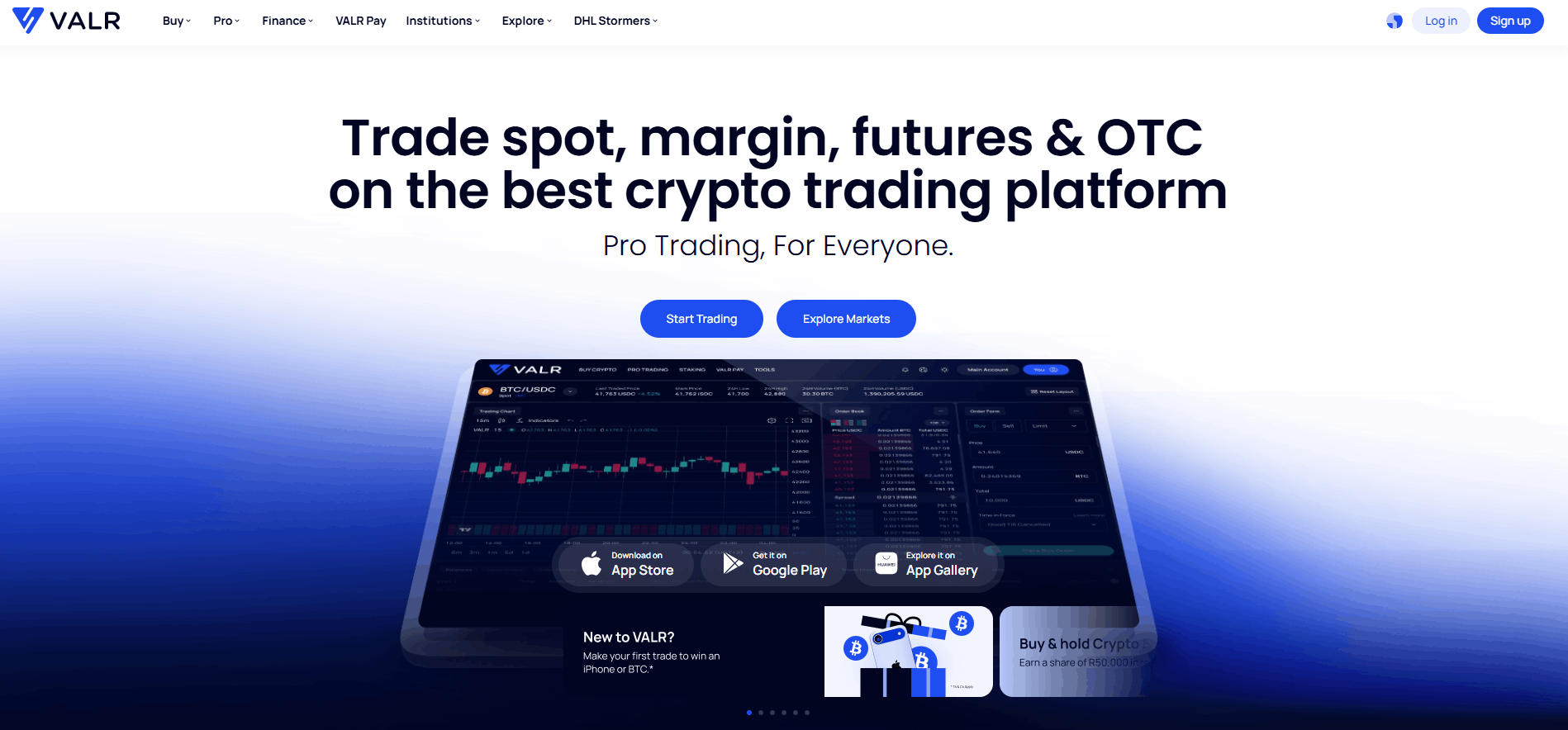
- VALR (Pty) Ltd holds FSP 53308. Its exchange covers spot markets, OTC services, and other crypto products, while ZAR EFT deposits do not face a platform fee.
- Entry-tier spot fiat fees are 0.180% maker and 0.350% taker, and Simple Buy/Sell has a 1.6% fee.
- The product range is suitable for active traders who want more than a basic buy and sell screen.
Features
| Feature | VALR |
|---|---|
| FSCA authorisation | FSP 53308 |
| Service model | Exchange and OTC |
| ZAR funding | EFT and card |
| Trading fees | Tiered maker/taker |
| Suitable for | Active traders |
Pros and Cons
| Pros | Cons |
|---|---|
| FSCA-authorised South African entity | Fee structure varies by transaction type |
| Spot markets and OTC services | Simple Buy/Sell costs more than exchange trading |
| ZAR EFT deposit support | More features can mean a steeper learning curve for complete beginners |
Why is VALR suitable for active South African crypto traders?
VALR combines local ZAR support with exchange trading, OTC services, and a tiered maker/taker fee model. That gives active traders more flexibility than a platform focused only on simplified instant purchases.
Is VALR regulated in South Africa?
Yes. VALR (Pty) Ltd holds FSP 53308. Investors should still confirm that the legal entity attached to their account matches the authorised South African company before depositing funds.
2. Luno
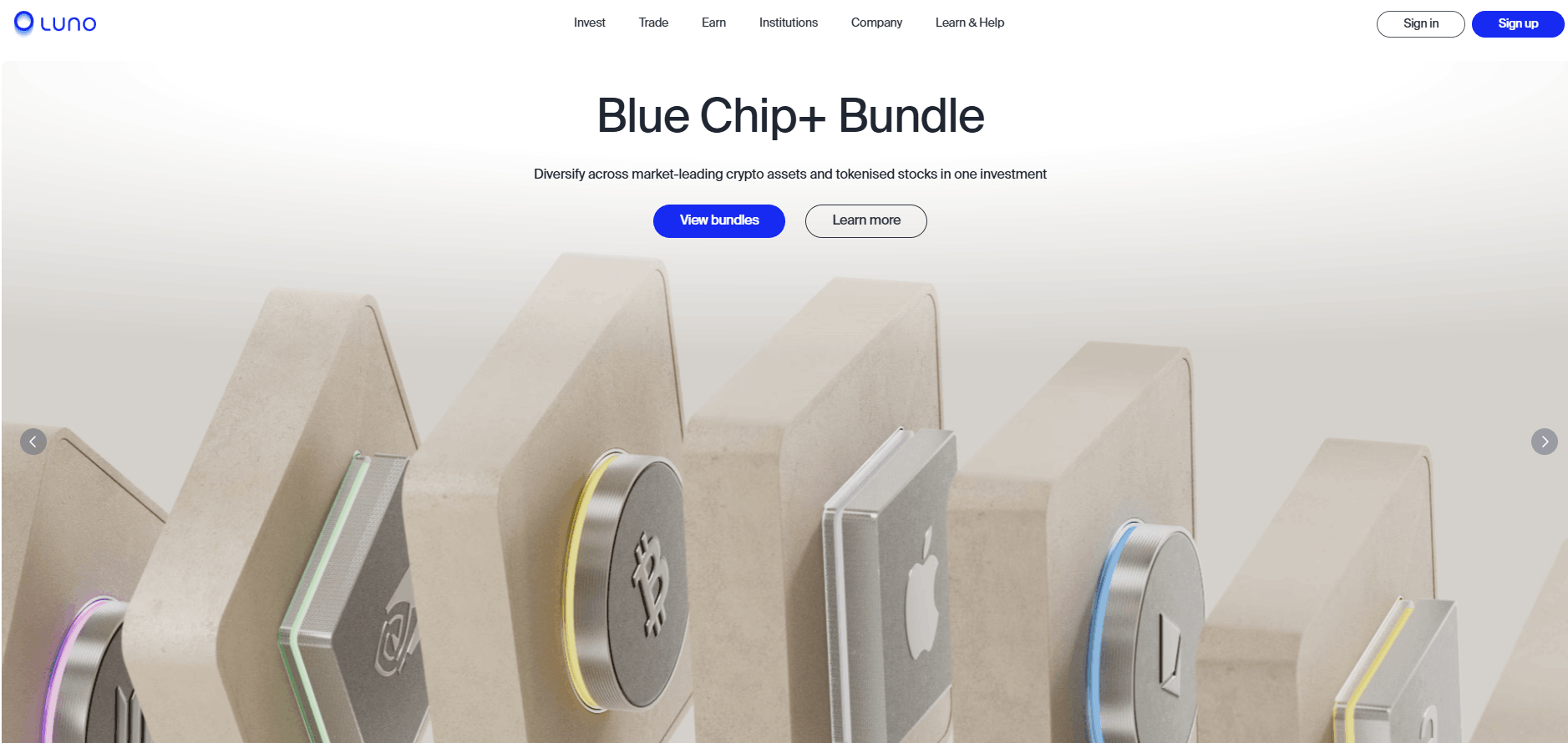
- Luno (Pty) Ltd holds FSP 53314 and combines a retail app, wallet facilities, an exchange, and crypto investment products.
- On standard crypto/ZAR exchange pairs, the entry tier is 0.40% maker and 0.60% taker.
- The interface and educational material are suitable for newer investors, while experienced traders can move to the exchange order book.
Features
| Feature | Luno |
|---|---|
| FSCA authorisation | FSP 53314 |
| Service model | Exchange and wallet |
| ZAR funding | Rand deposits |
| Fee model | Tiered maker/taker |
| Suitable for | Newer investors |
Pros and Cons
| Pros | Cons |
|---|---|
| Simple retail interface | Entry-level exchange fees can be higher than some competitors |
| ZAR support | Advanced users may prefer a broader specialist trading environment |
| Wallet and exchange facilities | Crypto investment remains exposed to market volatility |
Why is Luno suitable for newer crypto investors?
Luno combines a relatively straightforward retail interface with wallet facilities, ZAR support, and educational material. New investors can start with simpler transactions and move to the exchange order book as they become more comfortable.
Is Luno an authorised CASP in South Africa?
Yes. Luno (Pty) Ltd holds FSP 53314. As with any CASP, investors should verify that the account agreement names the same regulated legal entity.
3. AltCoinTrader
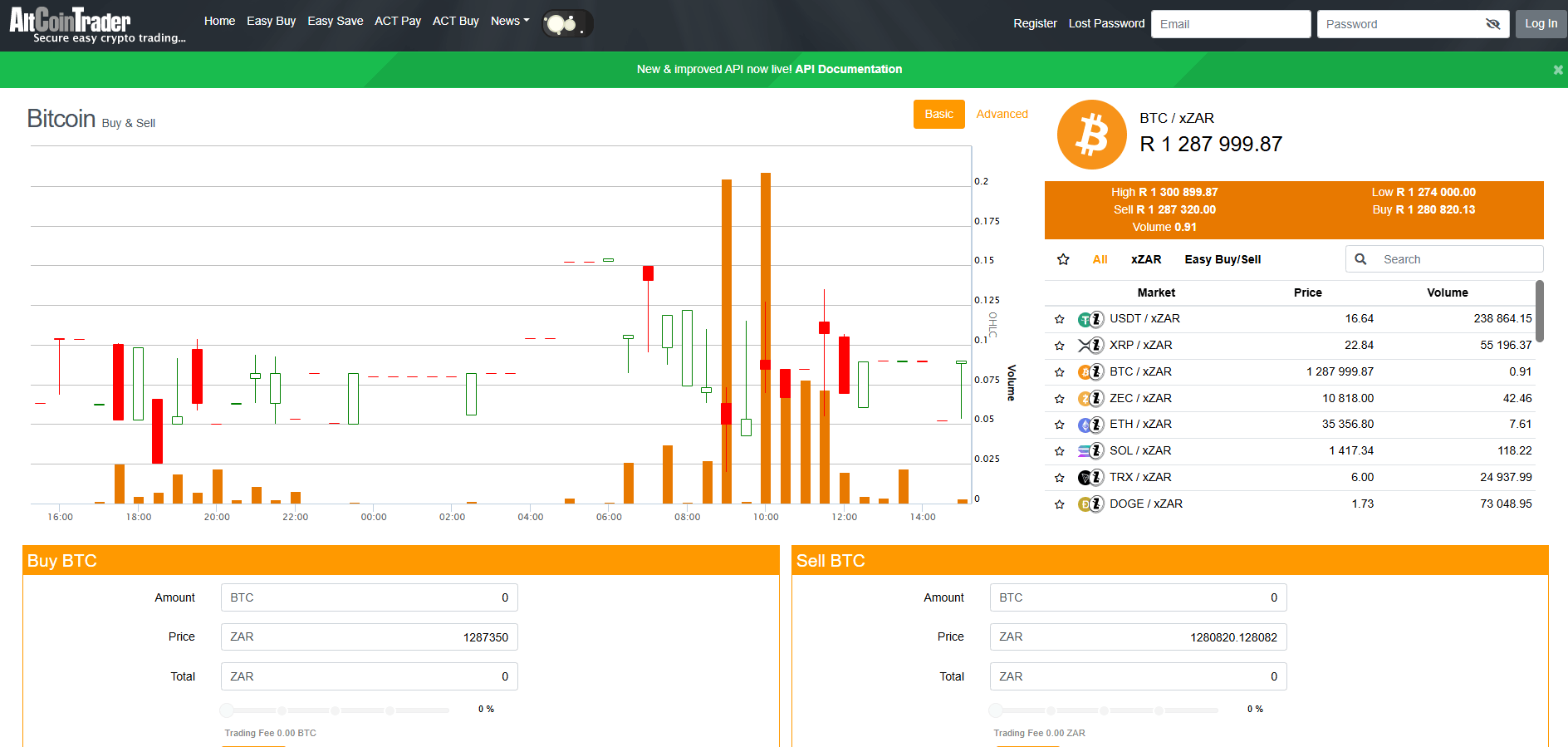
- AltCoin Trader (Pty) Ltd holds FSP 53614 and has served the South African crypto market since 2015.
- Entry-tier exchange fees are 0.50% maker and 0.60% taker, with lower rates at higher 30-day volumes.
- Its 2026 proof-of-reserves material reports an independent statutory audit and reserves above client liabilities, which provides another due diligence check beyond licence status.
Features
| Feature | AltCoinTrader |
|---|---|
| FSCA authorisation | FSP 53614 |
| Service model | Local exchange |
| ZAR funding | Rand deposits |
| Fee model | Tiered maker/taker |
| Suitable for | ZAR market traders |
Pros and Cons
| Pros | Cons |
|---|---|
| Established South African crypto presence | Entry-tier fees are not the lowest in this comparison |
| Local ZAR markets | Higher-volume users receive the stronger fee benefit |
| Proof-of-reserves material provides another due diligence point | Reserve information does not eliminate investment or operational risk |
What makes AltCoinTrader attractive to ZAR-based traders?
AltCoinTrader focuses on the South African market and provides local rand trading facilities. Its established local presence can appeal to users who prefer dealing primarily in ZAR rather than relying on offshore funding routes.
Does AltCoinTrader provide proof-of-reserves information?
Its 2026 proof-of-reserves material reports an independent statutory audit and reserves above client liabilities. Investors should treat this as an additional due diligence check rather than a replacement for regulatory and custody checks.
4. Dooya
- Dooya (Pty) Ltd holds FSP 53712, with Category I and Category II authorisation for crypto assets. Its services cover crypto arbitrage, individual crypto assets, and managed crypto bundles.
- Arbitrage has a 20% service fee on net profit after other fees, while wealth fees vary by portfolio size.
- The service is suitable for South African clients who prefer structured crypto exposure beyond a standard exchange.
Features
| Feature | Dooya |
|---|---|
| FSCA authorisation | FSP 53712 |
| Service model | Arbitrage and wealth management |
| ZAR facility | ZAR bank account |
| Fee model | 20% arbitrage fee; tiered wealth fees |
| Suitable for | Arbitrage and managed portfolios |
Pros and Cons
| Pros | Cons |
|---|---|
| Category I and Category II crypto asset authorisation | 20% arbitrage service fee on net profit after other fees |
| Managed crypto portfolio options | Fee structure is more complex than basic exchange trading |
| Offers services beyond standard exchange trading | Not aimed primarily at users who only want straightforward spot trading |
Who is Dooya best suited to?
Dooya is better suited to clients looking for crypto arbitrage or managed crypto exposure rather than only a conventional exchange account. Its portfolio-based services give investors a different route into the crypto market.
How does Dooya charge for crypto arbitrage?
The arbitrage service has a 20% service fee on net profit after other fees. Wealth-management fees vary according to portfolio size, so investors should review the applicable cost schedule before investing.
5. OVEX
- OVEX (Pty) Ltd holds FSP 53922 and has a material institutional, commercial, and OTC focus besides its exchange services.
- Its product set extends beyond a simple retail crypto screen, which can fit businesses or clients with large execution requirements.
- Eligibility and price can depend on the service, transaction size, and compliance review; a quote should be assessed before confirming the transaction.
Features
| Feature | OVEX |
|---|---|
| FSCA authorisation | FSP 53922 |
| Service model | Exchange and OTC |
| ZAR support | Rand services |
| Fee model | Service dependent |
| Suitable for | Large transactions |
Pros and Cons
| Pros | Cons |
|---|---|
| Strong OTC and institutional focus | Pricing can depend on the individual service |
| Suitable for larger transaction sizes | Eligibility may involve additional compliance review |
| Offers more than a basic retail exchange service | Less straightforward for users wanting simple small purchases |
Why is OVEX suited to large crypto transactions?
OVEX has a significant OTC, institutional, and commercial focus. That can make it more appropriate for clients who need larger execution sizes or more specialised transaction arrangements than a standard retail crypto screen provides.
Are OVEX fees fixed?
Not necessarily. Eligibility and pricing can depend on the service, transaction size, and compliance review. Clients should assess the quote and full transaction cost before confirming an OTC trade.
6. ChainEX
- ChainEX (Pty) Ltd holds FSP 53799 and is a South African exchange with ZAR crypto markets, mobile facilities, and API support.
- Fees apply to successful trades and withdrawals, with tariff information linked from its support material.
- ChainEX is suitable for traders who prefer a local exchange and rand-denominated markets, but the current fee schedule should be checked before execution.
Features
| Feature | ChainEX |
|---|---|
| FSCA authorisation | FSP 53799 |
| Service model | Local exchange |
| ZAR support | ZAR markets |
| Fee basis | Trade fee schedule |
| Suitable for | Rand-focused traders |
Pros and Cons
| Pros | Cons |
|---|---|
| South African exchange with ZAR markets | Trading and withdrawal charges should be checked before execution |
| Mobile facilities | Fee schedules can change |
| API support | Primarily suited to traders who specifically want local rand markets |
Is ChainEX suitable for traders who prefer ZAR markets?
Yes. ChainEX is a South African exchange with rand-denominated crypto markets, which can make funding and trading easier for clients who prefer to keep their activity centred on ZAR.
Does ChainEX support API trading?
Yes. ChainEX provides API support alongside its exchange and mobile facilities. Traders should still check its latest trading and withdrawal fee schedule before executing transactions.
7. Cape Crypto
- Cape Crypto (Pty) Ltd holds FSP 53746 and provides an exchange, simplified buy and sell facilities, OTC services, and Bitcoin Lightning functionality.
- The company also provides API crypto infrastructure to fintech firms and banks.
- Retail clients should compare the exchange price with the simplified purchase route because fee treatment and execution can differ between the two routes.
Features
| Feature | Cape Crypto |
|---|---|
| FSCA authorisation | FSP 53746 |
| Service model | Exchange and OTC |
| ZAR funding | Rand deposits |
| Fee model | Exchange and instant-buy fees |
| Suitable for | Local retail clients |
Pros and Cons
| Pros | Cons |
|---|---|
| Exchange and simplified buy/sell facilities | Costs can differ between the exchange and simplified purchase routes |
| OTC services | Users need to compare execution methods before purchasing |
| Bitcoin Lightning and API infrastructure | Different products may have different fee treatment |
What services does Cape Crypto offer?
Cape Crypto combines exchange trading with simplified buying and selling, OTC services, Bitcoin Lightning functionality, and API infrastructure. That gives it a broader service range than a platform focused purely on retail spot trading.
Should I use Cape Crypto's exchange or instant-buy option?
That depends on the price and fee treatment available when you transact. Retail clients should compare the exchange route with the simplified purchase option because execution and overall costs can differ.
8. AFRIDAX
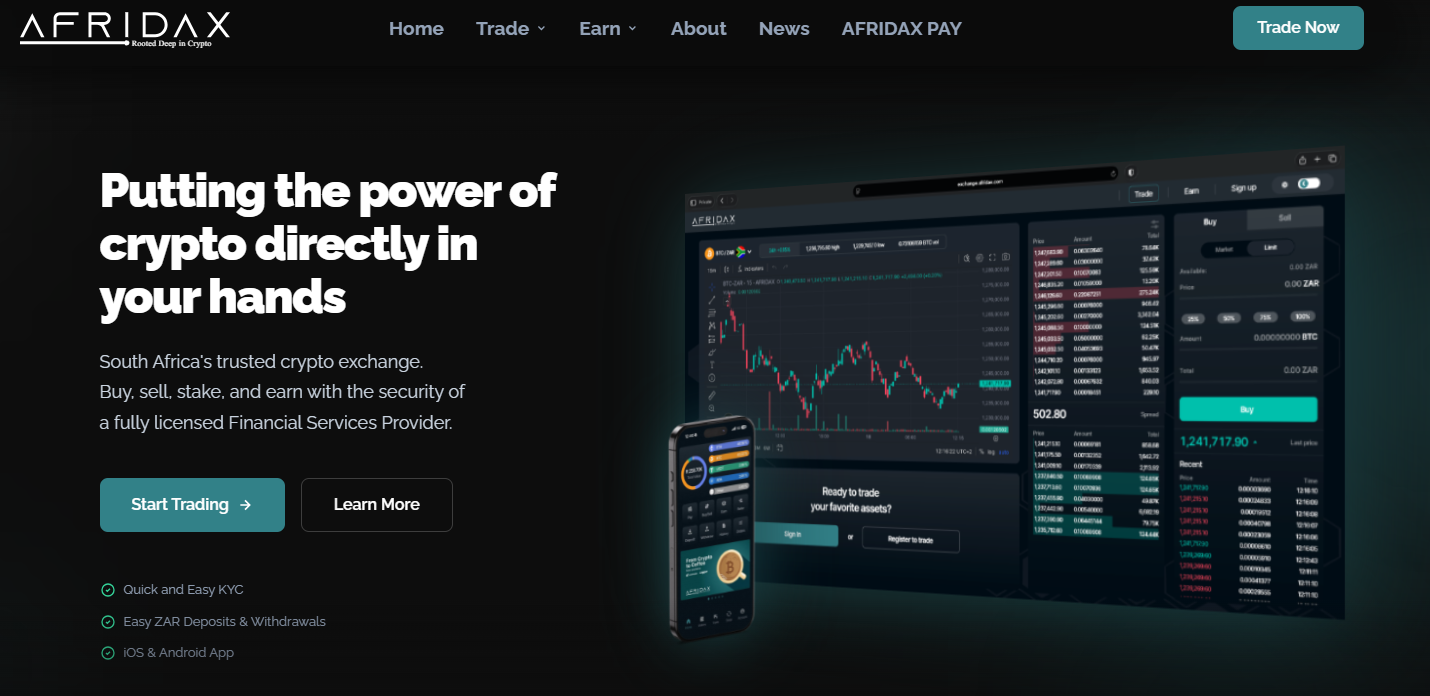
- AFRIDAX (Pty) Ltd holds FSP 54234. Its current tariff has a 0% maker fee, a 0.1% taker fee, free ZAR EFT deposits, a R15 standard ZAR withdrawal fee, and a R60 instant ZAR withdrawal fee.
- The platform also has spot markets, OTC services, stake services, and crypto-to-rand payment facilities, which broaden the service beyond spot orders.
Features
| Feature | AFRIDAX |
|---|---|
| FSCA authorisation | FSP 54234 |
| Service model | Exchange and OTC |
| ZAR funding | Free EFT |
| Trading fees | 0% maker, 0.1% taker |
| Suitable for | Low-fee ZAR trades |
Pros and Cons
| Pros | Cons |
|---|---|
| 0% maker fee | ZAR withdrawal fees apply |
| 0.1% taker fee | Instant withdrawals cost more than standard withdrawals |
| Free ZAR EFT deposits | Fee schedules can change |
Why is AFRIDAX attractive to fee-conscious ZAR traders?
Its current tariff includes a 0% maker fee, a 0.1% taker fee, and free ZAR EFT deposits. This makes the platform particularly relevant to traders who compare transaction costs closely.
Does AFRIDAX charge for ZAR withdrawals?
Yes. The current tariff has a R15 standard ZAR withdrawal fee and a R60 instant ZAR withdrawal fee, so the withdrawal method should be included when calculating the total cost of using the platform.
9. HODL OTC
- HODL OTC (Pty) Ltd holds FSP 53723 and provides intermediary services for crypto transactions without general financial advice.
- While there is no separate trade fee for ZAR-to-crypto conversion, the quoted price contains a broker spread from 0.2% to 2.4%, based on the crypto asset.
- ZAR withdrawals have a R60 charge, which should be included when you compare transaction costs.
Features
| Feature | HODL OTC |
|---|---|
| FSCA authorisation | FSP 53723 |
| Service model | Intermediary and OTC |
| ZAR facility | ZAR settlement |
| Pricing model | Spread-based quote |
| Suitable for | OTC clients |

Pros and Cons
| Pros | Cons |
|---|---|
| Personalised OTC execution | Quoted price includes a broker spread |
| ZAR settlement | Spread can range from 0.2% to 2.4% |
| No separate trade fee for ZAR-to-crypto conversion | R60 ZAR withdrawal charge |
How does HODL OTC charge for crypto transactions?
There is no separate trade fee for ZAR-to-crypto conversion, but the quoted price contains a broker spread ranging from 0.2% to 2.4%, depending on the crypto asset.
Is HODL OTC suitable for investors who want personalised execution?
Yes. HODL OTC focuses on intermediary and OTC services rather than a conventional public exchange model, which can suit clients who prefer a more personalised transaction process.
10. Yellow Card South Africa
- Yellow Card Financial South Africa (Pty) Ltd is a Category I FSP with crypto asset authorisation under FSP 53790.
- South African resident clients contract with the local entity, while the wider group serves several African markets.
- The service covers crypto purchase, sale, transfer, storage, and commercial OTC facilities, which are suitable for clients with a wider African remit.
Features
| Feature | Yellow Card South Africa |
|---|---|
| FSCA authorisation | FSP 53790 |
| Service model | Crypto platform and OTC |
| ZAR availability | ZAR support |
| Fee basis | Quote/service dependent |
| Suitable for | Pan-African clients |
Pros and Cons
| Pros | Cons |
|---|---|
| South African Category I FSP | Pricing can depend on the service or quote |
| Purchase, sale, transfer and storage facilities | Users must confirm which group entity provides each service |
| Broader African market presence | Cross-border activity can involve additional legal considerations |
Why is Yellow Card suitable for clients with a wider African remit?
The wider Yellow Card group operates across several African markets, while South African resident clients contract with the local authorised entity. Its service range also extends to commercial OTC facilities.
Which Yellow Card entity serves South African clients?
Yellow Card Financial South Africa (Pty) Ltd is the local Category I FSP with crypto asset authorisation under FSP 53790. Clients should confirm that this entity appears in the terms attached to their South African account.
How we ranked the CASP brokers
The order gives regulatory status priority, followed by rand functionality, fees, custody, product scope, and client fit. An FSCA licence is an entry requirement for this comparison, not proof that one platform is safer or more profitable than another.
- Current South African authorisation and legal-entity match
- ZAR deposits, withdrawals, and local bank compatibility
- Fees, spreads, and transaction-cost transparency
- Custody model, security controls, and asset withdrawals
- Product scope, support, and client suitability
Regulatory verification and the legal entity under the client contract should precede feature comparisons, especially where a global brand has several subsidiaries.
Local CASP authorisation vs offshore crypto services
A crypto website can accept a South African client without the same regulatory relationship as an FSCA-authorised South African CASP.
Local authorisation tells you which South African legal entity has permission for specified FAIS activities; it does not automatically extend to every offshore affiliate, derivative product, wallet service, or cross-border transfer.
| Check | South African authorised CASP | Offshore or global platform | Verify before depositing |
|---|---|---|---|
| Legal entity | South African company | Foreign company possible | Company in client contract |
| Regulatory status | FSCA authorisation | Foreign regime possible | Regulator and scope |
| ZAR facilities | Often direct local rails | Card, bank, or other routes | Deposit and withdrawal path |
| Cross-border element | Domestic service possible | Foreign transfer possible | Current SARB rules |
South Africa’s cross-border crypto framework is still under policy development. A draft Crypto Assets Manual proposes a framework for cross-border crypto transfers, but draft provisions are not final law and should not be treated as current enforceable requirements.
A global brand can have a South African subsidiary for one product and a foreign subsidiary for another.
The logo can look identical while the contract, regulator, dispute route, custody arrangement, and cross-border treatment differ, which is why you should verify the legal entity on the terms page before depositing funds.
How to verify a CASP before you deposit
A licence check can expose a mismatch between a brand, a legal entity, and the service attached to an account. Here is how you can verify a CASP:
- Search the FSCA regulated entity register and confirm the FSP number beside the exact company name.
- Match that company and FSP number with the legal terms attached to the account you plan to open.
- Confirm that the crypto service you want falls under the relevant entity and authorised activity.
- Review fees, rand withdrawal terms, custody, wallet withdrawal rules, complaints procedures, and risk disclosures before payment.
A logo, app store page, or social media profile is not enough evidence of authorisation. The FSCA provides an FSP search facility and a current CASP publication, which gives investors a direct route to verify the provider before money leaves a bank account.
Final takeaway
When you compare a South African CASP, you should start with the legal entity and FSCA authorisation, then move to rand facilities, fees, custody, liquidity, wallet withdrawals, and product scope.
The cheapest advertised fee is not enough if the service model does not match how you intend to buy, hold, transfer, or sell crypto.
Crypto assets can lose substantial market value, and regulatory authorisation does not remove investment or operational risk. Verify the provider first, compare the exact service second, and commit capital after the costs and custody terms are understood.
Conclusion
The 10 Best Crypto Asset Service Provider (CASP) Brokers in South Africa are not all built for the same type of crypto user. VALR may make more sense for active traders, while Luno is easier for newer investors. AFRIDAX focuses strongly on low-cost ZAR transactions; HODL OTC and OVEX are more specialised toward OTC execution; and Dooya takes a different route with arbitrage and managed crypto portfolios. Regulation should be the starting point, but it should not be the only deciding factor. The legal entity, custody setup, fees, withdrawal process, ZAR support, liquidity, and the actual service you plan to use matter just as much.
You might also like:
- Best Crypto Brokers for Beginners
- Best Cryptocurrency Trading Platforms
- Best Cryptocurrencies for Scalping
- Best Crypto Brokers
- Best Forex Brokers South Africa
Frequently asked questions
Does FSCA authorisation guarantee that crypto is safe?
FSCA authorisation does not guarantee investment returns or protect crypto prices from loss. It confirms regulatory approval for financial services under FAIS. Market volatility, fraud, cyber incidents, liquidity problems, wallet errors, and business failure can still cause losses, which makes product-level due diligence necessary even with an authorised CASP.
Can South Africans deal with offshore crypto platforms?
South Africans can face different legal and exchange control considerations when crypto activity crosses borders. Platform availability does not equal South African CASP authorisation, and the company under the client contract can be foreign. Current SARB rules and any later final cross-border framework should be checked before a transaction that moves capital outside South Africa.
How do I check a CASP’s FSCA status?
Search the FSCA FSP register, match the legal company name and FSP number, and confirm crypto asset authority under the relevant licence. The terms attached to the account should show the same entity. A mismatch between the website brand and the regulated company warrants further verification before a deposit.
Are spot crypto and crypto derivatives regulated in the same way?
Product type can change the regulatory analysis. An entity with crypto asset authorisation for intermediary services does not automatically have permission for every derivative, discretionary product, or foreign product attached to the same brand. Check the legal entity, product terms, and regulatory permissions for the exact service before you commit funds.
What does CASP mean in South Africa?
CASP means Crypto Asset Service Provider. In South Africa, the term applies to businesses providing specified financial services in relation to crypto assets. Firms that provide relevant advice or intermediary services must operate within the applicable FAIS framework and obtain the necessary FSCA authorisation.
Do all crypto platforms operating in South Africa have an FSCA CASP licence?
No. A crypto platform being available to South African users does not automatically mean the platform or the legal entity behind the account is an FSCA-authorised CASP. Always check the exact company name and FSP number rather than relying only on the brand name shown on a website or mobile app.
What should I compare when choosing a CASP broker?
Start with FSCA authorisation and the legal entity behind the account, then compare fees, ZAR deposits and withdrawals, custody, wallet withdrawal support, liquidity, security controls, product availability, and customer support. The cheapest advertised trading fee is not necessarily the cheapest overall service once spreads and withdrawal costs are included.
Can I deposit South African rand with a CASP?
Many South African CASPs support ZAR funding, but the available method varies by provider. Some support EFT deposits, while others provide different bank, card, or settlement arrangements. Check deposit fees, processing times, minimum amounts, withdrawal options, and whether the bank account belongs to the authorised legal entity before transferring funds.
Do I own the cryptocurrency when using a CASP?
That depends on the service. Some CASPs allow users to buy and hold actual crypto assets and may support withdrawals to private wallets. Other services can involve managed portfolios, intermediary arrangements, OTC execution, or different product structures. Check the product terms and custody arrangement before assuming that crypto can be withdrawn to your own wallet.
Which CASP is best for beginners in South Africa?
Luno can be suitable for newer investors because it combines a relatively simple retail interface with rand facilities, wallet functionality, educational material, and access to an exchange order book. The right provider still depends on the crypto assets you want, your preferred payment method, fees, custody requirements, and how actively you plan to trade.
Which CASP is best for active crypto traders?
VALR can suit active South African traders because it offers spot markets, OTC services, ZAR funding, and a tiered maker/taker fee structure. More active traders should still compare liquidity, order types, withdrawal charges, custody arrangements, and the current fee tier that applies to their expected trading volume.
Which CASP has low trading fees?
AFRIDAX stands out in this comparison with its current 0% maker and 0.1% taker fee structure alongside free ZAR EFT deposits. Trading fees are only one part of total cost, though. Withdrawal fees, spreads, instant-purchase charges, and service-specific pricing should also be included when comparing platforms.
You Might Also Like




Recommended brokers