
The trade itself does not have to become larger when leverage increases. What changes is the amount of your capital required to open it: 1:500 requires one-fifth of the amount needed at 1:100 for the same exposure.
How does 1:500 leverage affect my trading account compared to 1:100?
With 1:500 leverage, you need less money to open the same trade. For example, a R100,000 position requires R200 in margin at 1:500, compared to R1,000 at 1:100. That leaves more available funds in your account, but it doesn't reduce the risk. If the market moves against your position, your losses will be the same at either leverage ratio, assuming the trade size stays unchanged.

🏆10 Best Forex Brokers in South Africa
| Rank | Broker | Broker Review | Regulators | Minimum Deposit | Visit Broker |
|---|---|---|---|---|---|
| 🥇 |  | Read Review | ASIC, FSA, CBI, BVI, FSCA, FRSA, CySEC, ISA, JFSA | $100 | Visit Now |
| 🥈 |  | Read Review | FSCA, FCA, DFSA, FSA, CMA | $0 | Visit Now |
| 🥉 |  | Read Review | FSCA, FSC, CYSEC, DFSA, CMA, FSC, FSA | $5 | Visit Now |
| 4 |  | Read Review | ASIC, CySEC, FSA, SCB | $0 | Visit Now |
| 5 |  | Read Review | BVI FSC | $0 | Visit Now |
| 6 |  | Read Review | FSA, FSC, FSCA, ASIC, CMA | $20 | Visit Now |
| 7 |  | Read Review | Exness is a globally regulated broker, holding multiple licenses from respected financial regulators around the world. | $10 | Visit Now |
| 8 |  | Read Review | ASIC, CySEC, FSCA, FSA, FSC, CMA | $100 | Visit Now |
| 9 |  | Read Review | FSC | $10 | Visit Now |
| 10 |  | Read Review | FSA, CySEC, FSCA, FSC | $10 | Visit Now |


Can I lose my entire deposit faster with 1:500 leverage than with 1:100?
Yes, especially if you use 1:500 leverage to open larger positions than your account can comfortably support. Higher leverage allows you to control more money with a smaller margin requirement, but even a small market movement can cause significant losses when your position is too large. If you keep your position size the same, however, both leverage ratios produce the same market profit or loss before trading costs.
Key point
A R100,000 position requires R1,000 upfront at 1:100 leverage and R200 at 1:500 under a simple fixed-ratio calculation.
What changes is the amount of your own capital committed at the outset, not the rand impact of a price change on the same position. A 1% decline equals R1,000 in either case before trading costs.
Quick Answer for South African Traders
| Question | Quick answer |
|---|---|
| What does 1:100 mean? | A R100,000 position needs R1,000 of initial margin in a simple fixed-ratio example. |
| What does 1:500 mean? | The same R100,000 position needs R200 of initial margin. |
| Does higher leverage reduce losses? | No. An unchanged position has the same market exposure. |
| What creates more risk? | Using available leverage to increase total position size. |
| What should traders check? | Account equity, instrument terms, margin close-out levels and trading costs. |
How 1:100 and 1:500 Leverage Work in South Africa
- What is the difference between 1:100 and 1:500 leverage?
- How much capital does each leverage ratio require?
- Why the same position can lose the same amount at either leverage
- How higher leverage can increase total exposure
- What South African traders should check before they choose leverage
- How leverage affects margin and available account equity
- What happens when a leveraged position moves against you?
- 1:100 vs 1:500 leverage with a R5,000 trading account
- How position size changes the risk
- Margin level, stop-out and forced liquidation explained
- How leverage changes risk across forex, gold and indices
- When 1:100 leverage may be more suitable
- When 1:500 leverage demands extra care
- How spreads, overnight costs and slippage affect leveraged trades
- How to calculate position size before selecting leverage
- Common leverage mistakes South African beginners make
- Quick leverage checklist before opening a trade
- Who this guide is for
- Who this guide is not for
- Realistic expectations about leveraged trading
- Quick Summary Table: 1:100 vs 1:500
- Frequently asked questions about 1:100 and 1:500 leverage
- Final thoughts: A lower deposit requirement does not reduce market risk
What is the difference between 1:100 and 1:500 leverage?

Leverage compares the size of your trade with the amount of your own money required to open the position. Under a fixed 1:100 ratio, each R1 of required deposit supports R100 of notional exposure. Under 1:500, each R1 supports R500.
The larger ratio reduces the deposit required for the same exposure, which leaves more account equity uncommitted.
The table below holds the notional position at the same level wherever a direct comparison appears.
| Factor | 1:100 leverage | 1:500 leverage |
|---|---|---|
| Simplified deposit rate | 1% | 0.2% |
| Deposit on R100,000 | R1,000 | R200 |
| Capital committed | Higher | Lower |
| Price exposure at R100,000 | R100,000 | R100,000 |
| Loss from a 1% adverse move | R1,000 | R1,000 |
| Capacity from the same deposit | Lower | Higher |
The lower deposit requirement at 1:500 gives a trader more room to open larger positions or several positions.
Risk increases when that extra capacity leads to greater notional exposure. A trader who holds the same R100,000 position at either ratio has the same market exposure before costs, while the required deposit differs.
How much capital does each leverage ratio require?
The initial deposit is the capital that a provider requires before a leveraged position can open. It supports the position but is not the purchase price of the reference asset, and it is not a fee. The simple fixed-ratio calculation divides the notional position by the leverage ratio.
Required deposit = Notional position ÷ leverage ratio
With leverage of 1:100, the reciprocal of 100 equals 1%. When traders use leverage of 1:500, the reciprocal of 500 equals 0.2%. Thus, a fixed-ratio example produces a fivefold difference in the amount of capital committed to the same trade.
The figures below assume a fixed ratio and no product-specific adjustment.
| Position amount | Deposit at 1:100 | Deposit at 1:500 | Difference |
|---|---|---|---|
| R50,000 | R500 | R100 | R400 |
| R100,000 | R1,000 | R200 | R800 |
| R250,000 | R2,500 | R500 | R2,000 |
| R500,000 | R5,000 | R1,000 | R4,000 |
Each row follows the same arithmetic. A R250,000 position at 1:100 requires R2,500, while 1:500 requires R500.
The R2,000 difference is left in the account until another requirement, loss, fee, withdrawal, or position affects the balance. The lower deposit does not reduce the notional exposure attached to the R250,000 position.
Provider requirements can differ by instrument, account classification, exposure tier, and market conditions. Some providers apply higher deposit percentages to larger positions or various products.
Therefore, the applicable product specification must take priority over a simplified ratio example. Current provider documentation confirms both tier-based requirements and leverage adjustments linked to account equity or defined market periods.
Why the same position can lose the same amount at either leverage
Profit and loss are tied to the size of the market exposure and the price move, not to the initial deposit by itself.
If two trades each have R100,000 of notional exposure, the same percentage move produces the same simplified rand change before spreads, commission, finance charges, slippage, currency conversion, and provider close-out rules.
Leveraged CFD profit and loss calculations apply to the size of the trade exposure rather than the initial deposit.
For example, consider a R100,000 position under each leverage ratio.
At 1:100, the required deposit is R1,000. At 1:500, the required deposit is R200. If the market moves 0.5% against the position, the simplified loss is R500 in either case.
If the market moves 1% against the position, the simplified loss is R1,000 in either case. The leverage ratio changes how much capital supports the trade; it does not change the price move applied to the R100,000 exposure.
Therefore, a trader can lose several times the initial deposit attached to a highly leveraged position if the provider’s close-out process does not end the trade before that point, subject to the account terms and any negative-balance protection that applies.
The example is deliberately simple. Real Forex and CFD results can differ because spreads, commission, overnight finance, slippage, conversion rates, contract specifications, stop orders, and forced-close thresholds affect the final result.
How can higher leverage increase total exposure?

Maximum leverage defines the largest ratio a provider permits under the relevant account and product terms. Effective leverage describes the ratio that a trader creates between total notional exposure and account equity. A 1:500 facility does not mean every trade operates at 500:1.
For example, an account has equity of R5,000. A R100,000 position creates effective leverage of 20:1 because R100,000 ÷ R5,000 = 20. The result is 20:1 whether the provider permits a maximum of 1:100 or 1:500.
If the trader increases exposure to R250,000, effective leverage becomes 50:1. A 1% adverse move on R250,000 equals R2,500 before costs and other adjustments, compared with R1,000 on R100,000.
Multiple open positions can create the same exposure problem. If R5,000 of account equity supports four positions of R25,000 each, total notional exposure equals R100,000, and effective leverage equals 20:1.
Correlation can also increase risk when different positions respond to the same currency, commodity, index, or macroeconomic event. Thus, position size should be assessed across the account, not trade by trade in isolation.
A risk-first process can ensure the maximum ratio does not dictate the trade size.
- Decide the maximum rand loss you can accept before you choose the notional exposure.
- Set an exit level based on the trade idea, price structure, and risk tolerance.
- Calculate the position size from the rand risk and distance to the chosen exit.
- Check the required deposit, available account equity, and the provider’s forced-close rules before entry.
The trade plan passes the final check when the potential loss fits the chosen risk limit and leaves enough account equity for adverse movement.
What South African traders should check before they choose leverage
A South African trader should verify the provider, legal entity, product terms, and account rules before any leveraged trade.
The FSCA regulates market conduct in South Africa, and its online services allow consumers to confirm the registration status of financial services providers. A brand name by itself does not establish which legal entity provides the account.
A website brand and a local web address do not prove which company provides the account. The client agreement, account application, and legal notices should identify the relevant entity.
Regulatory checks should match that entity exactly, because a group can contain companies with different licences, jurisdictions, and product permissions.
Six checks reduce the risk of dependence on an advertised ratio without the terms that govern it.
- Legal entity: Confirm the exact company that contracts with you, because group companies can have different licences and product terms.
- FSCA status: Check the provider through the FSCA search facility and confirm that the authorisation matches the relevant financial service.
- Product terms: Confirm the leverage available for the exact Forex pair, CFD, commodity, index, share, or other leveraged instrument.
- Deposit rules: Check whether larger exposure tiers, account classification, or market conditions can change the required deposit percentage.
- Close-out rules: Read the account equity thresholds, forced-close process, and negative-balance terms before you commit capital.
- Trade costs: Check spreads, commission, overnight finance, and currency conversion charges separately from the initial deposit requirement.
Provider terms can change the amount of capital required for an open position. Product type can also affect the permitted ratio, and retail terms can differ from professional-client terms.
A trader should verify the exact product specification before entry instead of proceeding on the assumption that a broker-wide maximum applies to every trade.
Current South African provider documentation confirms that maximum leverage can vary with account equity and defined trade periods.
CFDs and other OTC derivatives can fall within South Africa’s Financial Markets Act framework when the provider acts as an OTC derivative provider.
Regulatory status, product terms, and the entity with which the client contracts should also be checked as separate items before money moves to an account.
How leverage affects margin and available account equity
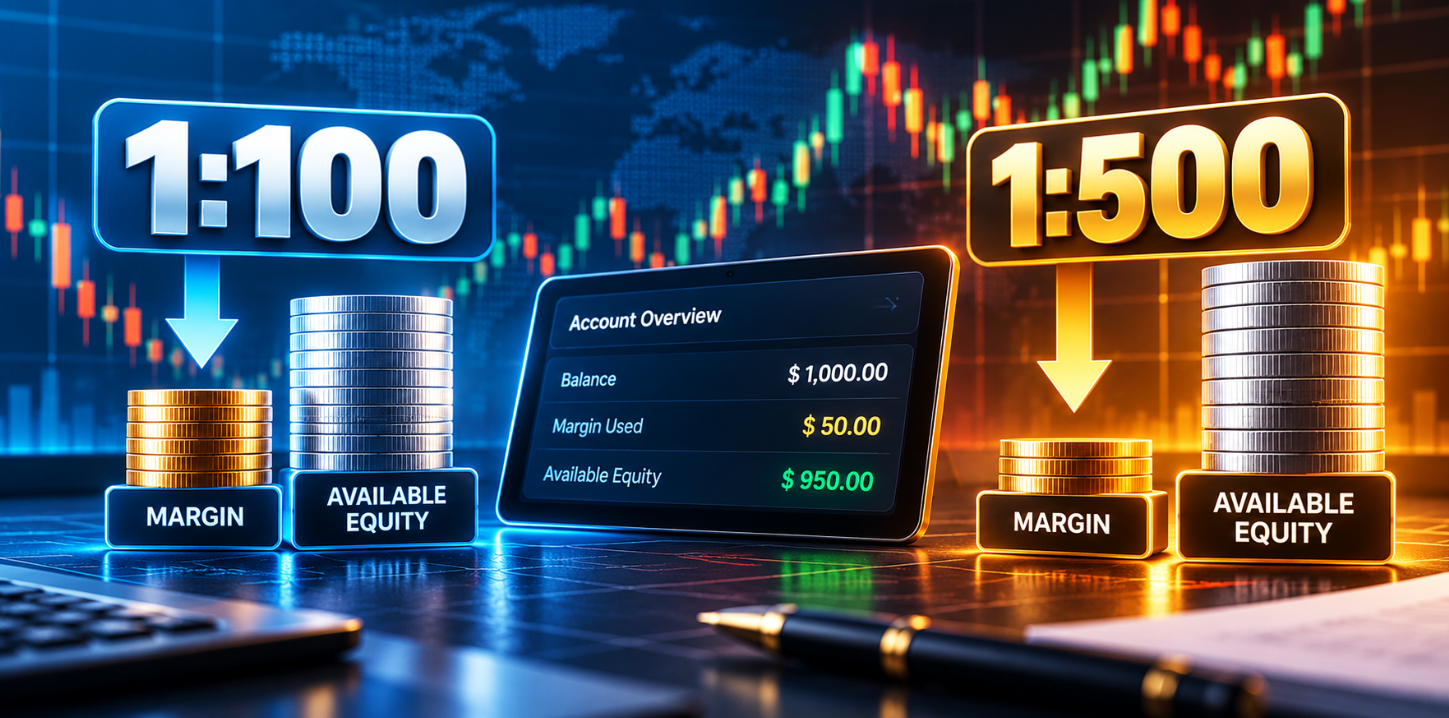
Initial margin is the amount your provider sets aside to support an open trade. It is not a charge that disappears when the position opens. The amount remains tied to that position while it is open, subject to changing account and product rules.
Free margin is the portion of account equity that is not currently being used as required margin. A lower margin requirement may leave more free margin available, but that extra room can disappear quickly if an open position starts losing money. A trader should never treat free margin as money they can lose without consequence.
| Item | At 1:100 | At 1:500 |
|---|---|---|
| R100,000 notional position | R1,000 initial margin | R200 initial margin |
| Initial margin rate | 1% | 0.2% |
| Market exposure | R100,000 | R100,000 |
| Effect of a 0.5% adverse move | R500 loss | R500 loss |
What happens when a leveraged position moves against you?
A losing position reduces account equity, whether the broker allows 1:100 or 1:500. As equity falls, the account may have less room to support open positions. If it reaches the provider’s warning or liquidation level, trades can be closed automatically, sometimes at an unfavourable price.
It is easy to assume that a R200 margin requirement means the most you can lose is R200. That is not what margin means. Actual losses can be greater than initial margin, subject to the broker’s protections, execution and close-out arrangements.
1:100 vs 1:500 leverage with a R5,000 trading account
Imagine two South African traders each deposit R5,000. Both open a R100,000 position. Their initial margin differs, but their account equity, market exposure and simplified percentage risk are identical before costs. They are both effectively using 20:1 leverage.
Now suppose the trader with access to 1:500 uses the spare margin to increase the position to R250,000. A 1% adverse move would then equal R2,500, which is half the starting account equity before costs. The danger comes from the larger position, not from the number printed next to the leverage setting.
| Scenario | Notional exposure | Initial margin | Loss on 1% adverse move |
|---|---|---|---|
| R5,000 account at 1:100 | R100,000 | R1,000 | R1,000 |
| R5,000 account at 1:500, same trade | R100,000 | R200 | R1,000 |
| R5,000 account at 1:500, bigger trade | R250,000 | R500 | R2,500 |
How position size changes the risk
Position size matters because every pip or price movement is applied to the trade you actually hold. Two traders using the same broker can have very different outcomes if one opens a small trade and the other opens a much larger one.
For example, doubling the notional exposure from R50,000 to R100,000 also doubles the simplified rand effect of the same percentage move. The leverage setting decides whether the provider will allow the trade with the available margin; it does not cancel that relationship.
Margin level, stop-out and forced liquidation explained
A broker may show a margin level as a percentage comparing account equity with used margin. As losses reduce equity, the margin level can fall. The precise margin-call and stop-out thresholds depend on the provider's rules, and they should be checked before opening a position.
When a stop-out threshold is reached, the broker may close one or more positions automatically. The process is not a guarantee that the account will avoid further losses, particularly during fast markets, price gaps or thin liquidity.
| Term | What it means |
|---|---|
| Account equity | Account balance adjusted for floating profit or loss |
| Used margin | Capital allocated to support open positions |
| Free margin | Equity remaining after used margin |
| Margin level | Equity divided by used margin, expressed as a percentage |
| Margin call | A warning or restriction when margin conditions deteriorate |
| Stop-out | Broker-initiated position closure under specified account rules |
How leverage changes risk across forex, gold and indices
The maximum leverage advertised for a forex trading account may not apply to every instrument. Brokers can set separate margin requirements for currency pairs, gold, oil, indices, shares and other CFDs. These requirements can also change around important market events or when exposure becomes large.
Volatility also affects the way an account behaves. Gold and certain indices can move sharply around economic announcements, while USD/ZAR may have wider spreads than major forex pairs. Check each symbol's contract details rather than assuming one leverage number applies to the whole platform.
| Market | Points to verify before entry |
|---|---|
| Major forex pairs | Available leverage, pip value and spread |
| USD/ZAR and other less-liquid pairs | Spread, volatility, contract size and margin tier |
| Gold CFDs | Contract specifications, financing and event-driven volatility |
| Index CFDs | Instrument-specific margin, trading hours and price gaps |
| Share CFDs | Lower leverage limits, corporate events and overnight costs |
When 1:100 leverage may be more suitable
For someone still learning how margin works, a lower maximum ratio can provide a useful limit on the amount of notional exposure that an account can support. It does not guarantee smaller losses, but it may make it harder to build an extremely large position using very little margin.
Even with 1:100 leverage, the account can lose money quickly when a trade is oversized. The better habit is to choose the intended loss per trade first, then calculate position size and confirm that the margin requirement fits the account.
- You prefer a tighter upper limit on buying power.
- You are still testing your sizing and stop-loss rules.
- You want to reduce the temptation to open several large trades.
- You are comfortable committing more margin to the same position.
When 1:500 leverage demands extra care
At 1:500, the small upfront margin can look attractive because it leaves a larger balance shown as available. That flexibility can help with capital allocation, but it can also make position sizes seem more affordable than they really are.
A R200 initial requirement on R100,000 exposure does not turn a R1,000 market loss into a R200 loss. It only means the initial amount required to support the position was smaller. Higher leverage is particularly unforgiving when traders repeatedly add positions after losses or leave too little equity to absorb volatility.
- Avoid sizing positions from the margin figure alone.
- Check combined exposure across open trades.
- Allow for higher spreads during volatile periods.
- Know the stop-out level before trading.
- Do not assume a broker will always close a position at a planned price.
How spreads, overnight costs and slippage affect leveraged trades
Leverage calculations usually start with neat round numbers. Live trading does not. The spread is a cost built into the difference between the buy and sell price. A commission may be charged separately, and holding a CFD overnight may trigger financing adjustments.
Slippage matters too. If the market gaps or moves rapidly, an order can fill away from the requested level. Those details are especially important when account equity is small relative to the position. Always assess the possible total loss rather than just the advertised margin rate.
How to calculate position size before selecting leverage
Start with the account and the maximum rand loss you are prepared to accept. Then work backwards from the distance between the entry price and your stop. Your broker's contract size and pip or point value determine how large the position can be.
Only after that calculation should you ask whether the broker's 1:100 or 1:500 setting provides enough margin to open the trade. If the correct risk-based position is too large for your account or the trade costs are unreasonable, reducing the trade or skipping it may make more sense than increasing leverage.
Simple pre-trade sequence
- Choose a maximum acceptable rand loss.
- Define the entry and intended exit price.
- Calculate position size from the price distance and instrument value per point.
- Check the required margin for the selected instrument.
- Allow extra equity for price moves, spreads and other costs.
Common leverage mistakes South African beginners make
Most leverage problems begin before a trade is placed. A trader sees a low deposit requirement, assumes the position is cheap, and overlooks what a modest move in the underlying market could do to the account. Another common mistake is comparing margin figures while ignoring different contract sizes.
There is also the temptation to use the same position size on EUR/USD, USD/ZAR and gold without checking their specifications. The instruments do not behave identically, so their risks should not be treated as interchangeable.
| Mistake | A better approach |
|---|---|
| Treating margin as maximum loss | Calculate price-move loss using exposure |
| Choosing the biggest lot the platform allows | Size from a defined rand risk limit |
| Ignoring several correlated trades | Measure total account exposure |
| Assuming all instruments offer 1:500 | Check the exact symbol specification |
| Assuming a stop guarantees the exit price | Plan for gaps and slippage |
Quick leverage checklist before opening a trade
Use this short check before opening or increasing any leveraged forex or CFD position. It is meant to catch the practical details that an advertised leverage figure cannot tell you.
- Confirm the contracting company and relevant regulatory permissions.
- Check which leverage setting applies to the specific symbol.
- Know the total notional exposure, not only the margin.
- Calculate an estimated loss at the planned exit level.
- Check free margin, margin-call rules and forced-close thresholds.
- Account for spread, commission, financing and possible slippage.
- Review open positions that may move together.
Who This Guide Is For
This guide is for South African traders comparing 1:100 with 1:500 leverage, especially anyone opening a first forex or CFD account, checking broker trading conditions or trying to understand why a smaller margin requirement does not necessarily mean a smaller loss. The examples use rand amounts so the arithmetic is easier to follow.
Who This Guide Is Not For
This guide is not a strategy for making guaranteed profits from high leverage. It does not replace a broker's legal terms or the contract specifications for an individual instrument. It also cannot tell you which leverage ratio is suitable for your circumstances without information about your finances, experience and risk tolerance.
Realistic Expectations About Leveraged Trading

A 1:500 facility does not turn a small account into a low-risk account. It makes a greater amount of notional exposure possible with less required margin, which is useful only when the resulting positions are controlled carefully.
It is perfectly reasonable to have access to a higher leverage limit and still trade with low effective leverage. Many of the most important decisions happen before the entry: how much you can afford to lose, where you would exit and how large the position should be.
Quick Summary Table: 1:100 vs 1:500
| Question | 1:100 | 1:500 |
|---|---|---|
| Margin rate in a fixed-ratio example | 1% | 0.2% |
| Margin on R100,000 | R1,000 | R200 |
| Loss on a 1% move against R100,000 | R1,000 | R1,000 |
| Maximum exposure possible from the same margin | Lower | Higher |
| Does the ratio alone set the final loss? | No | No |
| Most important risk control | Position size | Position size |
Conclusion
The key distinction is simple. A 1:500 ratio requires less initial capital than 1:100 for the same notional exposure, but the same position still reacts to price movement in the same way before costs and account adjustments.
The main risk difference appears when the smaller deposit requirement leads to a larger position or several open positions, because total exposure then increases.
Before you choose a provider or leverage ratio, verify the legal entity, FSCA status, product terms, deposit rules, close-out thresholds, and trade costs. Decide the rand loss you can tolerate first, then set a position size that fits that limit.
You might also like:
Frequently asked questions
Is 1:500 leverage riskier than 1:100?
A higher maximum ratio can create greater risk if it leads to a larger position. A R100,000 position has the same simplified price exposure under either ratio, but 1:500 requires less capital to support it. Extra capacity can encourage greater exposure, which increases the rand effect of the same market move.
Does 1:500 leverage make a trade more profitable?
A higher ratio does not increase profit on an unchanged position. Profit and loss depend on the notional exposure, market move, trade direction, and applicable costs. The leverage ratio changes the initial deposit requirement and the amount of exposure that account capital can support under the provider's terms.
How much capital is required for a R100,000 position?
A simplified fixed-ratio calculation gives R1,000 at 1:100 and R200 at 1:500. Those figures equal 1% and 0.2% of R100,000. Actual provider requirements can differ by instrument, exposure tier, account classification, and market conditions, which makes the product specification important before entry.
Can a broker change the leverage available on an account?
Broker terms can permit leverage adjustments under defined conditions. Product type, account status, exposure size, market volatility, or other contractual rules can affect the ratio or required deposit. A trader should check the current legal terms and product specifications before entry, especially after an account or product change.
Is 1:100 leverage automatically safer for a beginner?
A lower maximum ratio can restrict how much exposure the same deposit can support, but it does not make a trade safe by itself. A poorly sized R100,000 position can cause the same market loss under 1:100 or 1:500. Position size, exit discipline, account equity, and costs still decide the financial effect.
Can you lose more than the initial margin on a 1:500 trade?
Yes. Initial margin is collateral supporting a position, not an automatic limit on its loss. The outcome depends on market movement, execution, close-out processes, and any applicable negative-balance protection.
What is effective leverage?
Effective leverage compares your total notional market exposure with your account equity. If you hold R100,000 of positions with R5,000 in equity, your effective leverage is 20:1, even if your broker advertises 1:500.
Does 1:500 mean you must use all available leverage?
No. A maximum leverage ratio is a limit on what may be allowed, not an instruction to trade at that ratio. You can hold a smaller position and use much lower effective leverage.
What is the difference between margin and a minimum account deposit?
Margin is the capital required to support a particular position. A minimum account deposit is a broker's account funding rule. They are different figures, and neither tells you the full risk of a trade.
Does a stop-loss remove leverage risk?
A stop-loss can help define an intended exit, but execution can differ from the requested level during a gap or volatile market. It reduces neither the need to size a trade carefully nor the importance of understanding broker rules.
You Might Also Like




Recommended brokers