


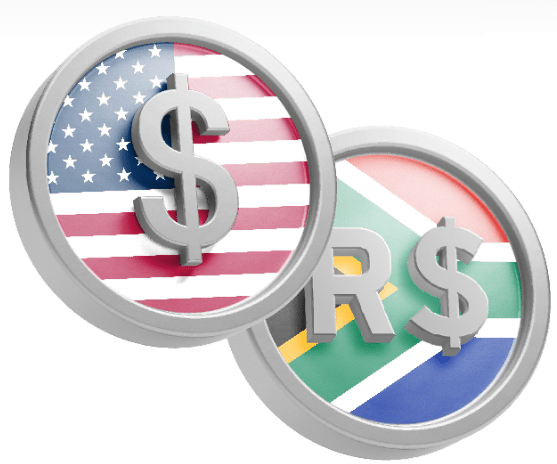
The USD/ZAR exchange rate is one of the most watched pairs in South Africa. It affects fuel prices, grocery costs, travel budgets, and savings denominated offshore. This guide covers the history of the rand, the US dollar, how bilateral trade shapes the relationship, the rand's long-term depreciation, and what actually drives USD/ZAR movements day to day.
What is the current USD to ZAR exchange rate and what drives it?
The USD to ZAR exchange rate reflects how many South African rand one US dollar can buy. It is driven by South African Reserve Bank (SARB) and US Federal Reserve interest rate decisions, inflation differentials, commodity prices (especially gold and platinum), South African political and fiscal risk, global risk sentiment, and the rand's role as an emerging market currency. Short-term moves are news-driven; long-term trends reflect fundamentals.
For South African savers, importers, travellers, and traders, the exchange rate matters practically — not just as a trading instrument but as a cost-of-living indicator. A weaker rand means higher fuel prices, more expensive imports, and more expensive travel abroad.

🏆10 Best Forex Brokers in South Africa
| Rank | Broker | Broker Review | Regulators | Minimum Deposit | Visit Broker |
|---|---|---|---|---|---|
| 🥇 |  | Read Review | ASIC, FSA, CBI, BVI, FSCA, FRSA, CySEC, ISA, JFSA | $100 | Visit Now |
| 🥈 |  | Read Review | FSCA, FCA, DFSA, FSA, CMA | $0 | Visit Now |
| 🥉 |  | Read Review | CySEC, IFSC, DFSA, FCA | $5 | Visit Now |
| 4 |  | Read Review | ASIC, CySEC, FSA, SCB | $0 | Visit Now |
| 5 |  | Read Review | BVI FSC | $0 | Visit Now |
| 6 |  | Read Review | FSA, FSC, FSCA, ASIC, CMA | $20 | Visit Now |
| 7 |  | Read Review | Exness is a globally regulated broker, holding multiple licenses from respected financial regulators around the world. | $10 | Visit Now |
| 8 |  | Read Review | ASIC, CySEC, FSCA, FSA, FSC, CMA | $100 | Visit Now |
| 9 |  | Read Review | FSC | $10 | Visit Now |
| 10 |  | Read Review | FSA, CySEC, FSCA, FSC | $10 | Visit Now |


Is it worth trading USD/ZAR as a South African forex trader?
Yes, USD/ZAR is worth trading for South African forex traders who understand its volatility profile. The pair moves sharply around SARB rate decisions, Fed announcements, local political news, mining strikes, and global risk shocks. Spreads are wider than EUR/USD or GBP/USD, so it suits swing traders more than scalpers. Traders who follow both US and South African economic calendars tend to do best.
That said, USD/ZAR is not a beginner's first pair. It is volatile, sensitive to local political noise, and often moves in sudden gaps rather than clean trends. Beginners are usually better off starting with EUR/USD or GBP/USD and graduating to USD/ZAR once risk management is dialled in.
Quick Answer for South African USD/ZAR Watchers
Best suited to: South African importers, exporters, offshore savers, forex traders focusing on ZAR pairs, and anyone with USD-denominated spending (travel, offshore investments, imports).
Not relevant for: Short-term scalpers avoiding exotic pairs with wider spreads, or anyone purely trading major pairs like EUR/USD and GBP/USD.
| Question | Short Answer |
|---|---|
| Main drivers of USD/ZAR | Interest rates, inflation, commodities, political risk |
| Long-term trend | ZAR has depreciated consistently since 1971 |
| Best time to trade USD/ZAR | London-NY overlap (15:00-18:00 SAST) |
| Volatility | High — news-sensitive and gap-prone |
| Correlated with | Gold, platinum, global risk sentiment |
| Key regulators | Federal Reserve (USD), SARB (ZAR) |
USD to ZAR Exchange Rate - Overview
- History of US-South Africa Relations
- Bilateral Trade Between the US and South Africa
- History of the US Dollar
- Current Denominations, Abbreviations, and Valuations of the US Dollar
- Origin of the Dollar Symbol
- The Rand and Where It Is Used
- Origin of the Word Rand
- Denominations, Abbreviations, and Valuations of the Rand
- History of the South African Rand as Currency
- Brief Exchange Rate History of the Rand
- What Drives USD/ZAR Day to Day
- Practical Impact of USD/ZAR on South Africans
- Frequently Asked Questions
This article was fact-checked using current USD/ZAR market data, South African Reserve Bank information, US Federal Reserve references, and 2026 bilateral trade data between South Africa and the United States.
1. History of US-South Africa Relations
Formal relations between the United States and South Africa trace back to 1789, when the US opened a Consulate in Cape Town. Over two centuries later, the relationship has evolved into one of South Africa's most important diplomatic and economic partnerships. The United States is South Africa's third-largest trading partner, with bilateral trade relations guided by the Trade and Investment Framework Agreement (TIFA), signed in 1999 and amended in 2012.
Key milestones in the US-SA relationship
- 1789: First US Consulate opened in Cape Town.
- 1994: South Africa's transition to democracy strengthens bilateral ties significantly.
- 1999: Trade and Investment Framework Agreement (TIFA) signed.
- 2012: TIFA amended to expand cooperation.
- Ongoing: Both countries belong to the UN, IMF, World Bank, and WTO.
Why the relationship matters for the rand
Bilateral political and trade relations shape investor sentiment toward emerging market currencies. When US-SA trade is expanding and diplomatic ties are stable, capital flows into South African markets more freely, strengthening the rand. When relations cool or tariffs threaten exports, the rand typically weakens. Traders and importers watch these dynamics alongside pure economic data.
Cooperation areas beyond trade
| Area | Collaboration Details |
|---|---|
| Health | HIV/AIDS programmes, PEPFAR funding |
| Education | Fulbright scholarships and research partnerships |
| Environment | Climate cooperation, conservation funding |
| Digital economy | Tech partnerships, fintech development |
| NEPAD support | African development initiatives |
2. Bilateral Trade Between the US and South Africa
The US is one of South Africa's most important trading partners. Bilateral trade has expanded consistently since 1994, with the US representing between 12% and 15% of all South African exports in recent years. The US is also the largest foreign direct investor in South Africa, accounting for roughly 40% of total FDI since the democratic transition.
What South Africa exports to the US
- Vehicles and vehicle parts (through AGOA benefits).
- Platinum, gold, and other precious metals.
- Iron, steel, and base metal products.
- Citrus fruits, wine, and other agricultural goods.
- Diamonds and gemstones.
What the US exports to South Africa
- Aircraft and aviation equipment.
- Machinery and industrial equipment.
- Petroleum products and refined fuels.
- Electronics, software, and tech services.
- Agricultural products — wheat, soybeans, dairy.
Why trade flows matter for the exchange rate
Strong South African export performance brings dollars into the country, which can support the rand. Weak exports — or heavy import bills on US goods — put pressure on it. Major trade policy shifts, such as changes to the African Growth and Opportunity Act (AGOA), can move USD/ZAR noticeably on announcement day.
Bilateral trade at a glance
| Metric | Approximate Figure |
|---|---|
| Total two-way trade (recent) | ~$14 billion |
| US share of SA exports | 12% - 15% |
| US share of FDI into SA (since 1994) | ~40% |
| Governing framework | TIFA (signed 1999, amended 2012) |
| Shared international bodies | UN, IMF, World Bank, WTO |
3. History of the US Dollar
The US dollar is the official currency of the United States and its territories — and the most widely held reserve currency on earth. It is used as a global benchmark, held by nearly every central bank, and acts as the standard currency in commodity markets. For South Africans, the dollar is the yardstick against which the rand is most often measured.
Key milestones in US dollar history
- 1785: The dollar officially adopted as the US money unit by the Continental Congress. Originally defined as 375.64 grains of fine silver.
- 1792: The Coinage Act creates the first US Mint and establishes the federal monetary system. Coins denominated in gold, silver, and copper.
- Early 1800s: Based on the Spanish dollar (piece of eight) design widely circulated in Spanish America.
- 1861: First US Treasury "Demand Bills" issued, featuring Abraham Lincoln. Nicknamed "Greenbacks" for their colour.
- 1863: National banking system established, authorised to issue national currency backed by US bonds.
- 1806 onwards: Silver coins suspended as the world standardised on gold.
- 1973: The dollar's value fully decoupled from gold under the Nixon-era policy shift.
Why the dollar became the world's reserve currency
After World War II, the Bretton Woods agreement pegged global currencies to the dollar, which was itself tied to gold. When the gold link was broken in 1973, the dollar remained central because the US economy was by far the largest and most liquid in the world. Central banks held dollars, commodities were priced in dollars, and international trade settled in dollars. That position has eroded slightly in recent years as emerging markets diversify reserves, but the dollar remains dominant.
Dollar nicknames and slang
- Greenback — from the colour of the 1861 Demand Bills.
- Buck — from deerskin "bucks" used for trade in colonial America.
- Smacker, bones, dead presidents, scrillas, paper — all common informal names.
4. Current Denominations, Abbreviations, and Valuations of the US Dollar
The US dollar sign is $. The ISO currency code is USD, also abbreviated US$. One dollar divides into 100 cents (symbol ¢) or 1,000 mills (symbol ₥, used for accounting and taxation purposes). The decimal structure has stayed essentially unchanged since the 1792 Coinage Act.
Coin denominations in circulation
- Penny (1¢)
- Nickel (5¢)
- Dime (10¢)
- Quarter (25¢)
- Half dollar (50¢)
- Dollar coin ($1)
Paper currency denominations
- $1, $2, $5, $10, $20, $50, $100 Federal Reserve Notes.
- Approximately $1.7 trillion in circulation (as of recent data).
- Around $1.65 trillion of that is in Federal Reserve Notes.
- Notes are printed on cotton-fibre paper, not the usual wood-fibre paper found in most prints.
Where the dollar is used beyond the US
- Panama and Ecuador use the dollar as official legal tender (dollarisation).
- British Virgin Islands and Turks and Caicos Islands use the dollar as their sole currency.
- Many countries accept the dollar as an informal alternative payment currency.
- Multiple currencies are pegged to the dollar, including some Gulf currencies.
5. Origin of the Dollar Symbol
The $ symbol has two commonly cited origin stories. The most accepted explanation is that it evolved from the late 18th-century abbreviation "ps" for the Spanish peso (also called the Spanish dollar), which circulated widely in Spanish America and the early United States. Over time, the p and s were written over each other, producing the stylised $ symbol used today.
The alternative Pillars of Hercules theory
A second theory traces the $ symbol to the Pillars of Hercules on the Spanish Coat of Arms — two vertical bars with a swinging banner in the shape of an S. The Spanish dollar design incorporated these pillars, and the symbol may have been inspired by them. Historians debate which story is more accurate, but both point back to the Spanish dollar's role in American currency history.
Why the symbol still matters
The $ symbol is now used for dozens of currencies worldwide — Canadian dollar, Australian dollar, Hong Kong dollar, and more. Context usually makes clear which dollar is meant, but when ambiguity matters, the US dollar is written as US$ or USD. Writing just "$" on a South African financial document is almost always understood to mean the US dollar.
6. The Rand and Where It Is Used
The South African rand is legal tender in the Common Monetary Area (CMA), which covers South Africa, Eswatini, Lesotho, and Namibia. The last three countries have their own currencies (the lilangeni, loti, and Namibian dollar respectively), each pegged to the rand at parity, which makes the rand effectively interchangeable across the region.
Common Monetary Area details
- South Africa: Issuer of the rand through the South African Reserve Bank.
- Eswatini: Uses both the lilangeni and the rand.
- Lesotho: Uses both the loti and the rand.
- Namibia: Uses both the Namibian dollar and the rand.
- Botswana: Was part of the CMA until 1976, now uses the pula independently.
Why the CMA matters for the rand
The CMA structure ties several small Southern African economies directly to the rand, which gives the rand more regional weight than its size alone would suggest. However, it also means the entire region is exposed to South African economic and political conditions, which is why rand volatility directly affects Lesotho, Eswatini, and Namibia.
7. Origin of the Word Rand
The rand takes its name from the Witwatersrand — Afrikaans for "white waters' ridge" — the geographic ridge upon which Johannesburg is built. The Witwatersrand is where most of South Africa's gold deposits have been mined since the late 19th century. Naming the national currency after the gold-rich region reflected the central role mining played in shaping the country's economy.
Why the name matters historically
Gold defined the South African economy for most of the 20th century, and the rand's early strength was closely tied to gold prices. Even today, the rand remains partially correlated with gold and platinum prices, and traders watching USD/ZAR often track commodity markets alongside interest rate decisions. The name is a reminder that the rand is a commodity-linked currency at its core.
8. Denominations, Abbreviations, and Valuations of the Rand
The rand's currency symbol is R (uppercase), and its name is written "rand" in lowercase in both English and Afrikaans. The ISO 4217 code is ZAR, derived from "Zuid-Afrikaanse Rand" (South African Rand), where "ZA" is a historical Dutch-language relic now only used as the country abbreviation. The rand divides into 100 cents (symbol: c).
Rand coins in circulation
- 10c, 20c, 50c (sub-rand denominations).
- R1, R2, R5 coins (R2 introduced 1989, R5 in 1994, new R5 with enhanced security in 2004).
- Smaller sub-cent denominations (½c, 1c, 2c, 2½c) have been discontinued.
Rand banknotes in circulation
- R10, R20, R50, R100, R200.
- Current series features Nelson Mandela's image (introduced 2012).
- Earlier series featured Jan van Riebeeck, then Big Five wildlife imagery.
- R1 and R2 notes have been replaced by coins.
Why the ZAR code includes the "Z"
The ZA prefix comes from "Zuid-Afrikaanse" (Dutch for South African), reflecting the Dutch origins of Afrikaans. South Africa's ISO code is ZA for the same reason, which is why you see .za domains and ZAR currency codes across international systems. The Dutch linguistic legacy lives on quietly in these abbreviations.
9. History of the South African Rand as Currency
South Africa's currency history is longer and messier than many people realise. Before the rand, multiple currencies circulated in the region, including the Guilder, Rixdollar, Spanish dollars, US dollars, French francs, Indian rupees, and British sterling. The rand itself was only introduced in 1961.
Key moments in rand history
- Late 17th century: The Rixdollar becomes the first South African currency to include paper notes.
- 1826: British occupation brings sterling into widespread use.
- 1921: The South African Reserve Bank (SARB) is established as the central bank.
- 14 February 1961: The rand is introduced as the official currency, replacing the South African pound at a rate of two rand to one pound (or 10 shillings to the rand).
- 1961: First coin denominations introduced — ½c, 1c, 2½c, 5c, 10c, 20c, 50c.
- 1989: R2 coin introduced.
- 1994: R5 coin introduced.
- 2004: New R5 coin with enhanced security features released to curb counterfeiting.
- 2012: New banknote series bearing Nelson Mandela's image issued.
Why the 1961 transition mattered
The switch from pound to rand was more than cosmetic — it marked South Africa's shift to a republic, moving away from its British colonial currency system. The rand was built on a decimal structure from day one, making it far easier to use than the pre-decimal pound-shilling system it replaced.
Rand coinage and banknotes evolution
| Year | Event |
|---|---|
| 1961 | Rand introduced; first coin and banknote series |
| 1966 | Second banknote series released |
| 1978 | Third series — R2, R5, R10, R20 notes |
| 1984 | R50 note introduced |
| 1989 | R2 coin replaces R2 note |
| 1990s | Big Five wildlife series launched |
| 1994 | R100 and R200 notes introduced; R5 coin released |
| 2012 | Mandela series banknotes issued |
10. Brief Exchange Rate History of the Rand
The rand has had a rough ride. When it was introduced in 1961, one rand traded at R0.72 to the US dollar — meaning one rand bought nearly $1.40. By late 1971, that parity still held. From then on, the rand has steadily depreciated, driven by apartheid-era sanctions, political pressure, mining-sector cycles, inflation differentials, and global risk sentiment toward emerging markets.
Rand depreciation milestones
- 1961 - 1971: R0.72 per USD (strong parity).
- 1974: SA delinks the rand from the dollar; starts managed floating at R0.87 per USD.
- 1983: Apartheid government abolishes the financial exchange rate system; international banks refuse to renew credit lines.
- 1985: Rand weakens to R2.40 per USD.
- 1986 - 1988: Partial recovery.
- End of 1989: R2.50 per USD.
- 1994 election: R3.60 per USD.
- 1999: Over R6 per USD.
- December 2001: R13.84 per USD following 9/11 and Zimbabwe land reform concerns.
- January 2014: R11.25 per USD.
- December 2015: Drops over 10% in four days after Nhlanhla Nene's surprise replacement as Finance Minister.
- 9 January 2016: All-time low of R17.92 per USD.
Why the rand keeps weakening long-term
Several structural factors drive the long-term depreciation. South African inflation has consistently been higher than US inflation. Political and fiscal risk — load-shedding, government debt, policy uncertainty — adds a persistent risk premium. Emerging market status means the rand sells off during global risk-off events. And commodity price cycles create sharp but temporary swings in either direction.
Recent exchange rate reference
| Date | USD/ZAR Rate |
|---|---|
| 31 July 2019 | R13.99 (period low) |
| 19 August 2019 | R15.47 (period high) |
| Average 2019-2026 | ~R14.76 per USD |
| 28 January 2026 | R14.59 per USD |
| 1 ZAR in USD terms | ~$0.068 |
11. What Drives USD/ZAR Day to Day
Long-term trends explain the big picture, but short-term USD/ZAR movements come from a handful of specific drivers. For South African traders, importers, and savers, knowing these drivers helps anticipate rate moves rather than being blindsided by them.
Short-term USD/ZAR drivers
- SARB interest rate decisions: Higher rates support the rand; cuts weaken it.
- US Federal Reserve decisions: Fed hikes push USD stronger against ZAR; cuts do the opposite.
- Inflation data: South African CPI and US CPI both move the pair on release days.
- Commodity prices: Gold and platinum gains support the rand; drops weaken it.
- South African political news: Finance Minister changes, cabinet reshuffles, and policy uncertainty often trigger sharp moves.
- Load-shedding and infrastructure news: Power supply concerns pressure the rand.
- Global risk sentiment: Emerging market selloffs hit the rand hard; risk-on days support it.
- US non-farm payrolls (NFP): First Friday of each month — major USD mover.
How traders use these drivers
The practical move for traders is to run two economic calendars — a US calendar and a South African one. Trade decisions near major releases either sit out the volatility (safer for beginners) or position ahead of the trend confirmation (riskier but higher potential reward). Either way, a stop-loss on every position is non-negotiable, because USD/ZAR can gap hard on surprise news.
12. Practical Impact of USD/ZAR on South Africans
The USD/ZAR rate isn't just a chart on a screen — it affects daily South African life more directly than most residents realise. Understanding how helps households plan around weak-rand periods.
Where South Africans feel the rate every day
- Fuel prices: Petrol and diesel prices adjust monthly, partly based on USD/ZAR.
- Imported goods: Electronics, cars, and luxury items cost more when the rand is weak.
- International travel: Flights, accommodation, and spending abroad become more expensive.
- Offshore investments: Dollar-denominated ETFs and funds gain value in rand terms during rand weakness.
- Online shopping: Amazon, Apple, and other dollar-priced goods swing with the exchange rate.
- Tertiary education abroad: UK and US tuition becomes significantly more expensive when the rand weakens.
- Imported food: Wheat, rice, cooking oil — many staples track global commodity prices in dollars.
Who benefits from a weaker rand
- Exporters — mining companies, wine producers, citrus farmers earn more rand per dollar sold.
- South Africans earning in foreign currency — remote workers, freelancers paid in USD.
- Tourism industry — international visitors get more for their money.
- Offshore investors — dollar-denominated assets gain in rand terms.
Who gets hurt by a weaker rand
- Importers and anyone buying imported goods.
- South Africans travelling abroad.
- Students studying overseas.
- Companies paying for software, cloud services, and tech in dollars.
- Consumers through higher fuel and imported-food prices.
Quick Summary Table
| Area | Key Point |
|---|---|
| Currency pair | USD/ZAR — US dollar vs South African rand |
| Long-term trend | Consistent rand depreciation since 1971 |
| Main drivers | Interest rates, inflation, commodities, political risk |
| Best trading window | London-NY overlap (15:00-18:00 SAST) |
| Volatility | High — news-sensitive and gap-prone |
| Common Monetary Area | SA, Eswatini, Lesotho, Namibia |
| Bilateral trade value | ~$14 billion two-way |
| All-time low | R17.92 per USD (9 January 2016) |
Conclusion
The USD/ZAR exchange rate tells the story of two very different economies — the world's largest reserve currency against a volatile emerging market currency tied closely to commodities and political cycles. For South Africans, the rate is less a financial abstraction and more a monthly reality that shows up at the fuel pump, the grocery till, and the airline check-in counter.
For traders, USD/ZAR offers real opportunities thanks to its volatility and sensitivity to news. For savers and importers, the long-term trend of rand depreciation is a reminder that offshore diversification isn't just a nice-to-have — it's a sensible hedge against structural currency weakness. Watch the Fed, the SARB, gold, and local political news. Those four factors drive almost every meaningful USD/ZAR move you will see in a given year.
Fact-checking note: USD/ZAR rates, central bank decisions, and bilateral trade figures can change. Always verify current exchange rates with a live market data source and consult official SARB and Federal Reserve announcements for policy updates.
Risk warning: Forex trading uses leverage and can result in rapid losses. USD/ZAR is volatile and gap-prone. Only trade with money you can afford to lose.
You might also like:
- What is the forex market and how can one trade on it?
- Pound to Rand
- How to trade the forex market
- Euro to rand exchange rate
- Best Forex Brokers with ZAR Accounts
Frequently Asked Questions
What is the current USD to ZAR exchange rate?
The current USD to ZAR exchange rate changes throughout the day as the forex market moves. In recent trading, the rate has sat around R14.59 per US dollar, though political events, SARB decisions, and US Federal Reserve announcements can shift the rate quickly. Check a live forex platform or Plus500, Google Finance, or XE.com for real-time exchange rate updates before making decisions based on current pricing.
Will the US dollar continue to strengthen against the South African rand?
The long-term trend since 1971 has seen the rand depreciate consistently against the US dollar, driven by inflation differentials, political risk, and emerging market pressures. Most analysts expect this trend to continue in the medium term, though short-term swings in both directions remain common. Factors like commodity prices, SARB rate decisions, and global risk sentiment determine whether specific months see rand strength or weakness.
Can South Africans trade USD/ZAR on forex platforms?
Yes, South Africans can trade USD/ZAR through FSCA-regulated brokers like Exness, HFM, AvaTrade, IC Markets, and Pepperstone. The pair offers decent liquidity, though spreads are wider than EUR/USD or GBP/USD because USD/ZAR is classified as an exotic pair. Most brokers offer USD/ZAR on MT4, MT5, and cTrader platforms, with leverage of up to 1:500 depending on account type and broker.
Should South Africans invest in US dollars?
Most South African financial advisors recommend holding a portion of your portfolio in US dollars or dollar-denominated assets as a hedge against rand weakness. Offshore diversification through dollar ETFs, offshore funds, or direct dollar savings accounts helps protect long-term purchasing power. Allocations typically range from 20% to 40% of a growth portfolio, though the right mix depends on personal risk tolerance, time horizon, and overall financial plan.
What drives the USD/ZAR exchange rate day to day?
Short-term USD/ZAR movements are driven by South African Reserve Bank and US Federal Reserve interest rate decisions, inflation data, gold and platinum commodity prices, South African political news, cabinet reshuffles, load-shedding announcements, and global risk sentiment. Major US economic releases like Non-Farm Payrolls and CPI reports also create sharp moves. Traders typically track both US and South African economic calendars to anticipate upcoming volatility.
Why has the rand depreciated so much over time?
The rand's long-term depreciation reflects persistent South African inflation above US inflation, structural fiscal challenges, political and policy uncertainty, apartheid-era sanctions, load-shedding pressure on economic growth, and the rand's status as an emerging market currency sold off during global risk-off events. The combination has produced a steady decline from R0.72 per USD in 1961 to well over R14 per USD today — a dramatic structural shift.
How does bilateral trade affect the USD/ZAR rate?
Bilateral trade flows between South Africa and the US directly influence currency demand. Strong South African exports to the US bring dollars into the country, supporting the rand. Weak exports or heavy US import bills put pressure on the rand instead. Major trade policy shifts, such as changes to AGOA (African Growth and Opportunity Act) tariff benefits, can trigger sharp moves on announcement day as traders reprice the trade outlook quickly.
Where is the South African rand used besides South Africa?
The rand is legal tender across the Common Monetary Area (CMA), which includes South Africa, Eswatini, Lesotho, and Namibia. Each of the three smaller countries has its own currency (lilangeni, loti, and Namibian dollar respectively), all pegged to the rand at parity. Botswana was part of the CMA until 1976 but now uses the pula independently. Regional trade and remittances flow smoothly thanks to this arrangement.
What is the all-time low for the rand against the US dollar?
The rand's all-time low against the US dollar was R17.92 per USD on 9 January 2016, driven by the fallout from the sudden replacement of then Finance Minister Nhlanhla Nene with David van Rooyen in December 2015. The event destroyed international confidence in South African fiscal management, and the rand took weeks to partially recover. Political missteps have historically moved the rand faster than economic data on most trading days.
What is the best time to trade USD/ZAR from South Africa?
The best time to trade USD/ZAR from South Africa is during the London-New York overlap, roughly 15:00 to 18:00 SAST. This window combines deep liquidity, tighter spreads, and strong participation from both European and US traders. Most high-impact US data releases also land during this period, which creates clean directional moves. Avoid trading USD/ZAR during the Sunday open, late Friday, or the 00:00 to 03:00 SAST dead zone.
You Might Also Like




Recommended brokers