

If you are searching for the Best FINRA Regulated Forex Brokers in the United States, there is an important distinction to understand before comparing brokers.
FINRA is not the main regulator of U.S. retail forex trading. FINRA primarily supervises securities broker-dealers and registered securities professionals. Retail off-exchange forex is regulated mainly through the Commodity Futures Trading Commission (CFTC) and the National Futures Association (NFA).
That distinction matters because a broker can be properly authorised to accept U.S. forex traders without its forex entity being a FINRA member.
As checked in August 2026, the U.S. retail off-exchange forex market remains relatively concentrated. The firms covered in this comparison are FOREX.com, OANDA, tastyfx, Interactive Brokers, Charles Schwab Futures and Forex, and Trading.com.
There are also differences inside large financial groups. Interactive Brokers LLC is itself a FINRA-regulated securities broker-dealer while also operating within the relevant CFTC and NFA framework. Charles Schwab is structured differently: Charles Schwab & Co., Inc. is the FINRA-regulated securities company, while retail forex is handled through Charles Schwab Futures and Forex LLC.
For traders mainly interested in currencies, FOREX.com is our best overall U.S.-regulated forex broker for 2026. It combines a broad currency range, several pricing structures and one of the strongest platform selections available to U.S. retail forex traders.
What is the best FINRA-regulated forex broker in the United States?
FOREX.com is our best overall choice for U.S. retail forex traders in 2026.
The U.S. business is operated by GAIN Capital Group LLC, which is registered with the CFTC as a Futures Commission Merchant and Retail Foreign Exchange Dealer and is an NFA member.
FOREX.com offers around 80 currency pairs together with Spread-Only and RAW Pricing structures. Traders can also access FOREX.com's own platforms, TradingView, MetaTrader 4 and MetaTrader 5, depending on the account configuration.
That flexibility is the main reason it ranks first. A newer trader can keep the setup relatively straightforward, while a more active trader can move toward raw pricing, MetaTrader, or TradingView without having to change brokers.
If direct FINRA membership is specifically important to you, Interactive Brokers deserves closer attention. Interactive Brokers LLC is directly regulated by FINRA as a securities broker-dealer while also operating under the appropriate CFTC and NFA framework for its forex and commodities activities.

🏆10 Best Forex Brokers in South Africa
| Rank | Broker | Broker Review | Regulators | Minimum Deposit | Visit Broker |
|---|---|---|---|---|---|
| 🥇 |  | Read Review | ASIC, FSA, CBI, BVI, FSCA, FRSA, CySEC, ISA, JFSA | $100 | Visit Now |
| 🥈 |  | Read Review | FSCA, FCA, DFSA, FSA, CMA | $0 | Visit Now |
| 🥉 |  | Read Review | CySEC, IFSC, DFSA, FCA | $5 | Visit Now |
| 4 |  | Read Review | ASIC, CySEC, FSA, SCB | $0 | Visit Now |
| 5 |  | Read Review | BVI FSC | $0 | Visit Now |
| 6 |  | Read Review | FSA, FSC, FSCA, ASIC, CMA | $20 | Visit Now |
| 7 |  | Read Review | Exness is a globally regulated broker, holding multiple licenses from respected financial regulators around the world. | $10 | Visit Now |
| 8 |  | Read Review | ASIC, CySEC, FSCA, FSA, FSC, CMA | $100 | Visit Now |
| 9 |  | Read Review | FSC | $10 | Visit Now |
| 10 |  | Read Review | FSA, CySEC, FSCA, FSC | $10 | Visit Now |


Are FINRA-regulated forex brokers safe in the United States?
Using a properly registered U.S. forex dealer gives traders a substantially clearer regulatory framework than sending funds to an offshore company with limited oversight.
U.S. regulated firms operate under rules covering capital, reporting, disclosures, supervision, conduct and record-keeping. Traders can also verify the regulatory standing of the legal entity through official CFTC, NFA and, where relevant, FINRA records.
Regulation does not remove trading risk. Forex is leveraged, and even a relatively small market move can have a significant effect on account equity when a position is too large.
There is another point worth checking carefully. Do not assume that a retail forex balance automatically receives SIPC protection because another company in the same financial group is a FINRA or SIPC member. The legal entity actually holding your account is what matters.
- The exact legal entity named in your account agreement
- Its current CFTC registration and NFA membership
- Whether any FINRA or SIPC protection applies to that specific account
6 Best FINRA Regulated Forex Brokers in the United States
| Rank | Broker | Best For | Primary U.S. Forex Regulation | FINRA Relationship |
|---|---|---|---|---|
| 1 | FOREX.com | Best Overall U.S. Forex Broker | CFTC / NFA | FINRA-regulated StoneX securities affiliates |
| 2 | OANDA | Best for Flexible Trade Sizes | CFTC / NFA | Forex entity regulated through CFTC/NFA |
| 3 | tastyfx | Best Forex-Focused Platform | CFTC / NFA | Not a FINRA member |
| 4 | Interactive Brokers | Best for Professional Multi-Asset Traders | CFTC / NFA | Direct FINRA member |
| 5 | Charles Schwab Futures and Forex | Best for thinkorswim | CFTC / NFA | FINRA-member Charles Schwab & Co. affiliate |
| 6 | Trading.com | Best Simple MT5 Forex Account | CFTC / NFA | Forex business regulated through CFTC/NFA |
Best U.S. Forex Broker by Trader Type
| Trader Type | Best Fit | Why |
|---|---|---|
| Most U.S. forex traders | FOREX.com | Good platform choice, around 80 pairs and a choice between spread-only and RAW pricing |
| Beginners / small position sizes | OANDA | No standard minimum deposit and positions can be sized down to very small amounts |
| Forex-focused traders | tastyfx | 85+ pairs on its main accounts and several pricing structures |
| Professional / multi-asset traders | Interactive Brokers | Institutional-style FX pricing, APIs and access to multiple global markets |
| thinkorswim users | Charles Schwab Futures and Forex | Advanced charting and a familiar Schwab trading ecosystem |
| Simple MT5 setup | Trading.com | Straightforward account structure with MetaTrader 5 access |
- FOREX.com — Best Overall U.S.-Regulated Forex Broker
- OANDA — Best U.S. Forex Broker for Flexible Trade Sizes
- tastyfx — Best U.S. Forex Broker for Dedicated Forex Trading
- Interactive Brokers — Best FINRA-Regulated Broker for Professional Traders
- Charles Schwab Futures and Forex — Best U.S. Forex Broker with thinkorswim
- Trading.com — Best U.S. Forex Broker for Simple MetaTrader 5 Trading
1. FOREX.com

- Best overall U.S. forex broker
- Operated in the United States by GAIN Capital Group LLC
- CFTC-registered Futures Commission Merchant and Retail Foreign Exchange Dealer
- NFA member
- Around 80 currency pairs
- Spread-Only and RAW Pricing options
- FOREX.com platforms, TradingView, MT4 and MT5 available depending on account
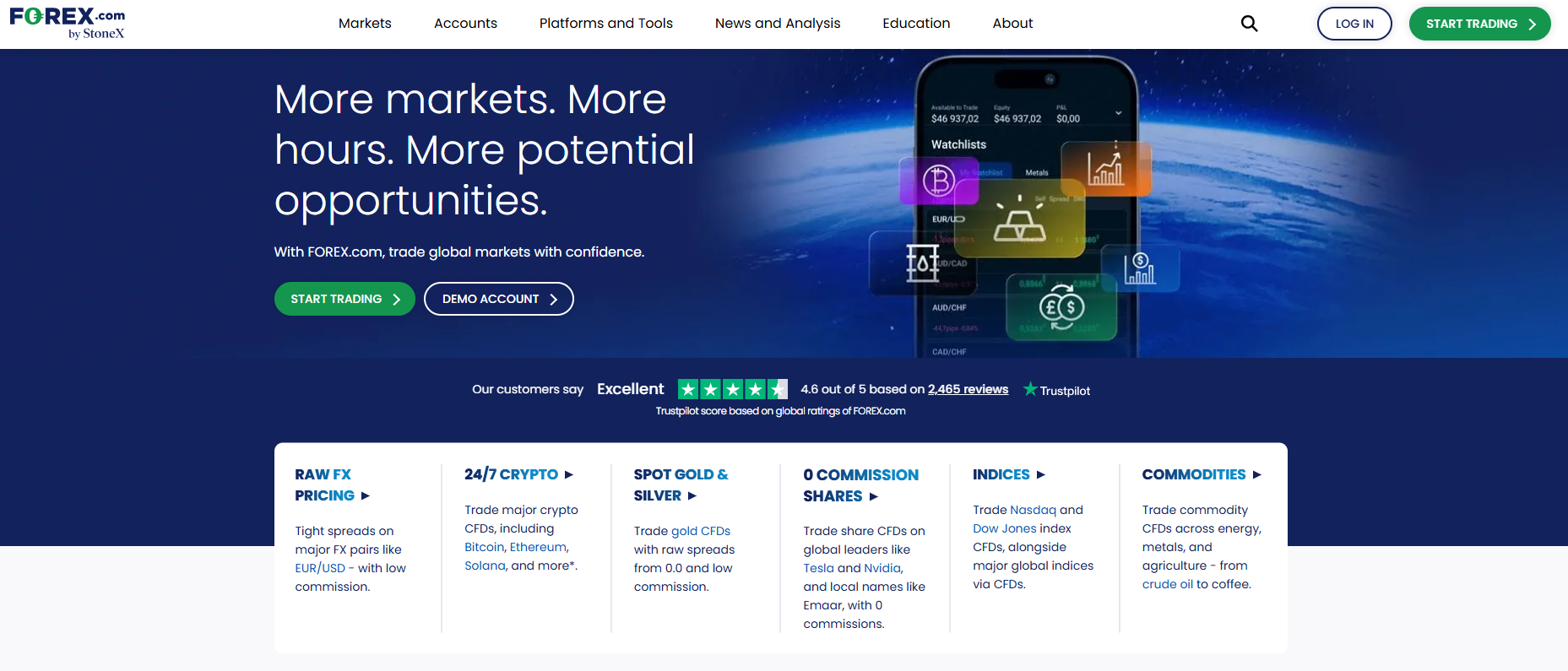
FOREX.com takes the top position because it offers a good balance between pricing, platform choice, forex range and accessibility.
The broker does not force every trader into the same setup. Someone who wants straightforward spread-based pricing can use one structure, while a more active trader can consider RAW Pricing and compare the spread plus commission against their usual trade size.
The platform selection is another major advantage. Depending on the account, traders can use FOREX.com's own web and mobile platforms, TradingView, MetaTrader 4 or MetaTrader 5.
Features
| Feature | FOREX.com |
|---|---|
| U.S. Regulation | CFTC and NFA |
| NFA ID | 0339826 |
| Minimum Deposit | $100 |
| Forex Pairs | 80+ |
| Spreads | From 0.0 pips |
| Platforms | FOREX.com, MT4, MT5, TradingView |
| Demo Account | Yes |
| Best For | U.S. forex traders |
| Open an Account | Open Account |
Pros and Cons
| Pros | Cons |
|---|---|
| Well-regulated U.S. forex entity | $100 minimum is higher than OANDA and tastyfx |
| Around 80 forex pairs | U.S. leverage limits apply |
| Choice of spread-only or RAW pricing | RAW pricing adds commission |
| MT4 and MT5 available | Forex accounts should not be confused with securities accounts |
| TradingView support | U.S. product range is narrower than some international FOREX.com entities |
| Good proprietary web and mobile platforms | Some U.S. trading rules restrict strategy flexibility |
| Part of StoneX Group | The number of account choices can take time to compare |
Why is FOREX.com one of the best forex brokers in the United States?
The main reason is balance.
FOREX.com gives traders a broad enough currency selection for more than just the major pairs, several pricing options and considerably more platform flexibility than many competitors.
It is especially useful if you do not yet want to commit to one trading environment. TradingView users, MT4 traders, MT5 users and traders who prefer proprietary software can all find a workable setup here.
Is FOREX.com regulated by FINRA?
FOREX.com's U.S. retail forex entity, GAIN Capital Group LLC, is regulated primarily through the CFTC and NFA rather than FINRA.
The wider StoneX Group includes separately regulated securities companies, but those registrations should not be treated as though they automatically apply to a FOREX.com retail forex account.
2. OANDA

- Best for beginners and smaller trade sizes
- OANDA Corporation is CFTC registered
- NFA member
- No standard minimum deposit
- More than 68 currency pairs
- Flexible position sizing
- OANDA platforms, MetaTrader 4 and TradingView
OANDA remains one of the more practical choices for traders who want to start carefully and control their dollar exposure.
Its main advantage is not simply the absence of a conventional minimum deposit. Position sizing is unusually flexible, which can be far more useful when you are learning how much money is actually at risk on each trade.
Instead of being pushed toward a larger conventional lot size, a trader can reduce the position and build a risk-management process around the account balance they actually have.
OANDA offers more than 68 currency pairs together with its own platforms, MetaTrader 4 and TradingView. Pricing can vary by account structure and eligibility, while higher-volume traders may have access to additional pricing benefits.
Features
| Feature | OANDA |
|---|---|
| U.S. Regulation | CFTC and NFA |
| NFA ID | 0325821 |
| Minimum Deposit | $0 |
| Forex Pairs | Major and minor pairs |
| Leverage | Up to 50:1 on majors |
| Platforms | OANDA Trade, MT4, TradingView |
| Demo Account | Yes |
| Best For | U.S. forex traders |
| Open an Account | Open Account |
Pros and Cons
| Pros | Cons |
|---|---|
| No minimum deposit | MT5 is not the main U.S. platform offering |
| Very flexible position sizing | Retail forex balances are not automatically SIPC protected |
| 68+ currency pairs | Some pricing structures have eligibility requirements |
| Good web and mobile platforms | U.S. leverage limits apply |
| TradingView support | FIFO rules apply |
| MT4 available | Traditional hedging flexibility is restricted under U.S. rules |
| API access | Regulatory history is still worth checking before funding |
| Works well for smaller accounts | Fewer pairs than FOREX.com, tastyfx and Interactive Brokers |
Is OANDA good for forex beginners in the United States?
Yes. It is particularly well suited to someone who wants to begin with smaller positions rather than simply taking the maximum leverage available.
The lack of a standard minimum deposit helps, but the more useful feature is precise position sizing. That gives newer traders much better control over actual dollar risk while testing whether a strategy works in live conditions.
Is OANDA FINRA regulated?
OANDA Corporation's U.S. retail forex business operates under the CFTC and NFA regulatory framework rather than FINRA.
3. tastyfx
- Best forex-focused trading experience
- Previously operated as IG US
- CFTC-registered Retail Foreign Exchange Dealer
- NFA member
- More than 85 forex pairs on selected account structures
- Standard, Zero+ and Prime options
- tastyfx platform, TradingView and MetaTrader 5 depending on account
tastyfx is one of the more forex-focused brokers in this comparison.
The U.S. business previously operated as IG US. The legal entity changed from IG US LLC to tastyfx LLC in June 2024, which means older regulatory or third-party material may still refer to the previous name.
Standard and Prime structures offer more than 85 forex pairs, while Zero+ focuses on a smaller group of widely traded currencies.
The Standard and Zero+ structures do not have a conventional minimum deposit, while Prime is aimed at substantially larger accounts and has a much higher entry requirement.
Platform availability can depend on the account selected, so this is one broker where I would check the platform and pricing combination before transferring funds.
Features
| Feature | tastyfx |
|---|---|
| Current Legal Entity | tastyfx LLC |
| Former Brand | IG US |
| Regulation | CFTC / NFA |
| Standard Retail Minimum | $0 |
| Forex Pairs | 85+ |
| Standard Spread | From around 0.8 pips |
| Zero+ Spread | From 0.0 pips |
| Zero+ Commission | Commission applies |
| Maximum Retail Leverage | Up to 50:1 where permitted |
| TradingView | Yes |
| MetaTrader 5 | Yes |
| Platform Compatibility | Varies by account type |
| Demo Account | Yes |
Pros and Cons
| Pros | Cons |
|---|---|
| 85+ forex pairs | Not a FINRA member |
| Very forex-focused offering | Forex deposits are not SIPC protected |
| No standard retail account minimum | Prime is aimed at much larger accounts |
| Several pricing models | Zero+ uses commission-based pricing |
| TradingView integration | Not designed as a broad securities brokerage |
| MetaTrader 5 available | U.S. leverage limits apply |
| Standard, Zero+ and Prime options | Account and platform compatibility needs checking |
| Demo account available | Availability can vary by state |
Is tastyfx the same broker as IG US?
Yes. The U.S. forex operation previously traded under the IG US name before being rebranded as tastyfx.
This is why older regulatory records or articles may still mention IG US when referring to the same U.S. forex business.
Is tastyfx regulated by FINRA?
No. tastyfx states that it is not a FINRA member or SEC-registered securities broker-dealer.
Its U.S. retail forex activities are regulated through the CFTC and NFA framework.
4. Interactive Brokers

- Best for professional and multi-asset traders
- Interactive Brokers LLC is directly FINRA regulated
- Also operates under SEC, CFTC and relevant NFA oversight
- More than 100 currency pairs
- Institutional-style FX pricing
- Advanced order types and APIs
- Forex alongside stocks, options, futures, bonds and other markets
If direct FINRA membership is one of your main requirements, Interactive Brokers is the clearest fit in this comparison.
It is also quite different from the typical retail forex broker.
Interactive Brokers uses a more professional trading model, with institutional-style currency liquidity and commissions linked to trading volume rather than simply widening the spread and presenting the whole cost as one number.
It offers more than 100 currency pairs and allows traders to manage currencies alongside equities, futures, options, bonds and other assets from the same broader trading environment.
The trade-off is complexity. Trader Workstation is extremely capable, but it has a much steeper learning curve than the average retail forex platform. Minimum forex order sizes can also make Interactive Brokers less convenient for someone experimenting with very small positions.
Features
| Feature | Interactive Brokers |
|---|---|
| U.S. Regulation | FINRA, SEC, CFTC and NFA |
| Minimum Deposit | $0 |
| Forex Pairs | 100+ |
| Spreads | From 0.1 pip |
| Platforms | TWS, IBKR Desktop, Mobile |
| Demo Account | Yes |
| Best For | Advanced U.S. traders |
| Open an Account | Open Account |
Pros and Cons
| Pros | Cons |
|---|---|
| Direct FINRA member | Forex order sizes can be large for retail traders |
| SEC and CFTC regulated | Steeper learning curve |
| 100+ currency pairs | Not designed around small beginner forex accounts |
| Institutional-style liquidity | Commission pricing needs proper cost calculation |
| Competitive FX spreads | Trader Workstation is complex |
| Professional FXTrader interface | Probably more platform than a casual forex trader needs |
| Strong multi-asset offering | Smaller traders may find OANDA or Trading.com easier |
| Powerful API access | The advanced tools take time to learn |
Why is Interactive Brokers best for professional forex traders?
Interactive Brokers starts to make sense when your requirements go beyond placing relatively simple retail forex trades.
Experienced traders get access to deep liquidity, sophisticated order functionality, APIs, professional execution tools and a much broader multi-asset environment.
Its forex pricing is also relatively transparent because the spread and commission are separated. That can make total trading costs easier to analyse when meaningful position sizes are involved.
For someone trading currencies alongside stocks, futures, options or bonds, the ability to manage those markets through one ecosystem is a major advantage.
Is Interactive Brokers FINRA regulated?
Yes. Interactive Brokers LLC is directly regulated by FINRA as a U.S. securities broker-dealer and is also regulated by the SEC.
Its forex and commodities activities fall under the relevant CFTC and NFA framework.
5. Charles Schwab Futures and Forex

- Best for thinkorswim users
- Forex provided by Charles Schwab Futures and Forex LLC
- Forex entity operates under CFTC and NFA oversight
- Charles Schwab & Co., Inc. is separately FINRA regulated
- More than 65 currency pairs
- thinkorswim desktop, web and mobile
- Strong technical analysis and order-management tools
Charles Schwab is particularly interesting for traders who already know and like thinkorswim.
The platform is the biggest reason Schwab earns a place in this comparison. It offers extensive charting, technical indicators, drawing tools, flexible layouts, detailed order controls and paper trading.
Forex is provided through Charles Schwab Futures and Forex LLC, while securities activity is handled separately through Charles Schwab & Co., Inc.
That distinction should not be overlooked. The wider Schwab brand may be familiar, but the regulatory treatment of a forex account depends on the company actually providing it.
Schwab offers more than 65 currency pairs. Forex trading generally does not involve a separate commission, with compensation instead incorporated into the bid-ask spread.
Features
| Feature | Charles Schwab |
|---|---|
| U.S. Regulation | CFTC, NFA and FINRA* |
| Forex Provider | Charles Schwab Futures and Forex LLC |
| Minimum Deposit | $0 |
| Forex Pairs | 65+ |
| Commission | $0; costs built into spread |
| Platform | thinkorswim |
| Demo Trading | Yes, paperMoney |
| Best For | Active U.S. forex traders |
| Open an Account | Open Account |
Pros and Cons
| Pros | Cons |
|---|---|
| Excellent thinkorswim platform | The forex entity itself is not the FINRA securities broker |
| 65+ currency pairs | Eligibility and availability restrictions can apply |
| No separate forex commission | The cost is still built into the spread |
| Strong education and research | Requires the appropriate Schwab account setup |
| paperMoney simulation | No MT4 or MT5 |
| Fits well into the broader Schwab ecosystem | Forex accounts do not automatically receive standard SIPC protection |
| FINRA-member securities affiliate | thinkorswim can be intimidating at first |
| Very good charting tools | Leverage still needs to be managed carefully |
Why is Charles Schwab good for forex trading?
For me, the main reason is thinkorswim.
It remains one of the stronger retail trading environments available in the United States, especially for traders who spend a lot of time on charting, technical analysis and detailed order management.
Schwab also makes sense if you already use the group for stocks, ETFs, options or other investments and prefer keeping more of your financial activity within one ecosystem.
Is Charles Schwab Futures and Forex FINRA regulated?
The forex entity, Charles Schwab Futures and Forex LLC, operates primarily under CFTC and NFA oversight.
Charles Schwab & Co., Inc. is the separate FINRA-regulated securities broker within the group.
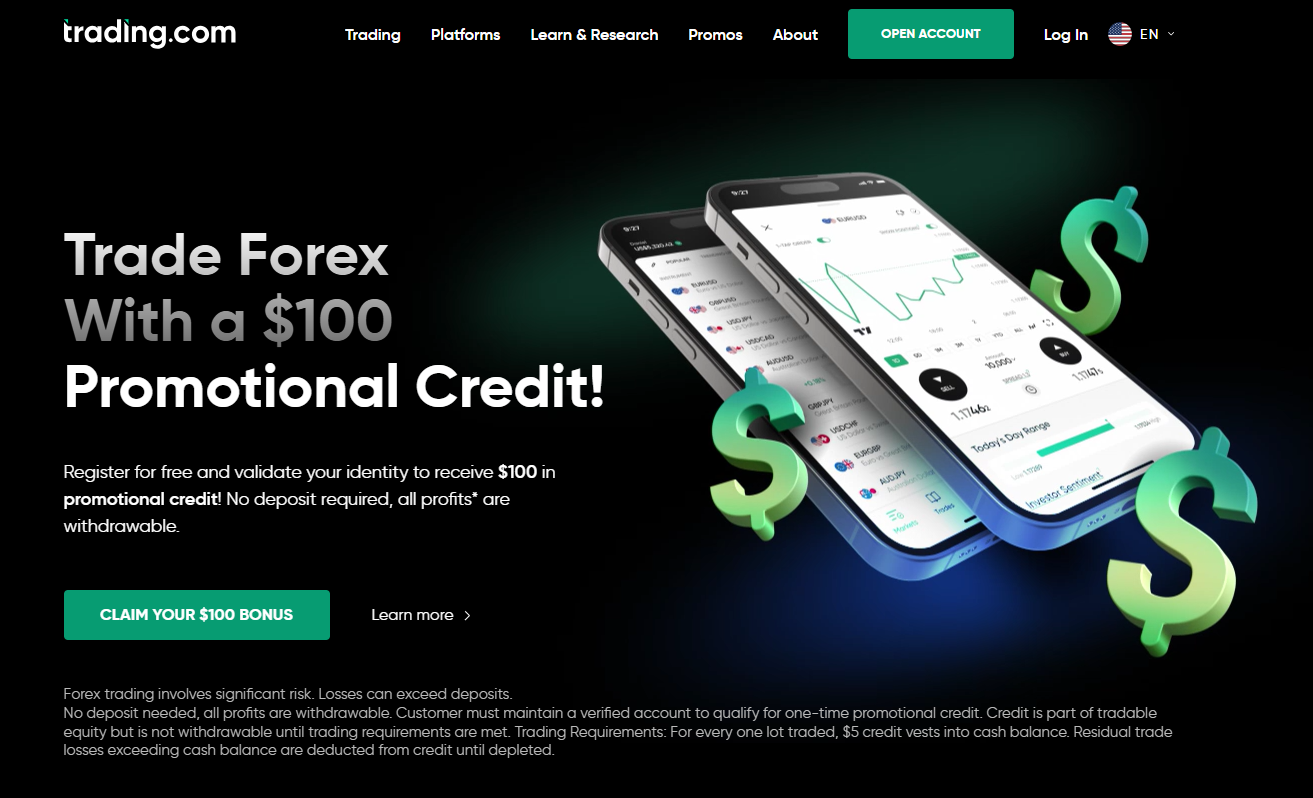
6. Trading.com

- Best simple MetaTrader 5 setup
- Trading.com Markets Inc. is CFTC registered
- NFA member
- One main T1 retail account
- Minimum deposit around $50
- More than 65 currency pairs
- WebTrader, mobile app and MetaTrader 5
Trading.com keeps its U.S. offering relatively simple, and that can be a real advantage for traders who do not want to compare several account tiers before opening an account.
The U.S. business centres on the T1 Account. The minimum deposit is around $50, the account is denominated in U.S. dollars and trading costs are generally incorporated into the spread rather than charged through a separate commission.
Traders get access to more than 65 currency pairs together with Trading.com's WebTrader, mobile platform and MetaTrader 5.
If your priority is simply getting a straightforward MT5 forex account without working through several pricing structures, Trading.com is one of the easier options to understand.
Features
| Feature | Trading.com |
|---|---|
| U.S. Regulation | CFTC and NFA |
| NFA ID | 0516820 |
| Minimum Deposit | $50 |
| Forex Pairs | 65+ |
| Leverage | Up to 50:1 |
| Platforms | MT5, WebTrader, Trading.com App |
| Demo Account | Yes |
| Best For | U.S. forex traders |
| Open an Account | Open Account |
Pros and Cons
| Pros | Cons |
|---|---|
| $50 minimum deposit | Smaller platform ecosystem than the larger brokers |
| Simple account structure | Not a direct FINRA securities broker |
| 65+ currency pairs | No MT4 |
| No separate trading commission | Trading costs remain inside the spread |
| MetaTrader 5 available | Fewer pairs than Interactive Brokers, tastyfx and FOREX.com |
| Proprietary WebTrader | Limited multi-asset functionality |
| Mobile app | Less account customisation |
| Easy account structure to understand | U.S. leverage limits apply |
Is Trading.com good for forex beginners?
Yes, particularly if simplicity matters to you.
There is one main T1 retail account, a relatively low minimum deposit and access to both Trading.com's proprietary technology and MetaTrader 5.
That removes some of the account-selection confusion newer traders can face at brokers offering several pricing and platform combinations.
Is Trading.com FINRA regulated?
No. Trading.com Markets Inc. operates its U.S. retail forex business under CFTC and NFA regulation rather than FINRA.
Which U.S. Forex Broker Has the Lowest Minimum Deposit?
OANDA and tastyfx stand out if you want to open an account without a conventional minimum opening deposit.
OANDA is particularly attractive for smaller accounts because its flexible trade sizing gives traders greater control over actual dollar exposure.
Interactive Brokers also does not impose a general minimum on a standard individual brokerage account, although its forex order-size structure means it is not necessarily the best choice for a very small forex account.
Trading.com starts at around $50, while FOREX.com lists an opening minimum around $100.
| Broker | Standard / General Minimum | Practical Consideration |
|---|---|---|
| OANDA | $0 | Very flexible position sizing |
| tastyfx | $0 | No conventional minimum on the standard retail account |
| Interactive Brokers | $0 general account minimum | Forex order sizes are considerably larger |
| Trading.com | $50 | Simple T1 account |
| FOREX.com | $100 | More platform and pricing options |
| Charles Schwab Futures and Forex | Depends on account setup | Requires the appropriate Schwab relationship |
Which U.S. Forex Broker Offers the Most Currency Pairs?
Interactive Brokers has the largest forex range in this comparison, with more than 100 currency pairs.
tastyfx follows with more than 85 on selected structures, while FOREX.com offers around 80.
OANDA provides more than 68 pairs, while Schwab and Trading.com each offer more than 65.
Pair count is useful, but I would not choose a broker on that number alone. Someone trading EUR/USD, GBP/USD and USD/JPY does not gain much practical value from another 80 obscure crosses they will never trade.
The quality of pricing, execution and platforms on the markets you actually use matters more.
| Broker | Approximate Forex Range |
|---|---|
| Interactive Brokers | 100+ pairs |
| tastyfx | 85+ pairs |
| FOREX.com | Around 80 pairs |
| OANDA | 68+ pairs |
| Charles Schwab Futures and Forex | 65+ pairs |
| Trading.com | 65+ pairs |
Which U.S. Forex Broker Is Best for MetaTrader?
FOREX.com has the broadest MetaTrader setup in this comparison because it supports both MetaTrader 4 and MetaTrader 5, depending on the account.
That makes it particularly useful for traders running Expert Advisors, custom indicators or automated strategies built for MetaTrader.
Trading.com provides MetaTrader 5 alongside its proprietary platform, while tastyfx also supports MT5 on relevant account configurations.
OANDA supports MetaTrader 4.
Schwab takes a completely different route with thinkorswim, while Interactive Brokers is built around Trader Workstation, FXTrader and its wider professional trading infrastructure.
There is no universally best platform. Someone running automated MT5 strategies has very different requirements from a discretionary trader working mainly from TradingView or a professional using APIs.
How Do Forex Trading Costs Compare?
This is one area where broker comparisons can become misleading very quickly.
The lowest advertised spread is not necessarily the lowest trading cost.
Some brokers incorporate most of their compensation into the spread. Others quote tighter raw spreads and charge a separate commission.
To compare them properly, use the same currency pair and position size and calculate the complete round-trip cost.
| Broker | Main Cost Model | Important Detail |
|---|---|---|
| FOREX.com | Spread-only or RAW + commission | RAW currently charges $7 per $100,000 traded per side |
| OANDA | Spread-only or core pricing + commission | Variable contract sizes can be as small as 1 unit |
| tastyfx | Spread-only, Zero+ commission, or Prime | Zero+ starts from 0.0 pips but commission applies |
| Interactive Brokers | Institutional-style spread + commission | Spot FX commission tiers are based on trade value |
| Charles Schwab Futures and Forex | Spread-based | No separate forex commission in the standard model |
| Trading.com | Spread-based | No separate retail commission, with most cost built into the spread |
For example, take the EUR/USD position size you normally trade. Calculate the spread cost, add commissions on both sides where applicable and account for any minimum commission.
A broker advertising spreads from 0.0 pips can still be more expensive for your particular trade size once the commission structure is included.
How Much Leverage Can U.S. Forex Brokers Offer?
U.S. retail forex leverage is considerably more restricted than the leverage commonly advertised by offshore brokers.
Retail forex leverage is generally limited to 50:1 on qualifying major currency pairs and 20:1 on other currency pairs.
Brokers can apply lower limits, and margin requirements can also change depending on the currency pair and prevailing market conditions.
The important point is that 50:1 is a maximum, not a target.
At 50:1 leverage, $1,000 of margin can support $50,000 of currency exposure. A 1% move in that underlying position is equivalent to $500 before spreads, commissions or other costs are considered.
That is a very large movement relative to $1,000 of margin.
Leverage is useful when it allows you to size a position efficiently. It becomes dangerous when the maximum available leverage determines the size of the trade.
FINRA vs CFTC vs NFA – What Is the Difference?
This is the regulatory distinction that matters most when comparing U.S. forex brokers.
FINRA supervises registered securities broker-dealers and securities professionals. It is most relevant when dealing with securities such as stocks, bonds and securities options.
The CFTC is the federal regulator responsible for U.S. derivatives markets and the registration framework covering retail foreign exchange dealers.
The NFA is the self-regulatory organisation overseeing many firms and individuals operating in U.S. futures and retail forex markets.
If you are opening a forex-only account, the first things to verify are normally the CFTC registration and NFA membership of the exact company holding the account.
FINRA becomes relevant where regulated securities activity is also involved.
Are U.S. Forex Accounts Protected by SIPC?
Do not assume they are.
SIPC protection primarily applies to qualifying securities and cash held at SIPC-member securities broker-dealers when a member brokerage firm fails.
Retail off-exchange forex accounts are treated differently.
This distinction becomes especially important when a large financial group operates through several legal entities.
Schwab is a useful example. Charles Schwab & Co., Inc. is the securities brokerage, while the group's forex operation is provided through another legal company.
The safest approach is to identify the exact company named in your forex agreement and read the disclosures applying specifically to that account.
Do not rely on the parent company's brand, logo or the regulatory status of another company in the same group.
How to Choose a U.S.-Regulated Forex Broker
Start with regulation, but do not stop there.
A global brokerage group may operate through completely different legal companies in the United States, United Kingdom, Europe, Australia and offshore jurisdictions. If you are a U.S. retail trader, the U.S. entity is the one that matters.
Once you have verified the company holding the account, compare the features that will actually affect how you trade:
- Number of forex pairs
- Spread-only versus commission pricing
- Minimum deposit
- Minimum trade size
- Maximum leverage
- MetaTrader 4 or MetaTrader 5 support
- TradingView integration
- Proprietary trading platforms
- Mobile trading
- API and algorithmic trading support
- Research and market analysis
- Demo accounts
- Funding and withdrawal options
- Volume-based discounts
- Customer support
- FINRA relationship if you also intend to trade securities
Do not automatically choose the broker showing the lowest headline spread.
A high-frequency or active trader may place more weight on raw spreads, commission levels and execution. Someone with a smaller account may get far more value from precise position sizing and a straightforward pricing model.
The best broker is the one whose regulatory structure, costs and trading environment fit the way you actually trade.
How to Verify a U.S. Forex Broker Before You Deposit
- Find the legal entity. Check the broker's U.S. website footer, account agreement or regulatory disclosure.
- Verify its CFTC and NFA status. Search for the company rather than relying only on the brand name.
- Check any FINRA claim carefully. Confirm whether FINRA membership belongs to the company holding your account or another company in the group.
- Read the forex risk and margin disclosures. Make sure you understand leverage and liquidation rules.
- Check the practical account conditions. Review funding, withdrawals, minimum position sizes, fees and platform restrictions before transferring money.
Which U.S. Forex Broker Is Best for Beginners?
OANDA is our strongest choice for beginners and smaller accounts.
There is no standard minimum deposit, but the main reason it ranks well for newer traders is position-size flexibility.
Being able to reduce the size of a trade gives you more control over the actual dollar amount at risk. That matters much more than gaining access to a high leverage limit.
Trading.com is another relatively easy broker to understand. It has one main T1 retail account, an opening deposit around $50 and access to MetaTrader 5 alongside its proprietary platform.
FOREX.com becomes especially attractive once you know which platform and pricing model you prefer because it gives you considerably more choice.
Which Broker Is Best for Professional Forex Traders?
Interactive Brokers is our strongest choice for professional and multi-asset traders.
It offers more than 100 currency pairs together with FXTrader, sophisticated order functionality, APIs and institutional-style pricing.
More importantly, currencies sit inside a much broader trading environment covering stocks, futures, options, bonds and other financial markets.
The disadvantage is complexity.
If you simply want to place a small EUR/USD trade from an uncomplicated forex platform, Interactive Brokers can be more trading infrastructure than you actually need.
It becomes far more compelling when you are trading larger sizes, using APIs, working across several asset classes or need more sophisticated control over execution.
Which Broker Is Actually FINRA Regulated?
Interactive Brokers LLC is the clearest broker in this comparison that is itself directly FINRA regulated and also provides access to forex.
Charles Schwab & Co., Inc. is also FINRA regulated, but Schwab's retail forex business is provided separately through Charles Schwab Futures and Forex LLC.
FOREX.com's wider StoneX group includes separately regulated securities businesses, while GAIN Capital Group LLC's retail forex activities operate primarily under CFTC and NFA oversight.
Tastyfx states that it is not a FINRA member.
OANDA Corporation and Trading.com Markets Inc. likewise operate their U.S. forex businesses primarily under CFTC and NFA regulation.
This is why the phrase “FINRA-regulated forex broker” needs context. For a forex trader, the company named in the account agreement matters more than the parent group's regulatory badges.
What is a FINRA Regulated Forex Broker?
The phrase FINRA-regulated forex broker is widely searched, but technically it can be misleading.
FINRA's primary role is supervising securities broker-dealers and registered securities professionals. It is not the main regulator for U.S. retail off-exchange forex.
If you are opening a U.S. forex account, the first regulatory checks should normally be the broker's CFTC registration and NFA membership.
FINRA becomes relevant when the same company, or another company in the financial group, also carries out regulated securities business.
Interactive Brokers is the clearest example in this comparison. Interactive Brokers LLC is directly FINRA regulated as a securities broker-dealer while also operating within the relevant CFTC and NFA framework.
How We Ranked These U.S. Forex Brokers
We compared the six brokers using criteria that have a practical effect on a U.S. forex trader rather than simply ranking them by the lowest advertised spread.
Our assessment considers:
- Regulatory clarity: The status of the actual U.S. entity offering the forex account
- Pricing: Spread structure, commissions and overall cost transparency
- Platforms: Proprietary platforms, MetaTrader, TradingView and professional tools
- Forex range: Number and variety of available currency pairs
- Accessibility: Minimum deposit and minimum trade-size requirements
- Trading tools: Charting, automation, APIs and order functionality
- Research: Market analysis and supporting trading resources
- Account suitability: Whether the broker makes more sense for beginners, active traders or professionals
Regulatory clarity receives particular attention because a licence or FINRA membership held by one company in a financial group should not automatically be treated as though it applies to every other entity.
Broker conditions can change. Pair counts, minimum deposits, spreads, commissions and platform availability were checked against information available in August 2026, but traders should confirm current conditions before opening or funding an account.
Our Review Methodology and Source Standard
We base this comparison on the regulatory status of the U.S. legal entities involved and the trading conditions available to U.S. clients.
For forex regulation, we prioritise CFTC and NFA records. FINRA records are used when assessing securities broker-dealer membership.
Broker product information such as currency-pair counts, account structures, platforms, minimum deposits and pricing models is checked against the brokers' U.S.-specific information rather than automatically applying international conditions to U.S. traders.
We do not treat a regulatory licence held by one company in a financial group as though it automatically covers another company.
We also do not rank a broker solely according to a promotional minimum spread.
Actual trading costs depend on the currency pair, account structure, spread, commission, trade size, liquidity and market conditions at the time an order is executed.
Last checked: August 2026. Broker conditions and regulatory records can change, so traders should independently confirm current information before depositing funds.
Conclusion
The phrase Best FINRA Regulated Forex Brokers in the United States is useful when searching for regulated U.S. brokers, but it does not describe the retail forex regulatory system particularly well.
For forex accounts, CFTC registration and NFA membership are normally the more important checks. FINRA primarily becomes relevant where securities brokerage activities are involved.
FOREX.com is our best overall choice because it offers a strong balance of roughly 80 currency pairs, several pricing structures and support for TradingView, MetaTrader 4, MetaTrader 5 and its own trading technology.
OANDA is particularly attractive for beginners and smaller accounts because there is no standard minimum deposit and position sizing is unusually flexible.
tastyfx suits traders who want a more forex-focused setup and a broad currency selection.
Interactive Brokers is the strongest choice for experienced and professional traders. It is also the clearest option here if direct FINRA membership matters to you.
Charles Schwab Futures and Forex stands out for thinkorswim and makes particular sense for traders already using the Schwab ecosystem.
Trading.com keeps things relatively straightforward and gives MT5 users a low entry point with a minimum deposit around $50.
Before choosing any of them, verify one thing first: the regulatory status of the exact legal entity that will hold your forex account.
That tells you considerably more than the logo at the top of the website.
Frequently Asked Questions
What is a FINRA regulated forex broker?
The phrase generally refers to a U.S.-regulated financial company that provides forex trading and has some relationship with FINRA. Technically, FINRA regulates securities broker-dealers rather than serving as the primary regulator of U.S. retail forex. Retail forex dealers operate mainly within the CFTC and NFA framework.
Does FINRA regulate spot forex trading?
FINRA is not the primary regulator of U.S. retail off-exchange forex. Traders should normally verify the CFTC registration and NFA membership of the company providing the forex account. FINRA becomes particularly relevant where securities brokerage services are also involved.
How many regulated retail forex dealers are there in the United States?
The U.S. retail forex market is relatively concentrated. The main firms covered in this comparison are FOREX.com, OANDA, tastyfx, Interactive Brokers, Charles Schwab Futures and Forex, and Trading.com.
Which forex broker is directly regulated by FINRA?
Interactive Brokers LLC is directly regulated by FINRA as a securities broker-dealer while also providing currency trading within the relevant CFTC and NFA framework.
Is FOREX.com FINRA regulated?
FOREX.com's U.S. forex entity, GAIN Capital Group LLC, is regulated for retail forex primarily through the CFTC and NFA. Other companies within the wider StoneX Group hold separate securities registrations.
Is Charles Schwab forex FINRA regulated?
Retail forex trading is provided through Charles Schwab Futures and Forex LLC under the relevant CFTC and NFA framework. Charles Schwab & Co., Inc., the related securities broker, is separately FINRA regulated.
How do I check whether a U.S. forex broker is regulated?
Start by finding the exact legal company named in the broker's U.S. account agreement or website footer. Check that entity through CFTC and NFA records. If the broker refers to FINRA membership, verify whether that registration belongs to the same legal company or to another company within the financial group.
What is the maximum forex leverage in the United States?
Retail forex leverage is generally limited to 50:1 on qualifying major currency pairs and 20:1 on other pairs. Individual brokers can impose lower limits or increase margin requirements when market conditions require it.
Which U.S. forex broker has no minimum deposit?
OANDA does not have a standard minimum deposit, while tastyfx also offers retail account structures without a conventional opening minimum. Interactive Brokers has no general minimum for a standard brokerage account, although forex order-size requirements can make it less suitable for very small trades.
Which U.S. forex broker has the most currency pairs?
Interactive Brokers has the largest currency range in this comparison, with more than 100 pairs. tastyfx follows with more than 85 on selected structures, while FOREX.com offers around 80.
Are forex accounts protected by SIPC?
Do not assume they are. SIPC protection primarily concerns qualifying securities and cash held at SIPC-member securities broker-dealers. A retail forex account may be held through a different legal entity even when another company in the same group is a SIPC member.
Is forex trading legal in the United States?
Yes. Retail forex trading is legal in the United States when traders use an appropriately registered U.S. dealer operating within the applicable CFTC and NFA regulatory framework.
You Might Also Like




Recommended brokers