



If you want to buy JSE-listed shares or ETFs in South Africa, start with regulation. Then look at cost. Everything else research, mobile apps, offshore markets, derivatives, and portfolio management comes after that.
These brokers are not really competing for exactly the same investor. EasyEquities is built around accessibility and smaller investments. Standard Online Share Trading and PSG Securities suit investors who want a more traditional trading setup. FNB, Absa and Nedbank become more interesting when research, advice and portfolio management start carrying more weight.
For most everyday South African investors, EasyEquities is our best overall choice. There is no large minimum investment, fractional investing is available, and percentage-based brokerage makes much more sense when you are investing smaller amounts such as R100, R500 or R1,000 at a time.
There is one distinction worth understanding before comparing any of them. An FSCA-authorised Financial Services Provider is not automatically a JSE member or authorised user. Always check the actual legal entity operating the service, its FSP status and, where applicable, its relationship with the Johannesburg Stock Exchange.
What is the best FSCA-regulated JSE broker?
EasyEquities is our first choice for most beginners and investors building smaller portfolios. The platform operates through First World Trader (Pty) Ltd, an authorised Financial Services Provider under FSP 22588.
What makes it stand out is accessibility. You do not need a large lump sum to get started, while its standard 0.25% brokerage structure is easier to absorb on small transactions than the minimum brokerage charges that can apply at more traditional stockbrokers.
That 0.25% should not be treated as the full cost of investing. EasyEquities also publishes a R25 monthly Thrive fee, although qualifying clients can have it waived. Other transaction and product-related charges may apply, so it makes more sense to compare your expected annual cost than one headline brokerage percentage.

🏆10 Best Forex Brokers in South Africa
| Rank | Broker | Broker Review | Regulators | Minimum Deposit | Visit Broker |
|---|---|---|---|---|---|
| 🥇 |  | Read Review | ASIC, FSA, CBI, BVI, FSCA, FRSA, CySEC, ISA, JFSA | $100 | Visit Now |
| 🥈 |  | Read Review | FSCA, FCA, DFSA, FSA, CMA | $0 | Visit Now |
| 🥉 |  | Read Review | CySEC, IFSC, DFSA, FCA | $5 | Visit Now |
| 4 |  | Read Review | ASIC, CySEC, FSA, SCB | $0 | Visit Now |
| 5 |  | Read Review | BVI FSC | $0 | Visit Now |
| 6 |  | Read Review | FSA, FSC, FSCA, ASIC, CMA | $20 | Visit Now |
| 7 |  | Read Review | Exness is a globally regulated broker, holding multiple licenses from respected financial regulators around the world. | $10 | Visit Now |
| 8 |  | Read Review | ASIC, CySEC, FSCA, FSA, FSC, CMA | $100 | Visit Now |
| 9 |  | Read Review | FSC | $10 | Visit Now |
| 10 |  | Read Review | FSA, CySEC, FSCA, FSC | $10 | Visit Now |


Are FSCA-regulated JSE brokers safe?
Using a properly authorised South African investment provider removes a large amount of unnecessary counterparty and fraud risk. It does not remove investment risk.
The FSCA supervises authorised financial-services businesses, while JSE members and authorised users must comply with the exchange rules relevant to the markets and services they operate in.
This is why the legal entity matters more than the name on the app. A recognisable brand can be reassuring, but the company actually operating your account, holding client assets or providing the investment service is what needs to be verified.
6 Best FSCA-Regulated JSE Brokers
| Rank | Broker / Platform | Best For | JSE Access |
|---|---|---|---|
| 1 | EasyEquities | Best Overall | Yes |
| 2 | Standard Online Share Trading | Active JSE Trading | Yes |
| 3 | FNB Stockbroking | Research and Banking Integration | Yes |
| 4 | Absa Stockbrokers and Portfolio Management | Managed Portfolios | Yes |
| 5 | PSG Securities | Advanced JSE Investors | Yes |
| 6 | Nedbank Private Wealth Stockbrokers | Larger and More Complex Portfolios | Yes |
Which JSE Broker Is Best for Different Investors?
There is no single broker that is best for every type of investor. A platform that works extremely well for someone investing R500 every month can be a poor fit for an active trader or someone managing a multimillion-rand portfolio.
- EasyEquities: Best overall for beginners and smaller regular investments.
- Standard Online Share Trading: Better suited to active investors who need broader market access, derivatives and more detailed trading tools.
- FNB Stockbroking: Stronger for investors who value research, broader stockbroking services and integration with the FNB environment.
- Absa Stockbrokers and Portfolio Management: Worth considering if you want the flexibility to move between self-directed investing and professional portfolio management.
- PSG Securities: Better suited to experienced investors who want traditional stockbroking, wider investment choice and professional dealing support.
- Nedbank Private Wealth Stockbrokers: More relevant once execution-only investing begins overlapping with advice, offshore investing and broader wealth management.
How We Selected the Best FSCA-Regulated JSE Brokers
We started with the part that matters most: the legal entity operating each service and the regulatory structure behind it. From there, we compared JSE access, trading costs, available investments, research, platform functionality, and the type of investor each provider is realistically designed for.
Cost received more weight than a long list of features. A platform can offer dozens of tools, but those tools have little value if the investor never uses them and pays extra for the privilege.
We also avoided judging every broker using exactly the same standard. Someone investing R500 every month has very different needs from someone managing R5 million across shares, ETFs, derivatives and offshore securities.
In practice, our assessment focuses on five areas: regulation and legal structure, total investing cost, JSE and product access, platform and research capability, and suitability for the investor the broker is targeting.
We reviewed the information in August 2026. Fees, product terms and eligibility requirements can change, so check each provider's current pricing and legal disclosures before opening or funding an account.
What is an FSCA Regulated JSE Broker?
In everyday use, the phrase “FSCA-regulated JSE broker” normally describes a South African regulated financial-services business that gives investors access to securities traded on the Johannesburg Stock Exchange.
The technical position can be more complicated. A company may be an authorised Financial Services Provider, a direct JSE member or authorised user, or provide access through another regulated market structure. Those categories are not interchangeable.
There is also an important distinction if you trade forex or CFDs.
Buying a conventional whole JSE share through a stockbroking account gives you exposure to the underlying security through the relevant custody and settlement structure. A CFD is different. It is a derivative that tracks the movement of the underlying market rather than giving you ownership of the share itself.
Depending on the provider and account, JSE investors may have access to:
- Ordinary JSE-listed shares
- ETFs
- ETNs
- Listed property
- Bonds
- Warrants
- Futures
- Options and other derivatives
- Tax-free investment products
- Managed portfolios
- Offshore shares and securities
6 Best FSCA-Regulated JSE Brokers (2026)
- EasyEquities — Best Overall FSCA-Regulated JSE Broker
- Standard Online Share Trading — Best FSCA Broker for Active JSE Trading
- FNB Stockbroking — Best FSCA Broker for Research and Banking Integration
- Absa Stockbrokers and Portfolio Management — Best FSCA Broker for Managed Portfolios
- PSG Securities — Best FSCA Broker for Advanced JSE Investors
- Nedbank Private Wealth Stockbrokers — Best FSCA Broker for High-Net-Worth Investors
1. EasyEquities
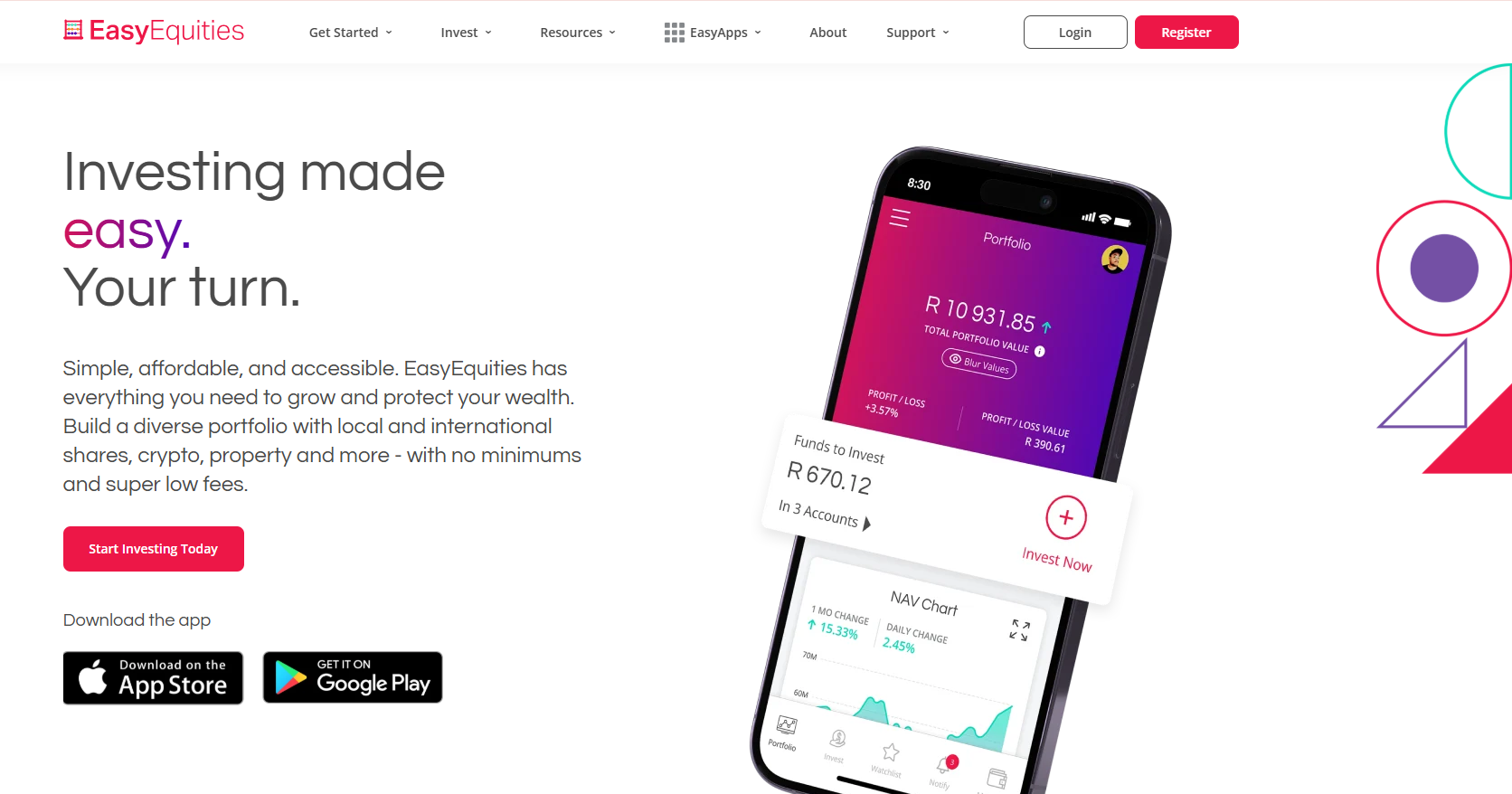
- EasyEquities has removed one of the biggest barriers to investing in South Africa: the idea that you need a large portfolio before buying shares becomes worthwhile.
- The platform is a product of First World Trader (Pty) Ltd, an authorised Financial Services Provider under FSP 22588.
- Its biggest advantage for smaller investors is flexibility. You do not need to wait until you can afford an entire share before putting money into the market.
- Fractional investing allows smaller rand amounts to be spread across more than one investment, which can make diversification more practical when you are starting with limited capital.
- There is an important legal difference, though. EasyEquities Fractional Share Rights, or FSRs, are not the same as owning part of a registered whole share. An FSR gives you contractual economic exposure to part of the security.
- Standard brokerage is currently 0.25% per transaction, subject to the provider's published terms and other applicable charges. EasyEquities also publishes a R25 monthly Thrive fee unless the client qualifies for a waiver.
- For many smaller investors, the platform remains inexpensive, but I would not describe it as “free.” Calculate what the account is likely to cost you over a year.
Features
| Feature | EasyEquities |
|---|---|
| Regulated Entity | First World Trader (Pty) Ltd |
| FSP | 22588 |
| Minimum Investment | No large minimum |
| Standard Brokerage | 0.25% |
| Thrive Fee | R25/month unless qualifying waiver applies |
| JSE Shares | Yes |
| ETFs | Yes |
| Fractional Investing | Yes |
| Tax-Free Investing | Yes |
| Mobile Investing | Yes |
| International Investing | Yes |
| Beginner Friendly | Excellent |
Pros and Cons
| Pros | Cons |
|---|---|
| No large investment minimum | Not designed as a professional day-trading terminal |
| Percentage-based brokerage suits smaller trades | Monthly Thrive fee can apply |
| Fractional investing available | FSRs are different from owning a whole share |
| Easy platform to understand | Research is lighter than at several traditional brokers |
| Local and offshore investments | Some additional services carry separate costs |
| Tax-free investment account available | Parts of the standard service use delayed pricing |
| Works well for regular small contributions | Limited appeal for investors needing advanced derivatives and execution tools |
Why is EasyEquities good for beginners?
Beginners can start with small amounts without having minimum brokerage dominate every investment decision.
You can build positions gradually, use fractional exposure where appropriate, and learn how shares and ETFs behave without committing a large lump sum from day one.
The interface is also easier to understand than a traditional dealer platform. When you are still learning concepts such as market orders, ETFs, dividends and capital gains, simplicity has real value.
Is EasyEquities FSCA regulated?
Yes. EasyEquities is a product of First World Trader (Pty) Ltd, an authorised Financial Services Provider under FSP 22588.
2. Standard Online Share Trading
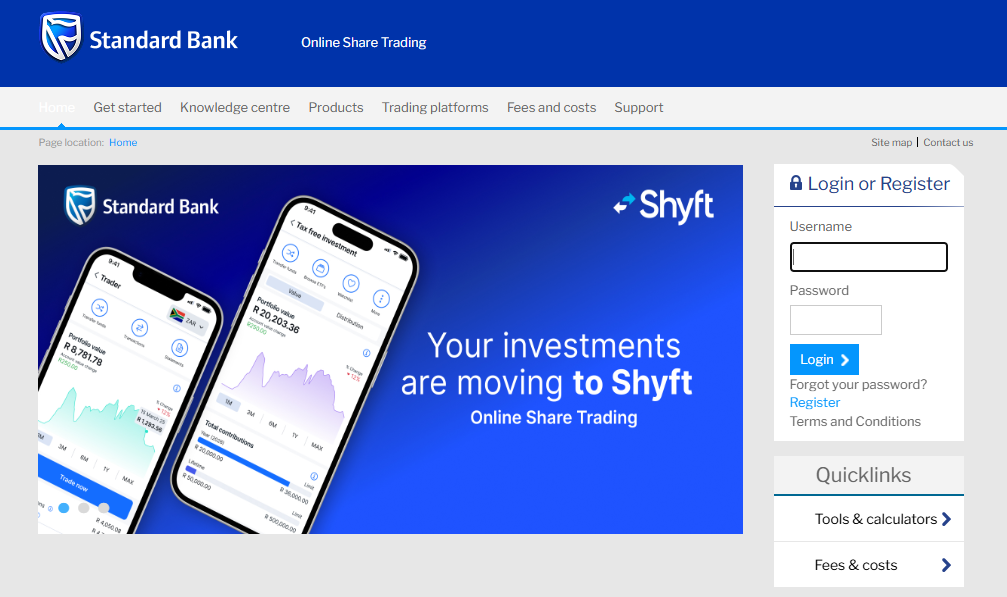
- Standard Online Share Trading is built for a very different type of investor.
- The service is operated by SBG Securities (Pty) Ltd, an authorised user of the JSE and an authorised Financial Services Provider under FSP 26691.
- Alongside ordinary shares and ETFs, the platform supports products such as futures, CFDs and warrants.
- That additional functionality is useful if you actively manage positions, follow markets closely or use more sophisticated trading strategies.
- More functionality also creates more costs to understand. Depending on your activity, brokerage, account charges, market-data costs and statutory fees can all matter.
- If your plan is simply to invest R500 into an ETF every month, much of this functionality may be unnecessary. If you trade actively, it becomes considerably more useful.
Features
| Feature | Standard Online Share Trading |
|---|---|
| Operating Entity | SBG Securities (Pty) Ltd |
| FSP | 26691 |
| JSE Status | Authorised JSE User |
| JSE Shares | Yes |
| ETFs | Yes |
| CFDs | Yes |
| Futures | Yes |
| Warrants | Yes |
| Market Information | Yes |
| Research and Education | Yes |
| Online Trading | Yes |
Pros and Cons
| Pros | Cons |
|---|---|
| Authorised JSE user | Costs can be harder to justify on very small portfolios |
| Detailed market information | Steeper learning curve |
| Shares and derivatives available | Pricing is more involved than on a simple investment app |
| Research and education | Passive investors will not use many of the tools |
| Well suited to active portfolios | Product-specific and statutory costs still apply |
| Established stockbroking infrastructure | Less beginner-focused than EasyEquities |
Why is Standard Online Share Trading good for active investors?
Because it gives you considerably more room than a basic buy-and-hold investment app.
You can work with ordinary shares and ETFs alongside futures, CFDs and warrants while using more detailed market information.
For someone monitoring positions regularly, execution, market data and product choice matter. For someone placing one passive investment a month, they usually matter far less.
Is Standard Online Share Trading FSCA regulated?
Yes. The service is operated by SBG Securities (Pty) Ltd, an authorised Financial Services Provider under FSP 26691 and an authorised user of the Johannesburg Stock Exchange.
3. FNB Stockbroking
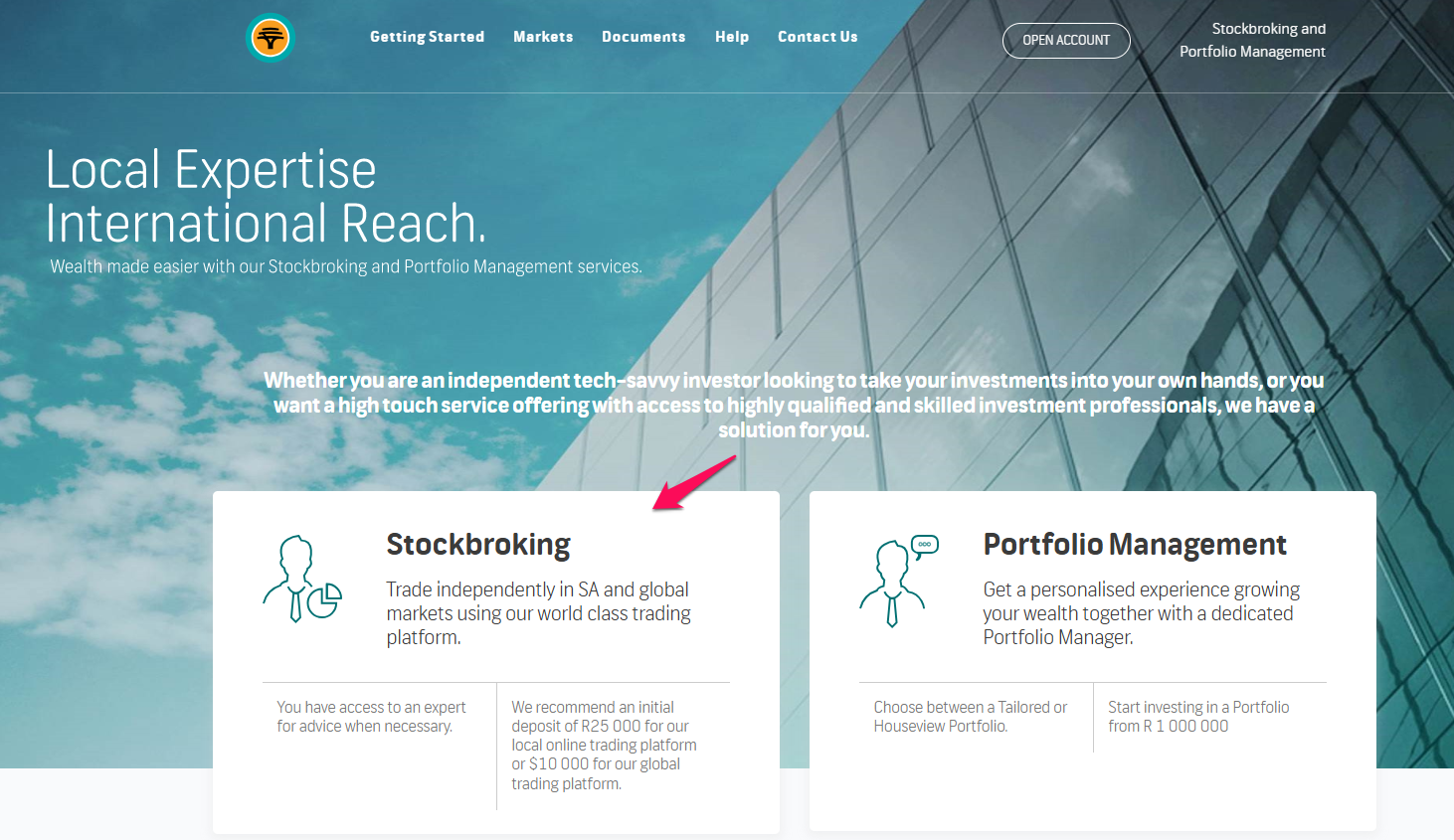
- FNB Stockbroking is a stronger fit for investors who want traditional stockbroking infrastructure, research and the convenience of operating within the wider FNB and FirstRand environment.
- FNB Stockbroking and Portfolio Management (Pty) Ltd is currently listed by the JSE as an Equity Market member.
- The full stockbroking service should be separated from FNB Shares Zero. They target different investors and use different pricing structures.
- The broader stockbroking offering provides local and international market access, research and portfolio-management options.
- That becomes more useful when you are selecting individual companies, managing a larger portfolio or want more professional support.
- If your entire strategy is one small ETF contribution every month, the full service may offer more functionality than you actually need.
Features
| Feature | FNB Stockbroking |
|---|---|
| JSE Status | Equities Member |
| JSE Shares | Yes |
| ETFs | Yes |
| ETNs | Yes |
| Local Stockbroking | Yes |
| Global Shares | Yes, through selected services |
| Investment Research | Strong |
| Managed Portfolios | Yes |
| Banking Integration | Excellent |
| Lower-Cost FNB Option | Shares Zero available separately |
Pros and Cons
| FNB Stockbroking – Pros | FNB Stockbroking – Cons |
|---|---|
| JSE Equity Market member with established stockbroking infrastructure | Full-service stockbroking can be more than a beginner actually needs |
| Strong investment research and market information | Costs vary depending on the product and service used |
| Access to both local and selected international investments | Traditional stockbroking pricing may be less attractive for very small portfolios |
| Works well for investors already using the wider FNB banking ecosystem | More complicated than a simple app-based investing platform |
| Portfolio-management options are available for larger or more involved portfolios | Managed and advisory services come with additional costs |
| FNB Shares Zero gives cost-conscious investors a separate lower-cost option | Shares Zero has a more limited investment range than the full stockbroking service |
What is FNB Shares Zero?
FNB Shares Zero deserves separate treatment because it operates quite differently from a traditional full-service stockbroking account.
FNB currently states that Shares Zero has no minimum opening balance and no monthly account fee.
Qualifying FNB and Ashburton ETFs and ETNs can be bought with zero brokerage. FNB publishes a 0.25% brokerage charge for purchases of non-FNB/non-Ashburton ETFs and ETNs and for sales.
That can make Shares Zero extremely competitive for the right investor. The trade-off is that the available investment universe is more limited than a full stockbroking account.
The cheapest option therefore depends on what you actually intend to buy, not which product has the word “zero” in its name.
Does FNB Stockbroking provide investment research?
Yes. Research and market information form an important part of the full FNB stockbroking service.
That becomes more valuable when you are analysing individual companies or managing a larger portfolio. Someone making an automated ETF contribution every month may never need most of it.
4. Absa Stockbrokers and Portfolio Management
- Absa works well for investors who want the option of managing investments themselves while retaining access to professional portfolio-management services later.
- Absa Stockbrokers and Portfolio Management is a member of the JSE Equity Market and an authorised Financial Services Provider under FSP 45849.
- The business covers self-directed stockbroking as well as professionally managed investments.
- That flexibility becomes more useful as portfolio size and complexity increase.
- A R20,000 portfolio and a R5 million portfolio rarely need the same level of service. On a small portfolio, extra administration and management costs can take too large a bite. On a larger portfolio, professional advice and management can be easier to justify.
Features
| Feature | Absa Stockbrokers and Portfolio Management |
|---|---|
| FSP | 45849 |
| JSE Status | JSE Equity Market Member |
| JSE Shares | Yes |
| ETFs / Exchange-Traded Securities | Yes |
| Offshore Investing | Available |
| Managed Portfolios | Yes |
| Shari'ah Investment Options | Available through selected services |
| Online Trading | Yes |
| Research | Yes |
Pros and Cons
| Absa Stockbrokers and Portfolio Management – Pros | Absa Stockbrokers and Portfolio Management – Cons |
|---|---|
| JSE Equity Market member and authorised FSP under FSP 45849 | Managed portfolios generally make more sense for larger investment balances |
| Investors can choose between self-directed trading and managed portfolios | Not designed around ultra-low-cost investing in very small amounts |
| Access to JSE-listed shares and exchange-traded securities | Pricing differs across services, so total cost takes more work to compare |
| Offshore investment options are available | The wider product range can feel complicated for beginners |
| Research and professional support are available | Full-service features may be unnecessary for passive ETF investors |
| Useful for investors who may want to move from DIY investing to professional management later | Advice and portfolio management add another layer of fees |
Can I buy JSE shares through Absa?
Yes. Absa Stockbrokers and Portfolio Management gives investors access to JSE-listed investments through its stockbroking services. Professionally managed options are also available for investors who do not want to make every portfolio decision themselves.
Is Absa Stockbrokers FSCA regulated?
Yes. Absa Stockbrokers and Portfolio Management (Pty) Ltd is an authorised Financial Services Provider under FSP 45849 and a member of the JSE Equity Market.
5. PSG Securities
- PSG Securities sits much closer to traditional stockbroking than a simple mobile investment app.
- PSG Securities Ltd is an authorised Financial Services Provider under FSP 42996 and a member of the Johannesburg Stock Exchange.
- The platform is better suited to experienced investors who need wider investment access, professional dealing support or more sophisticated trading functionality.
- The main consideration for smaller investors is cost.
- Minimum brokerage, administration fees and optional market-data or service charges can have a disproportionate effect on small transactions.
- A fixed R100 cost on a R1,000 trade represents 10% of the transaction. On a R100,000 trade, the same R100 is only 0.1%.
- This is why total cost as a percentage of the amount invested matters more than comparing rand fees in isolation.
Features
| Feature | PSG Securities |
|---|---|
| FSP | 42996 |
| JSE Status | JSE Member |
| JSE Shares | Yes |
| Offshore Investing | Available through relevant services |
| Derivatives | Available through relevant accounts |
| Exchange-Traded Products | Yes |
| Professional Dealing Support | Yes |
| Online Trading | Yes |
| Advanced Investor Tools | Yes |

Pros and Cons
| PSG Securities – Pros | PSG Securities – Cons |
|---|---|
| Authorised FSP under FSP 42996 and a JSE member | Small trades can become expensive where minimum brokerage charges apply |
| Better suited to experienced investors who want a traditional stockbroking setup | Administration and market-data charges may apply |
| Access to JSE shares, exchange-traded products and selected derivatives | Less intuitive for someone completely new to investing |
| Offshore investing is available through relevant services | Pricing needs to be checked carefully because costs go beyond headline brokerage |
| Professional dealing support is available | Generally better value once the portfolio and trade sizes are larger |
| Broader trading environment than a basic mobile investment app | Overkill for someone who only wants to invest a few hundred rand into an ETF each month |
How much does PSG Securities charge?
PSG uses a more traditional stockbroking pricing model, which means the final cost can involve more than one percentage commission.
Check minimum brokerage, administration charges, market-data costs and statutory fees before comparing it with a lower-cost app-based provider.
Transaction size is important. A fee that is perfectly reasonable on a six-figure trade can be expensive when the amount invested is only R1,000.
Is PSG Securities FSCA regulated?
Yes. PSG Securities Ltd is an authorised Financial Services Provider under FSP 42996 and a member of the Johannesburg Stock Exchange.
6. Nedbank Private Wealth Stockbrokers
- Nedbank Private Wealth Stockbrokers sits at the traditional end of this comparison, combining execution-only share dealing with access to broader advisory and wealth-management services.
- Nedgroup Private Wealth Stockbrokers (Pty) Ltd is an authorised Financial Services Provider under FSP 50399 and a member of the Johannesburg Stock Exchange.
- The “Private Wealth” name should not lead you to assume that every service works the same way. Execution-only stockbroking and full wealth management are different offerings.
- The broader private-wealth proposition becomes more relevant when tax planning, offshore assets, advice and discretionary management begin to matter alongside normal share dealing.
Features
| Feature | Nedbank Private Wealth Stockbrokers |
|---|---|
| FSP | 50399 |
| JSE Status | JSE Member |
| JSE Shares | Yes |
| ETFs and Listed Securities | Yes |
| International Markets | Available through broader offering |
| Research | Yes |
| Advisory Services | Yes |
| Managed Portfolios | Yes |
| Execution-Only Trading | Yes |

Pros and Cons
| Nedbank Private Wealth Stockbrokers – Pros | Nedbank Private Wealth Stockbrokers – Cons |
|---|---|
| Authorised FSP under FSP 50399 and a JSE member | The Private Wealth branding can make the service appear less accessible to smaller investors |
| Execution-only stockbroking is available alongside advisory services | More involved than a basic app-based investing account |
| Access to JSE-listed shares, ETFs and other listed securities | Advice and managed portfolios carry additional fees |
| International investment access is available through the broader offering | Unlikely to be the cheapest option for very small transactions |
| Research, advice and portfolio-management services are available | Much of the wider value only becomes relevant as portfolio size and complexity grow |
| Stronger fit for investors whose needs extend beyond simply buying and selling shares | Can be unnecessary for straightforward, passive investing |
Is Nedbank Online Share Trading only for wealthy investors?
No. Execution-only stockbroking should be considered separately from Nedbank's broader Private Wealth advisory services.
Check the requirements and fees attached to the specific account you want rather than assuming every service carrying the Private Wealth name has the same entry threshold.
Is Nedbank Private Wealth Stockbrokers regulated?
Yes. Nedgroup Private Wealth Stockbrokers (Pty) Ltd is an authorised Financial Services Provider under FSP 50399 and a member of the Johannesburg Stock Exchange.
Which FSCA-Regulated JSE Broker Has the Lowest Fees?
There is no single cheapest JSE broker because the answer changes with transaction size, frequency and the investments you buy.
EasyEquities is especially competitive on smaller trades because standard brokerage is percentage-based at 0.25%. The Thrive fee and any additional transaction charges still need to be included in the calculation.
FNB Shares Zero can be cheaper in specific situations. There is currently no monthly account fee, while qualifying FNB and Ashburton ETFs and ETNs can be bought without brokerage.
That does not mean every Shares Zero transaction costs nothing.
Traditional brokers require a slightly different calculation. Minimum brokerage, administration charges, market-data fees and advice costs can outweigh what initially looks like an attractive headline commission.
The simplest way to compare brokers is to estimate what you expect to invest and trade over a full year, then calculate the total likely cost rather than comparing one fee in isolation.
| Broker | Typical Cost Position | Best Suited To |
|---|---|---|
| EasyEquities | Low percentage-based brokerage; other fees can apply | Small and regular investors |
| Standard Online Share Trading | Traditional trading and account costs | Active JSE investors |
| FNB Shares Zero | Very low cost for selected instruments | Cost-conscious ETF, ETN and Top 40 investors |
| FNB Stockbroking | Full-service stockbroking pricing | Research-focused investors |
| Absa Stockbrokers | Depends on account and service | Self-directed and managed investors |
| PSG Securities | Traditional brokerage structure | Larger and active portfolios |
| Nedbank Private Wealth | Traditional stockbroking and wealth-service pricing | Established and complex portfolios |
What Other Costs Apply When Buying JSE Shares?
Brokerage is only one part of the bill.
Depending on the provider and transaction, investors may also encounter Securities Transfer Tax, settlement-related charges, investor-protection levies, VAT, account fees, market-data costs and product-specific charges.
South Africa currently levies Securities Transfer Tax at 0.25% on applicable transfers of securities.
For example, a broker advertising 0.25% brokerage does not necessarily mean a R10,000 investment will cost exactly R25. Other statutory, settlement or account-related charges may still apply.
Do not assume every transaction is treated in exactly the same way. Check the broker's current cost profile and the contract note for the trade you are making.
EasyEquities vs Traditional JSE Stockbrokers
EasyEquities and traditional stockbrokers solve different problems.
EasyEquities is strongest when accessibility, simplicity and small transaction sizes matter. If you are investing R500 a month into an ETF, you probably do not need a professional dealing desk, derivatives access and an extensive institutional-style research library.
Traditional brokers such as PSG Securities, SBG Securities, Absa and FNB offer more depth. Depending on the provider, that can include company research, derivatives, professional dealing, advice, portfolio management and more detailed market information.
Those features become valuable when you actually use them.
A long-term ETF investor with a R30,000 portfolio may struggle to justify paying extra for sophisticated trading infrastructure. An investor managing R5 million across shares, futures and offshore assets is looking at a completely different equation.
How to Choose an FSCA-Regulated JSE Broker
Start with regulation. Then calculate what the account is realistically going to cost you.
Check the legal company name, FSP details and, where relevant, the firm's JSE membership or authorised-user status through official sources.
Once that checks out, compare the things that will actually affect your account:
- Brokerage percentage
- Minimum brokerage
- Monthly or annual account charges
- Platform and activity fees
- Minimum investment
- The JSE instruments you can actually trade
- Whole-share versus fractional-investment structure
- Live versus delayed prices
- Research
- Mobile and desktop functionality
- Tax-Free Savings Account availability
- Offshore investing
- Advice
- Portfolio management
- Customer support and complaints procedures
A tiny difference in advertised commission often matters less than investors expect. On a smaller account, one fixed monthly charge or minimum brokerage fee can have a much larger effect on returns.
How Can I Verify a JSE Broker?
Use the legal entity name and FSP number to verify the provider through official FSCA and JSE channels.
Do not trust a licence number simply because it appears on a website, social-media advert or WhatsApp message. Scammers regularly copy the names and regulatory details of legitimate financial companies.
Check that the website, contact details, legal entity and bank-payment information all match independently verified information.
If someone promises guaranteed investment returns, asks you to transfer money into an unrelated account or requests your banking password or one-time PIN, stop. Verify the communication independently before doing anything else.
Which JSE Broker Is Best for Beginners?
EasyEquities remains our preferred option for most beginners. You can start with a relatively small amount, fractional investing is available and the platform is simple enough to use without hiding the basic concepts investors need to understand.
FNB Shares Zero is also worth comparing if the investments you want are available through the product, particularly for existing FNB clients who value banking integration.
Which JSE Broker Is Best for Active Trading?
Standard Online Share Trading and PSG Securities are stronger choices for experienced, active investors. They provide a broader trading environment than a simple investing app and make more sense when execution, market data, product choice and derivatives matter.
For active trading, focus on total round-trip transaction cost rather than headline brokerage alone.
Which JSE Broker Is Best for Managed Investing?
Absa, FNB and Nedbank stand out if you want professional involvement in portfolio decisions. Their services range from execution-only dealing through to advice and discretionary portfolio management.
Managed investing generally becomes easier to justify as a portfolio grows because advice and management fees need to add enough value to cover their cost.
Which JSE Broker Is Best for Small Monthly Investments?
EasyEquities generally makes the most sense for investors contributing smaller amounts each month. Percentage-based brokerage avoids the impact that a large minimum commission can have on a small transaction.
FNB Shares Zero is also worth comparing where the securities you want are available. The cheaper option will depend on what you buy, how frequently you invest and which recurring charges apply.
Do I Own the JSE Shares I Buy?
That depends on exactly what you bought.
With conventional whole-share stockbroking, you obtain ownership rights in the security through the relevant custody and settlement structure.
Fractional investment products can work differently.
EasyEquities, for example, distinguishes between whole shares and Fractional Share Rights. An FSR gives you contractual economic exposure to part of a security rather than ownership of that underlying fractional share in the same way as a conventional whole share.
This distinction can affect voting rights, corporate actions, transfers and what happens in certain legal or insolvency situations. It is worth understanding before building a substantial position through fractional products.
Conclusion
Choosing a JSE broker is less about finding the platform with the longest feature list and more about matching the account to the way you actually invest.
EasyEquities remains our best overall choice for beginners and investors making smaller regular contributions. Standard Online Share Trading and PSG Securities become more appealing as trading activity and complexity increase, while FNB, Absa and Nedbank make more sense when research, advice or broader wealth-management services start to matter.
The process is fairly simple. Verify the legal entity first. Work out the real annual cost based on the transactions you expect to make. Then pay for the services you are actually going to use.
Frequently Asked Questions
What is an FSCA-regulated JSE broker?
It generally refers to a South African regulated financial-services business that gives investors access to JSE-listed securities. Some providers are direct JSE members or authorised users, while others provide access through different regulated structures. Always check the legal entity and its exact regulatory status rather than relying only on the brand name.
Which JSE broker is best for beginners in South Africa?
EasyEquities is one of the strongest choices for beginners because there is no large minimum investment, standard brokerage is percentage-based and fractional investing is available. FNB Shares Zero is also worth considering where its available shares, ETFs and ETNs match your investment strategy.
Which FSCA-regulated JSE broker has the lowest minimum investment?
EasyEquities allows very small contributions, while FNB states that Shares Zero has no minimum opening balance. Minimum investment is only one part of the comparison, though. Trading costs and recurring fees still matter.
Can I invest R100 in JSE shares?
Yes. Platforms offering fractional investment products can allow you to invest R100 even when one complete share costs more than that. The legal rights attached to a fractional product can differ from the rights attached to a whole share, so check the product structure before investing.
Do I actually own the shares I buy through EasyEquities?
It depends on whether you hold a whole share or a Fractional Share Right. EasyEquities states that whole-share investors have ownership rights, while an FSR provides contractual economic exposure to part of a security without ownership of the underlying fractional share.
Does EasyEquities charge a monthly fee?
EasyEquities currently publishes a R25 monthly Thrive fee. Qualifying clients can have the fee waived under the provider's published rules. Check the latest cost profile because these conditions can change.
Which JSE broker is best for active traders?
Standard Online Share Trading and PSG Securities are stronger choices for active investors because both provide more traditional stockbroking functionality and broader trading tools than a basic investment app.
Can I trade JSE shares using my mobile phone?
Yes. Major South African investment providers offer mobile or browser-based access. Active traders should still check whether the mobile platform provides the order types, market information and pricing data they rely on at desktop level.
Can I open a Tax-Free Savings Account with a JSE investment platform?
Yes. Several South African providers offer tax-free investment accounts containing qualifying investments such as ETFs. TFSA eligibility rules still apply, so not every security available in a normal stockbroking account can automatically be held inside the tax-free account.
What fees do JSE brokers charge?
Depending on the broker, you may pay brokerage, minimum commissions, account fees, market-data charges, settlement costs, investor-protection levies, VAT and applicable taxes. Securities Transfer Tax is currently 0.25% on applicable securities transfers in South Africa.
You Might Also Like




Recommended brokers