



This Bancor review has revealed that Bancor allows users to convert between two tokens, the same principles on which most exchanges are based. Bancor protocol aims to be a new standard according to which ERC20 tokens will be exchanged.
| 🔢 Aspect | 📌 Details |
| 🪙 Name | Bancor Network Token (BNT) |
| 📅 Launch Year | 2017 |
| 🔗 Blockchain Origin | Ethereum (ERC-20 token), with integrations across multiple DeFi networks |
| ⚙️ Consensus Mechanism | Inherits Ethereum’s Proof-of-Stake consensus mechanism |
| 🧮 Mining Algorithm | None – BNT is not mined |
| 🖥️ Mining Type | Not mineable; distributed via protocol incentives and liquidity rewards |
| 💎 Maximum Supply | Approximately 110–111 million BNT tokens |
| ⏱️ Block Time | ~12 seconds (based on Ethereum network block time) |
| 💸 Transaction Fees | Standard Ethereum gas fees depending on network congestion |
| 🚀 Transaction Speed | Seconds to a few minutes depending on Ethereum network activity |
| 🔐 Privacy Features | Public blockchain transparency with pseudonymous wallet addresses |
| 🌍 Use Case | Liquidity provision, decentralized token swaps, automated market making (AMM), and DeFi trading |
| 👥 Target Users | DeFi traders, liquidity providers, crypto investors, and decentralized application users |
| 📉 Market Position | Mid-cap DeFi token focused on liquidity infrastructure and automated token exchanges |
| 🔄 Exchange Availability | Available on major centralized and decentralized exchanges such as Binance, Coinbase, Kraken, and Bancor DEX |
| 🧠 Key Advantage | Early pioneer of automated market maker (AMM) liquidity protocols enabling token swaps without order books |
| ⚠️ Risk Level | Moderate to high due to DeFi competition, smart contract risks, and crypto market volatility |
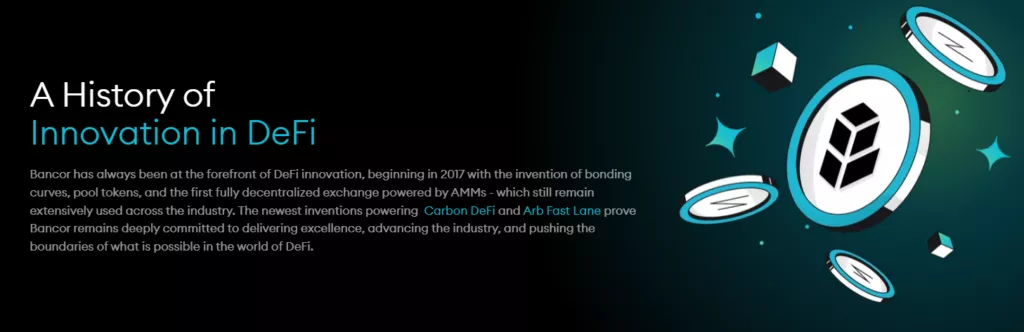
How to Buy Bancor (BNT)
Buying Bancor (BNT) is a straightforward process and can be done through most major cryptocurrency exchanges. Follow these steps to purchase BNT safely.
Step 1 – Choose a Cryptocurrency Exchange
- Select a reputable cryptocurrency exchange that lists Bancor (BNT).
- Popular platforms that support BNT trading include Binance, Coinbase, Kraken, KuCoin, and Gate.io.
- Ensure the exchange operates in your country and supports your preferred payment method.
Step 2 – Create an Account
- Register for an account on the chosen exchange by providing your email address and creating a strong password.
- Most exchanges require identity verification (Know Your Customer – KYC) to comply with financial regulations.
Step 3 – Secure Your Account
- Enable additional security features such as Two-Factor Authentication (2FA).
- This adds an extra layer of protection and helps safeguard your account against unauthorized access.
Step 4 – Deposit Funds
Deposit funds into your exchange account. Most platforms allow deposits through:
- Bank transfers
- Credit or debit cards
- Cryptocurrency deposits (such as BTC, ETH, or USDT)
- Choose the deposit option that best suits your needs.
Step 5 – Find the BNT Trading Pair
Navigate to the exchange’s trading section and search for BNT. Common trading pairs include:
- BNT/USDT
- BNT/BTC
- BNT/ETH
- BNT/USD
Select the trading pair that matches the currency you deposited.
Step 6 – Place a Buy Order
Enter the amount of BNT you want to purchase. You can choose between different order types:
- Market Order: Instantly buys BNT at the current market price.
- Limit Order: Allows you to set a specific price at which you want to buy BNT.
- Confirm the order to complete the purchase.
Step 7 – Store Your BNT Securely
- After purchasing BNT, consider transferring your tokens to a secure cryptocurrency wallet instead of leaving them on the exchange.
Popular wallets that support BNT include:
- MetaMask
- Trust Wallet
- Ledger Hardware Wallet
- Coinbase Wallet
Using a private wallet ensures you maintain full control over your digital assets and improves security.
How the Bancor Protocol Works
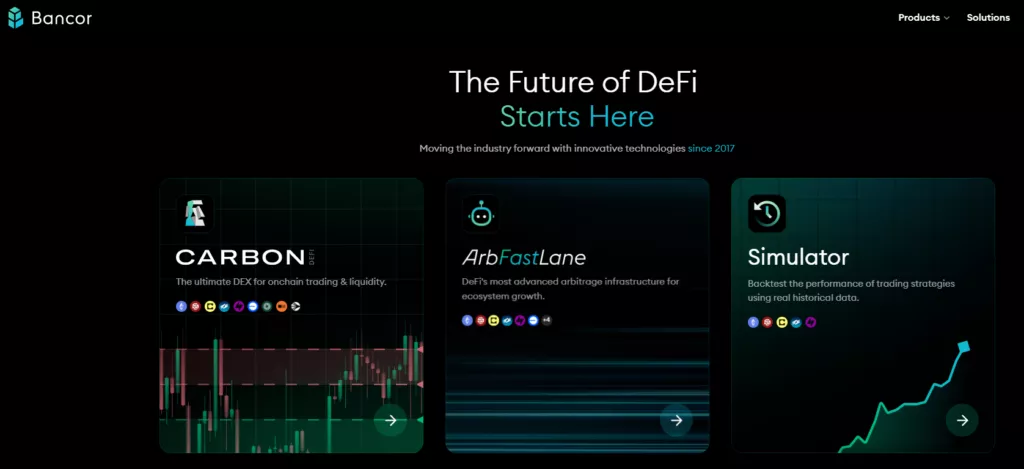
- The Bancor protocol introduced a new approach to token liquidity by using automated market maker (AMM) technology. Before the rise of AMM-based exchanges, most cryptocurrency trading relied on traditional order books where buyers and sellers had to match orders.
- Bancor changed this model by allowing tokens to be exchanged directly through smart contracts rather than through counterparties.
- At the core of the Bancor protocol are liquidity pools, which contain reserves of tokens locked within smart contracts. These pools enable users to convert tokens instantly without needing a buyer or seller on the other side of the trade.
- When a user swaps one token for another, the smart contract automatically calculates the exchange rate based on the Bancor Formula, which adjusts prices dynamically depending on the supply and demand of tokens within the liquidity pool.
- This mechanism ensures continuous liquidity, meaning that users can convert tokens at any time, regardless of market activity.
Key Components of the Bancor Protocol
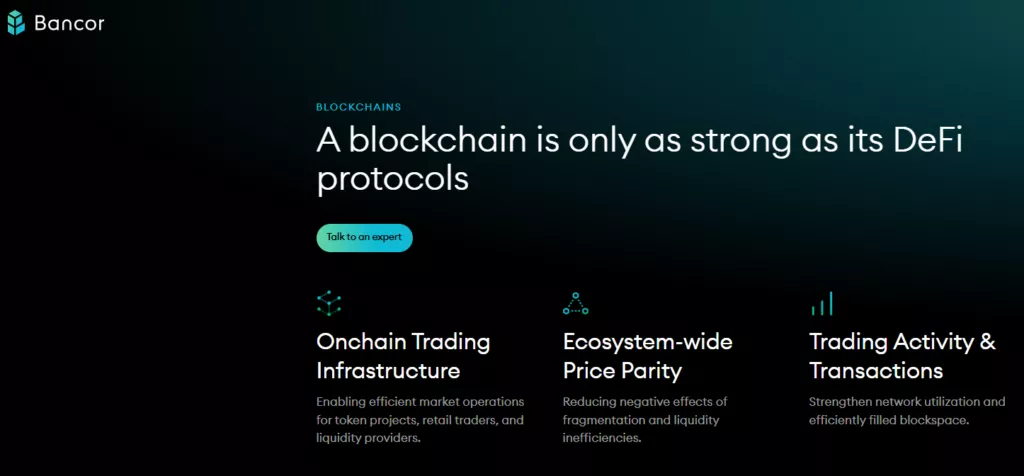
This architecture eliminates many of the limitations found in centralized exchanges.
The Bancor Automated Market Maker (AMM)
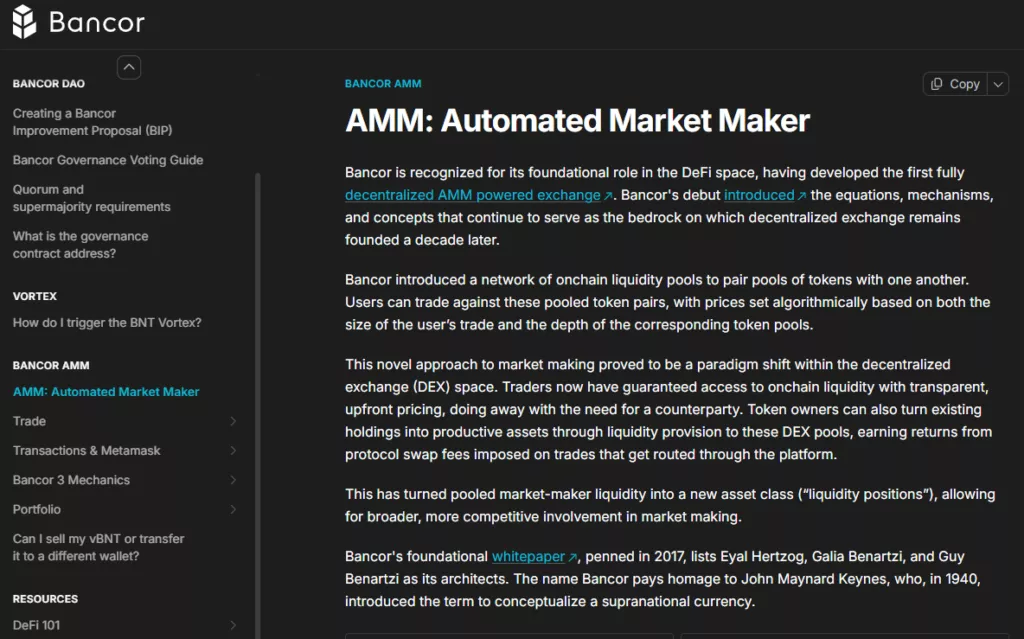
- Bancor was one of the earliest projects to pioneer the automated market maker model that later became widely adopted across the DeFi ecosystem.
- Unlike centralized exchanges that rely on order books, AMMs use mathematical formulas to determine token prices.
- In Bancor’s system, token prices are calculated based on the ratio between tokens held in liquidity pools. When a user performs a trade, the balance of the pool changes, which automatically adjusts the price.
- This dynamic pricing model helps maintain equilibrium within the liquidity pool while ensuring that trades can occur instantly.
- The Bancor AMM also introduced the concept of single-sided liquidity, which allows liquidity providers to deposit just one asset instead of requiring token pairs.
- This innovation helps reduce the complexity involved in providing liquidity.
Bancor Ecosystem Overview
The Bancor ecosystem consists of several components that work together to facilitate decentralized trading and liquidity provision.
| 🌐 Ecosystem Element | 📌 Function |
| Bancor Protocol | Core infrastructure enabling automated token conversions |
| BNT Token | Native token used as an intermediary in swaps |
| Liquidity Pools | Smart contracts that store token reserves |
| Governance System | Allows token holders to vote on proposals |
| DeFi Integrations | Partnerships with other decentralized platforms |
The Role of the BNT Token
- BNT serves as the core network token within the Bancor ecosystem.
- Instead of requiring every token pair to maintain its own liquidity pool, Bancor allows tokens to connect through BNT as an intermediary.
- For example, if a user wants to convert Token A into Token B, the system may convert Token A into BNT first and then convert BNT into Token B.
- This approach simplifies liquidity management and reduces the number of pools required for token conversions.
BNT Token Utility
| 🪙 Utility | 📌 Purpose |
| Liquidity Provision | Used within liquidity pools |
| Governance | Allows voting on network proposals |
| Network Fees | Supports protocol operations |
| Token Conversions | Acts as an intermediary between tokens |
Bancor Governance
- Governance within the Bancor ecosystem is managed through the vBNT governance token.
- When users provide liquidity to the network, they receive vBNT, which represents their stake in the protocol.
These governance tokens allow users to participate in decision-making processes related to:
- protocol upgrades
- liquidity pool adjustments
- reward structures
- system parameters
This decentralized governance model ensures that the network evolves according to community consensus.
Bancor vs Traditional Cryptocurrency Exchanges
- One of Bancor’s primary goals is to remove the need for centralized exchanges.
- Traditional exchanges require users to deposit funds into custodial wallets, which introduces counterparty risk.
- Bancor eliminates this requirement by enabling users to trade directly from their own wallets.
| ⚙️ Feature | 🟣 Bancor | 🏦 Centralized Exchange |
| 🔐 Custody | Non-custodial – users maintain full control of their private keys and wallets | Custodial – exchange holds and manages user funds |
| 💧 Liquidity | Automated liquidity pools powered by smart contracts | Order books matching buyers and sellers |
| 🌍 Access | Permissionless – anyone with a compatible crypto wallet can trade | Requires registration, account setup, and often KYC verification |
| 🔎 Transparency | On-chain transactions visible on the blockchain | Limited transparency, most operations occur internally |
| 🛡️ Control | User-controlled funds traded directly from personal wallets | Exchange-controlled funds until users withdraw assets |
Bancor vs Uniswap vs SushiSwap
The decentralized exchange sector has grown significantly since Bancor’s launch.
| ⚙️ Feature | 🏦 Bancor | 🏢 Centralized Exchange |
| 🔐 Custody | Non-custodial – users keep control of their wallets and private keys | Custodial – exchange holds and manages user funds |
| 💧 Liquidity | Automated liquidity pools powered by smart contracts | Order book model matching buyers and sellers |
| 🌍 Access | Permissionless – anyone with a crypto wallet can trade | Requires registration and account verification |
| 🔎 Transparency | Fully on-chain and publicly verifiable transactions | Limited transparency with internal exchange systems |
| 🛡️ Control | User-controlled funds with direct wallet interaction | Exchange-controlled funds until withdrawal |
- Bancor offers several advantages compared to traditional trading platforms.
Continuous Liquidity
- The protocol ensures that tokens can be exchanged at any time without requiring counterparties.
Automated Pricing
- Prices are calculated using transparent mathematical formulas rather than relying on order books.
Decentralization
- Users maintain full control of their assets throughout the trading process.
Innovation in Liquidity Provision
- Bancor introduced single-sided liquidity and impermanent loss protection.
- These features helped shape the broader DeFi ecosystem.
Risks and Challenges
- Despite its innovations, Bancor also faces several challenges.
| ⚠️ Risk | 📌 Explanation |
| DeFi Competition | Platforms like Uniswap dominate trading volumes |
| Smart Contract Risk | Bugs or vulnerabilities could affect funds |
| Market Volatility | Token price fluctuations impact liquidity pools |
| Regulatory Uncertainty | DeFi regulation continues evolving |
| Adoption Risk | New protocols may attract more users |
Bancor Use Cases
- Bancor provides several practical use cases within decentralized finance.
Token Swapping
- Users can convert ERC20 tokens directly without relying on centralized exchanges.
Liquidity Provision
- Investors can deposit tokens into liquidity pools and earn rewards.
DeFi Integration
- Bancor integrates with other DeFi platforms to provide liquidity infrastructure.
Governance Participation
- Token holders can vote on proposals affecting the network.
These applications make Bancor an important part of the DeFi ecosystem.
Future Outlook for Bancor
- The decentralized finance sector continues to evolve rapidly, and Bancor remains part of this growing ecosystem.
Several factors may influence the future success of Bancor: DeFi Growth
- As decentralized finance expands, demand for liquidity solutions may increase.
Protocol Upgrades
- The development team continues to improve the protocol with new features.
Cross-Chain Integration
- Future versions of Bancor may support additional blockchains beyond Ethereum.
Institutional Interest
- Increasing institutional adoption of DeFi could benefit liquidity protocols like Bancor.
- While competition in the decentralized exchange sector remains intense, Bancor’s early innovations have secured its place in DeFi history.
Bancor in the DeFi Landscape
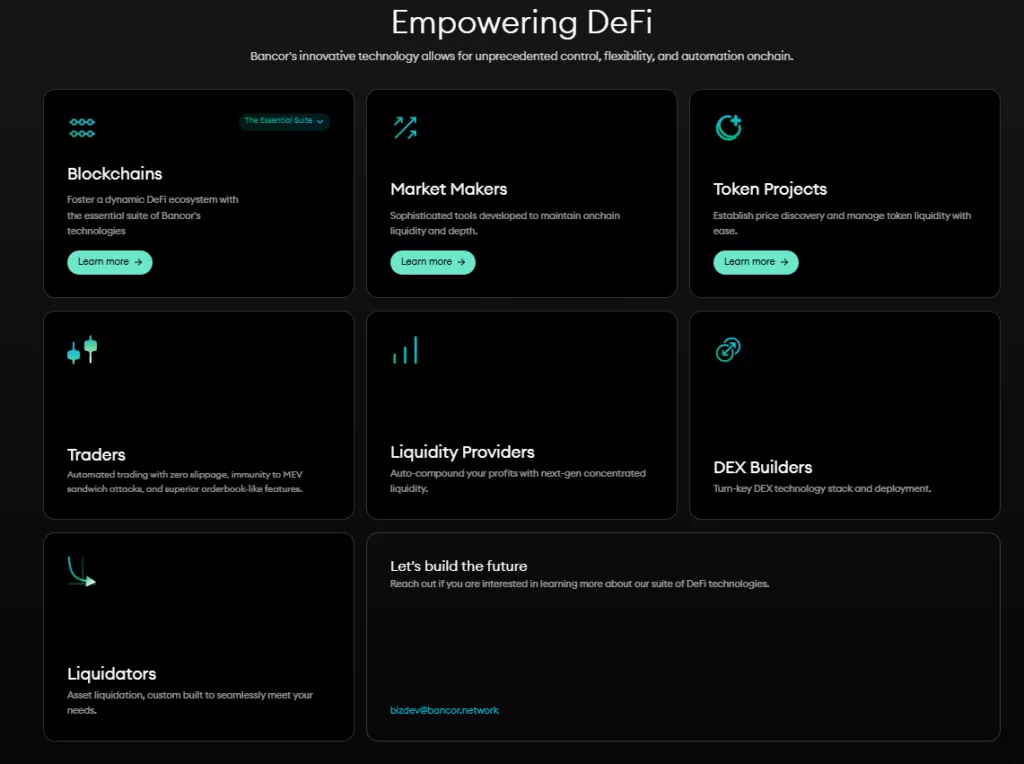
- Bancor played a crucial role in the early development of decentralized finance by introducing the concept of automated liquidity pools.
- Today, many DeFi platforms build upon the innovations originally introduced by Bancor.
These innovations include:
- automated market makers
- on-chain liquidity
- decentralized token swaps
- algorithmic price discovery
Even as newer protocols emerge, Bancor remains an influential project within the decentralized finance ecosystem.
Bancor Long-Term Investment Thesis
From an investment perspective, Bancor represents exposure to the decentralized exchange infrastructure sector. The value of BNT may depend on several factors:
- adoption of decentralized exchanges
- liquidity provision demand
- DeFi ecosystem growth
- governance participation
Investors interested in DeFi infrastructure projects may consider Bancor as part of a diversified cryptocurrency portfolio. However, as with all digital assets, careful research and risk management are essential.
Bancor Tokenomics Deep Dive
- Tokenomics refers to the economic structure that governs how a cryptocurrency functions within its ecosystem. In the case of Bancor, the native token BNT (Bancor Network Token) plays a central role in liquidity provision, governance, and protocol operations.
- Unlike many cryptocurrencies that simply function as a payment token, BNT is deeply integrated into the architecture of the Bancor protocol. It serves as a hub token that connects liquidity pools and enables seamless token conversions across the network.
BNT as a Hub Token
- One of Bancor’s most innovative ideas is the concept of a hub token model.
- Instead of requiring each token pair to maintain its own liquidity pool, Bancor allows tokens to connect through BNT as an intermediary.
For example:
- Token A → BNT → Token B
This model reduces the number of liquidity pools needed across the network and improves capital efficiency. Because BNT sits at the center of the ecosystem, demand for the token can increase as network activity grows.
BNT Supply Dynamics
- Unlike fixed-supply cryptocurrencies such as Bitcoin, BNT has a dynamic supply mechanism.
- The Bancor protocol can mint or burn BNT tokens as part of its liquidity management system.
- This allows the network to maintain balanced liquidity pools and support trading activity without relying solely on external market makers.
- This flexible supply model helps ensure that the protocol can maintain deep liquidity even during periods of high trading demand.
Liquidity Incentives
Liquidity providers play a crucial role in the Bancor ecosystem. These users deposit tokens into liquidity pools, allowing traders to convert tokens instantly without requiring traditional buyers and sellers. In return for providing liquidity, users earn rewards such as:
- Trading fees generated from token swaps
- Protocol incentives distributed in BNT
- Governance rights through vBNT tokens
These incentives encourage long-term participation within the ecosystem.
vBNT Governance Token
When users stake BNT into the Bancor protocol, they receive vBNT, a governance token that represents their participation in the network. vBNT serves several functions:
- Governance voting power
- Participation in protocol proposals
- Liquidity mining incentives
Through this governance model, Bancor ensures that decisions about the protocol are made collectively by participants rather than a centralized authority.
Token Utility
The BNT token serves multiple roles within the ecosystem.
| 🪙 Utility | 📌 Description |
| Liquidity Provision | Used in liquidity pools across the network |
| Token Swaps | Acts as an intermediary between token conversions |
| Governance | Enables voting through vBNT |
| Incentives | Distributed as rewards to liquidity providers |
| Protocol Operations | Helps maintain liquidity across the network |
Final Say About Bancor
Bancor is one of the earliest pioneers of decentralized finance (DeFi) and automated market maker (AMM) technology. By introducing liquidity pools and algorithm-based pricing, Bancor helped reshape how cryptocurrency trading works, allowing users to exchange tokens directly through smart contracts without relying on centralized intermediaries.
You might also like:
Bitcoin SV (BSV) ReviewDAI ReviewAave Review
What is Bancor?
Bancor is a decentralized liquidity protocol that allows users to convert cryptocurrency tokens instantly through automated market makers rather than traditional order books. The platform uses smart contracts to provide continuous liquidity without requiring buyers and sellers to match trades.
When was Bancor launched?
Bancor was launched in June 2017 following one of the largest initial coin offerings (ICOs) at the time. The project quickly gained attention for introducing automated liquidity mechanisms that later influenced the development of modern decentralized exchanges.
Who founded Bancor?
Bancor was founded by Guy Benartzi, Galia Benartzi, and Eyal Hertzog. The team aimed to solve liquidity challenges in cryptocurrency markets by creating a protocol that allows tokens to be exchanged automatically through smart contracts.
What is BNT?
BNT is the native token of the Bancor network. It functions as a hub token within liquidity pools, allowing users to convert between different cryptocurrencies and participate in governance decisions within the Bancor ecosystem.
What is the Bancor protocol?
The Bancor protocol is a decentralized liquidity network that enables automated token conversions through smart contracts. It eliminates the need for order books or counterparties, allowing users to exchange tokens directly from their wallets.
You Might Also Like






Recommended brokers